
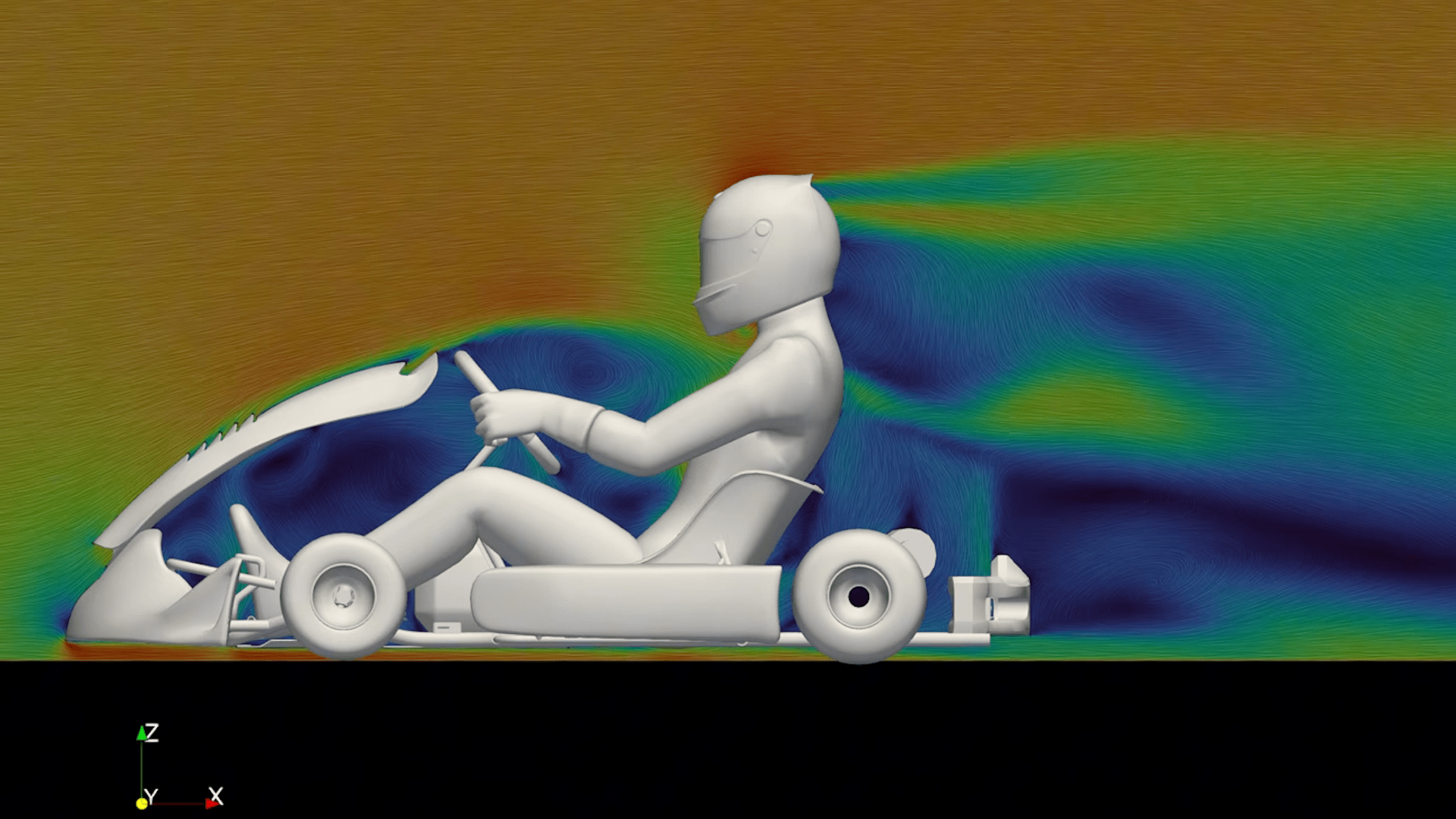


If you’ve ever spent extra money on a racing helmet loaded with chin spoilers and rear wings, hoping it would shave a tenth off your lap time, the data has some bad news.
YouTuber Oskar Savicki, who specializes in aerodynamic analysis of racing karts and open-wheel cars, put helmet spoilers through computational fluid dynamics simulations. The results challenge the assumption most weekend racers carry into the shop: those add-ons do almost nothing for drag reduction. What they do address is lift, and that distinction matters more than most drivers realize.
A helmet sitting on top of a driver’s head at 125 mph is a blunt object catching a wall of air. In a shifter kart, where the driver is fully exposed with no windshield or cockpit enclosure, the forces acting on the head and neck are brutal. Motorcyclists deal with similar physics, though riding position changes the equation considerably.
Savicki’s simulations show that a chin spoiler redirects airflow more evenly around the helmet. Depending on the driver’s head angle, it can deflect wake away from the neck and reduce the upward force trying to peel the helmet off the driver’s head. The lower the driver tucks their chin, the more effective the spoiler becomes.
The rear spoiler works the other end of the problem. It reduces the pressure differential between the front and top surfaces of the helmet versus the rear and bottom. Think of it as the second half of a one-two punch against lift. One spoiler prevents air from getting underneath, the other pushes the helmet down.
Together, they meaningfully cut lifting forces. Separately, they each contribute to a more stable, more comfortable experience at speed.
Here is where racers get tripped up. The helmet industry sells these features alongside premium pricing and aggressive styling. Drivers assume the spoilers make them more aerodynamic in the traditional sense, slipperier through the air, carrying more speed down a straight. The simulations simply do not support that conclusion.
But comfort and stability at triple-digit speeds are not trivial gains. A driver fighting neck fatigue or dealing with helmet buffeting at the end of a 20-lap final is a driver making mistakes. Clearer vision, less physical strain, and a more secure feeling on the head translate to better concentration. That is a real performance advantage, just not the one most buyers think they are paying for.
Former pro kart racer and Drive deputy editor Jerry Perez, who competed on the shifter kart circuit, confirmed the findings track with his own experience. The forces acting on an unprotected head at high speed are no joke. Anything that tames them is worth considering.
The broader lesson applies well beyond karting. Racers at every level tend to chase aerodynamic gains they can see, the wings, the splitters, the louvers, without understanding what those devices actually do. Sometimes the answer is less dramatic than the marketing suggests.
Helmet spoilers won’t make you faster. They might make you better. Whether that distinction is worth the upcharge depends entirely on how honest you are about where your lap time is actually being lost.



Share this Story