
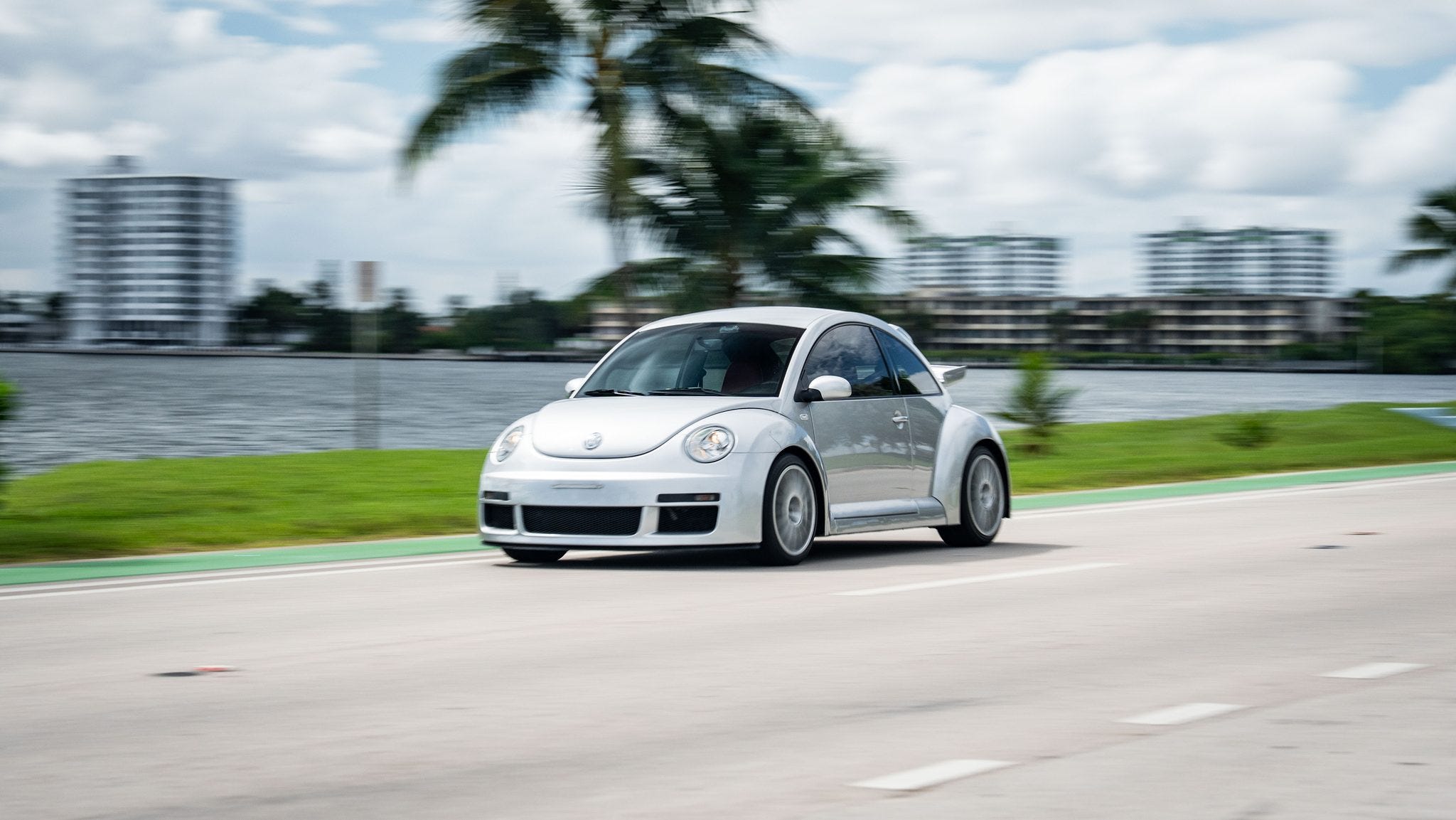


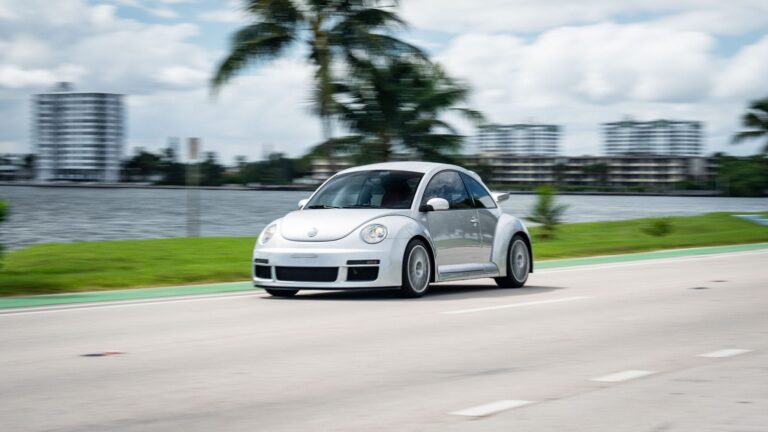
In 2001, you could buy two Porsche Boxsters for the price of one Volkswagen Beetle. That sentence alone tells you everything about the lunacy that drove Volkswagen under Ferdinand Piëch’s reign, and one of only 250 examples of that lunacy is now live on Bring a Trailer.
The New Beetle RSi was never sold in the United States. It was a European-market fever dream, born from the same corporate mindset that jammed a W12 engine into a Volkswagen Phaeton and greenlit the Bugatti Veyron. Piëch himself owned one, painted blue, because of course the man who ordered engineers to build a 1,000-horsepower hypercar would daily-drive a hopped-up Beetle.
This particular car is number 176 of 250, finished in the only color offered: silver. It has roughly 11,000 miles on its odometer.
Under the carbon-fiber bodywork sits a 3.2-liter VR6 engine producing 221 horsepower and 236 pound-feet of torque, paired with a six-speed manual gearbox and Haldex all-wheel drive. The same VR6 later showed up in the Golf R32, a car that actually made commercial sense. The RSi did not make commercial sense. It cost the equivalent of $80,000 at the time, before adjusting for inflation, which would push the figure well past six figures in today’s dollars.
What you got for that money was genuinely unusual. Carbon-fiber body panels that are now irreplaceable. Fixed-back racing bucket seats, a dashboard grab handle for passengers who quickly realized this wasn’t a normal Beetle, and massive 18-inch wheels wrapped in tires far wider than anything the New Beetle platform was designed to accommodate.
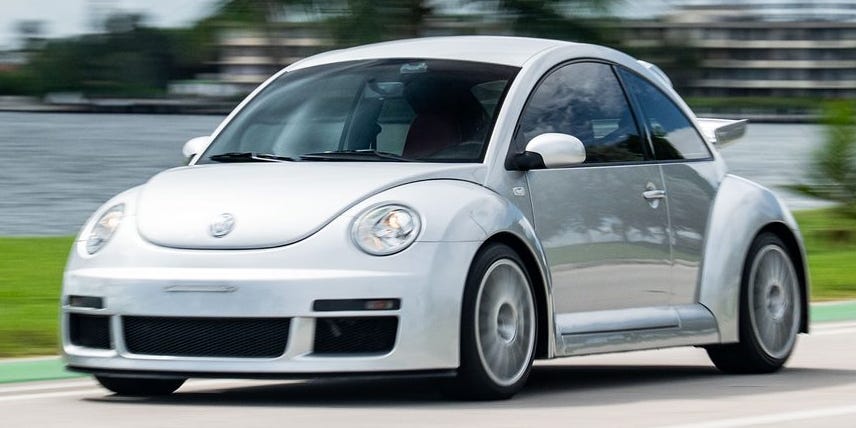
The result was a car that cornered like nothing shaped like a half-circle had any right to. The Haldex system let drivers get on the throttle early out of corners, and the VR6’s signature raspy wail made every pull through the gears feel like an event. It was a pocket rocket wearing a costume, a serious machine hiding behind the friendliest face in the VW lineup.
The practical reality of owning one outside Europe has always been the catch. The bodywork is unobtanium if damaged, though the mechanical underpinnings share enough DNA with U.S.-market VW products to keep maintenance from becoming a nightmare. The listing even invites the question of whether to leave the engine stock or send it to HPA Motorsports in Canada for one of their turbo kits that push well past 500 horsepower. That idea is both thrilling and slightly terrifying in a car this rare.
The RSi sits in a strange collector-market category. It’s not a supercar. It’s not a mainstream classic. It’s a monument to a very specific era at Volkswagen when money was being spent on engineering exercises that nobody asked for and nobody could justify.
The Phaeton lost billions. The Veyron was never meant to turn a profit. The RSi was a limited-run oddity that proved VW could build a genuinely fast, genuinely capable sports car out of its most whimsical platform.
Piëch’s VW was a company that operated on the principle that excess was its own reward. The RSi is one of the purest expressions of that philosophy, 250 silver bullets fired into a market that didn’t know what to do with them.
The auction closes October 28, and whoever wins will own a car that cost more than two Porsches when new. Whether the market agrees it was worth it then or now is the question the final bid will answer.
Share this Story