
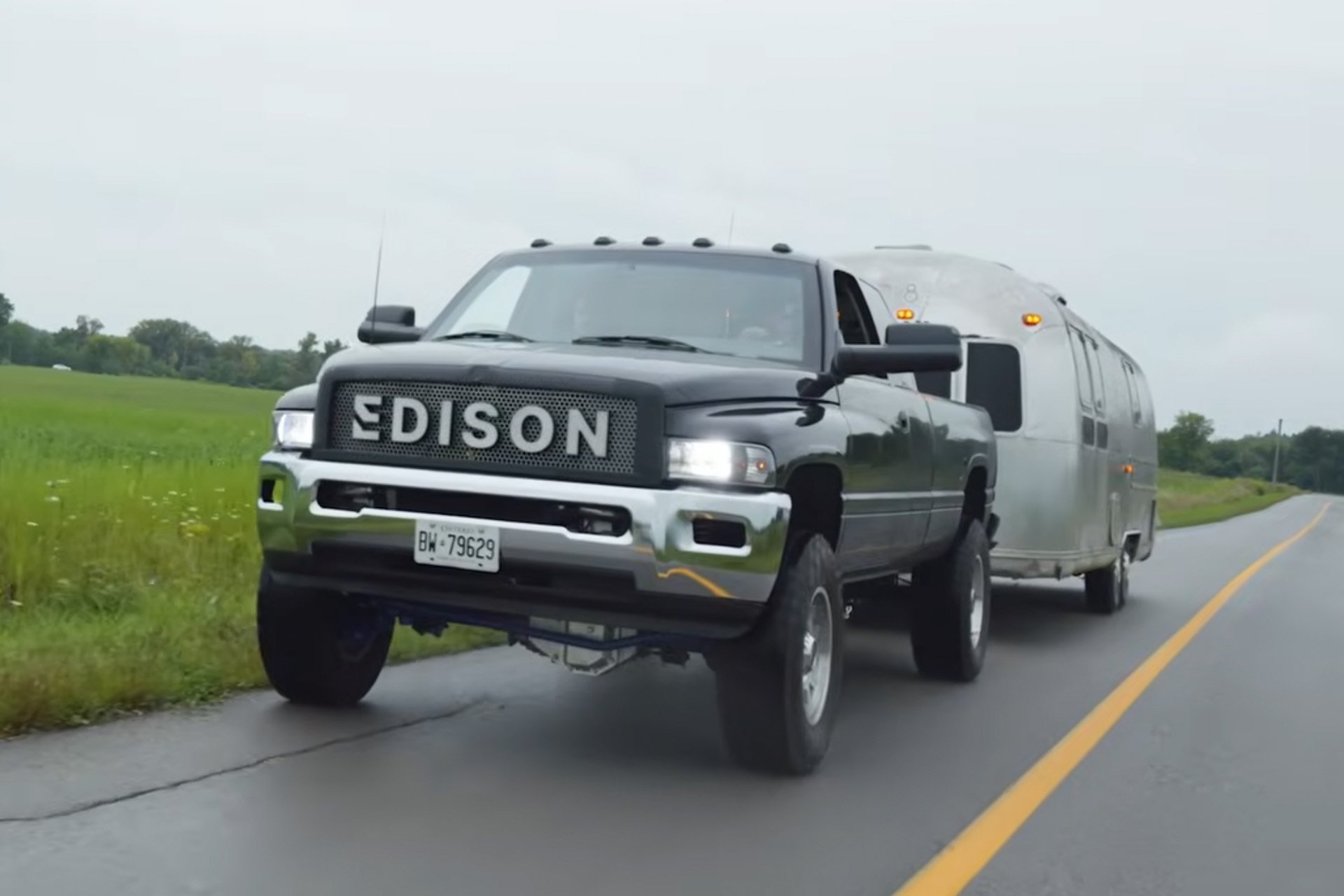


A 1995 Dodge Ram pulling an 8,000-pound Airstream down public roads doesn’t sound like the future of trucking. But the truck underneath that old sheet metal has no transmission, no driveshaft, and no conventional powertrain at all. Edison Motors, a small Canadian outfit, just proved its scratch-built diesel-electric pickup can handle a serious towing load using technology the railroad industry perfected a century ago.
The company calls it the ReCharger. It started life as a second-gen Ram with a 12-valve 5.9-liter Cummins. That engine is gone, replaced by a smaller Cummins R2.8 four-cylinder that does exactly one job: spin a generator.
The electricity it produces charges an onboard battery pack, which feeds power to electric axles that actually move the truck. No gears to shift. No torque converter. Just electrons doing what diesel fuel used to.
Edison’s Vice President of Pickups, Rich DeBoss, says the truck pulled the Airstream roughly 75 miles on a 60 kilowatt-hour battery charge alone. The diesel generator is meant to extend range indefinitely by recharging on the move, but the team is still dialing in that integration. Right now, they engage the generator manually, and future versions will automate it.
The towing footage tells a story numbers alone can’t. The truck pulls away from stops with zero drama, the instant torque of electric motors doing what they do best. More telling is the braking.
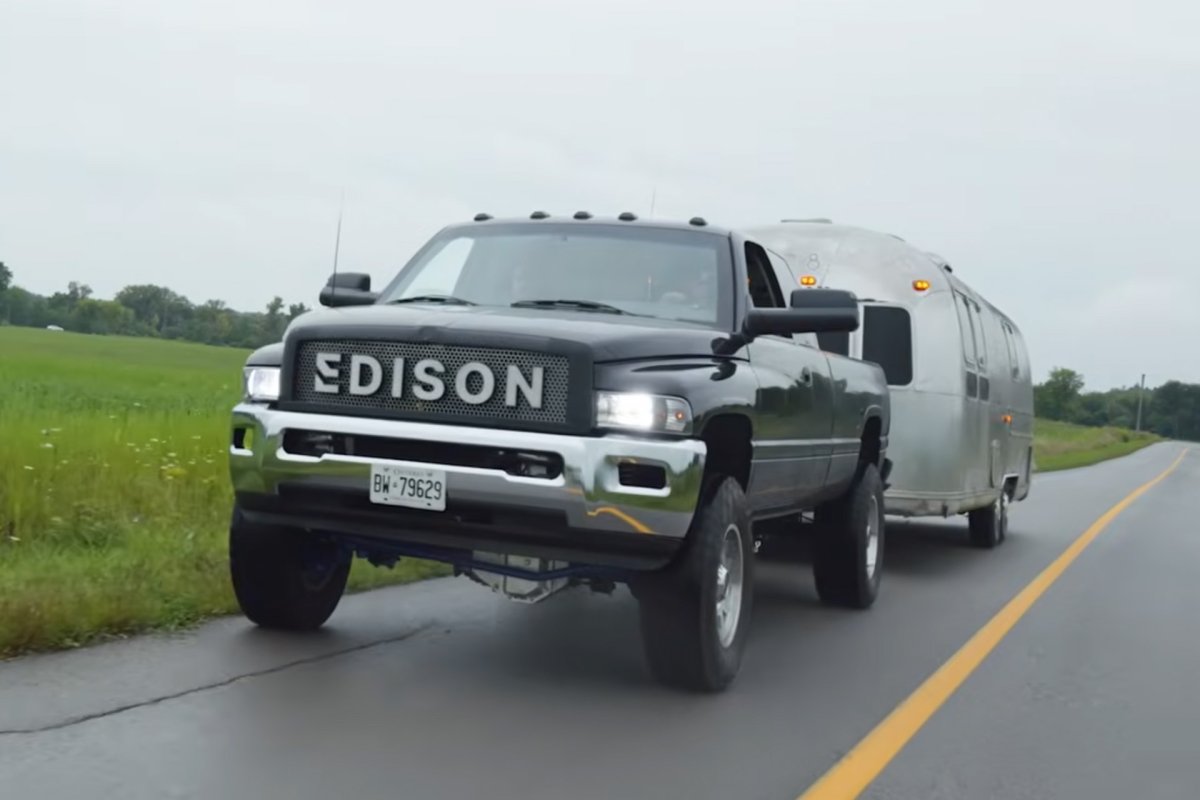
Instead of relying on Jake brakes or exhaust brakes to manage a heavy trailer on descents, the ReCharger uses regenerative braking turned up aggressively enough to nearly eliminate friction brake use during normal driving. Every foot of deceleration feeds energy back into the battery. It is, in the most literal sense, recycling momentum.
There is a catch with the current setup. DeBoss believes the R2.8 in the truck is an earlier, weaker variant producing less than 300 pound-feet of torque. He thinks a 3.0 to 4.0-liter engine would be the right fit for sustained highway charging.
The four-cylinder currently runs at 2,600 rpm, and the goal is to bring that down to a quieter 1,800 rpm in later builds.
Edison originally planned to sell its diesel-electric hardware as a conversion kit, letting enthusiasts build their own series-hybrid trucks. That plan has hit legal roadblocks in Canada. The company is now pivoting toward becoming an original equipment manufacturer, selling Edison-branded pickups with series-hybrid powertrains already installed.
It may also offer individual components for independent builders, but the kit-in-a-box dream appears to be on hold.
DeBoss is betting his career on it. He walked away from his established YouTube channel, DeBoss Garage, to work full-time at Edison. The company itself has graduated from a basement operation to a dedicated shop, though the dirt floor suggests the budget still favors engineering over aesthetics.
This is still a prototype, and Edison is still a tiny company operating on a shoestring compared to Detroit’s billions. But the core idea is not speculative. Diesel-electric propulsion moves freight trains weighing tens of thousands of tons across continents every single day.
Shrinking that architecture into a pickup truck is not a moonshot. It is an adaptation.
The question is whether Edison can scale it before a major manufacturer decides the locomotive playbook belongs in its truck lineup too. The R2.8 is still running at the wrong rpm, the generator still needs a human hand to switch on, and the legal path to selling complete vehicles remains unclear. But 8,000 pounds moved down a public road without complaint. That part already works.

Share this Story