
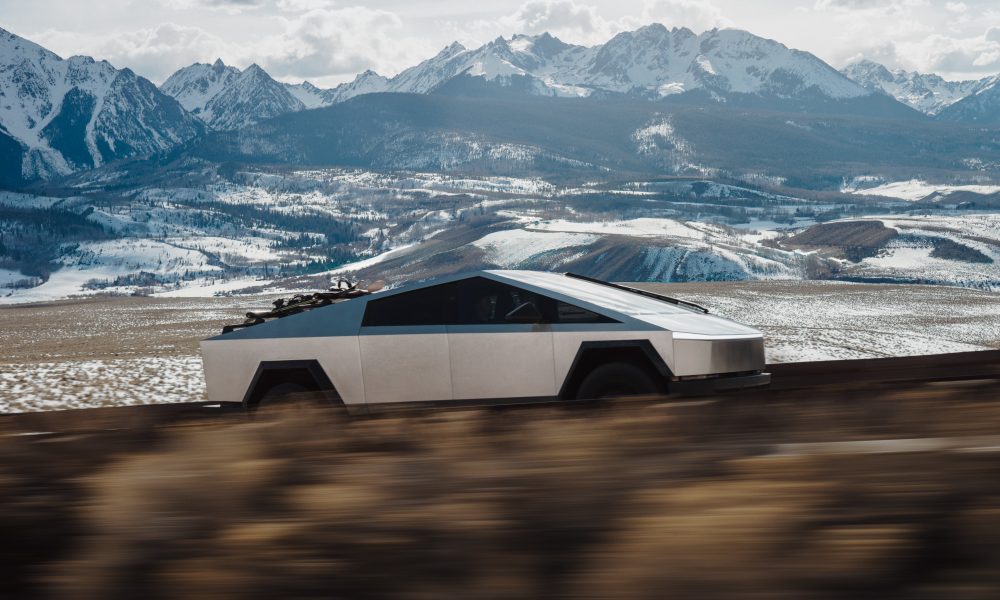


The IIHS just handed the 2025-2026 Tesla Cybertruck its Top Safety Pick+ award, the highest designation the institute offers. No other full-size pickup truck in America has earned it.
One week earlier, police in Greater Manchester seized a Cybertruck off the road for being illegal to drive in the United Kingdom.
That collision of facts tells you everything about where the Cybertruck sits right now. It’s a vehicle so safe it embarrasses every domestic rival in lab testing, yet so incompatible with overseas regulations that cops will flatly confiscate it.
The IIHS award applies to Cybertrucks built after April 2025, when Tesla quietly reinforced the front underbody and modified the footwell structure. Those changes earned “Good” ratings in small overlap front, moderate overlap front, and updated side crash tests. The truck’s automatic emergency braking system avoided every single pedestrian collision scenario, including a nighttime adult crossing and a child darting into the road.
The Ford F-150 didn’t qualify for any IIHS safety award. Neither did the Ram 1500. The Toyota Tundra managed a standard Top Safety Pick, one tier below.
Tesla’s stainless-steel exoskeleton, built from 30X cold-rolled steel, creates a safety cage that refuses to cave in during side impacts and rollovers. Integrated load paths channel crash energy away from occupants. Combined with the skateboard platform’s low center of gravity, the engineering delivers exactly what IIHS tests measure.
And that’s the catch. IIHS tests measure what happens to the people inside the truck.
European and UK regulators care about what happens to the people outside it. The Cybertruck’s angular panels, sharp edges, and rigid stainless-steel body fail pedestrian-protection standards that require rounded surfaces on protruding parts. A structure designed to resist deformation protects its occupants brilliantly while potentially transferring devastating force to a pedestrian, cyclist, or smaller vehicle.
The Greater Manchester police didn’t mince words when they pulled over a UK resident driving a foreign-registered Cybertruck last Thursday. “Legitimate concerns exist around the safety of other road users or pedestrians if they were involved in a collision with the Cybertruck,” the department said. The truck was confiscated and the driver was reported.
Tesla has floated the idea of an “international version” that could earn European type approval, but the company has made no visible progress. Its attention has been consumed by the Robotaxi rollout, leaving the Cybertruck a North America-only product for the foreseeable future.
The truck keeps evolving domestically, though. Tesla recently started assigning VINs for its new All-Wheel-Drive trim, priced at $69,990 after a brief $59,990 introductory window that lasted just ten days. Deliveries are expected by late summer.
After two and a half years of waiting, Cybertruck owners are also finally getting Actually Smart Summon. The parking-lot retrieval feature required extensive retraining due to the truck’s steer-by-wire system and sheer mass.
So the Cybertruck is getting safer, smarter, and cheaper in the one market where it can legally exist. Tesla engineered a vehicle that dominates the most rigorous U.S. crash tests ever designed for pickups, then built it in a shape that half the developed world considers a pedestrian hazard.
Both sides have a point. The IIHS data is real. The European concerns are legitimate.
A vehicle can be the safest truck in America for its occupants and simultaneously the most dangerous full-size pickup for everyone else on the road. Those two truths don’t cancel each other out.
They just make the Cybertruck the most polarizing safety story in the truck market since crash testing began. Ford and Ram should be embarrassed by the IIHS results. Tesla should be troubled that an entire continent looked at the same truck and saw a weapon.

Share this Story