
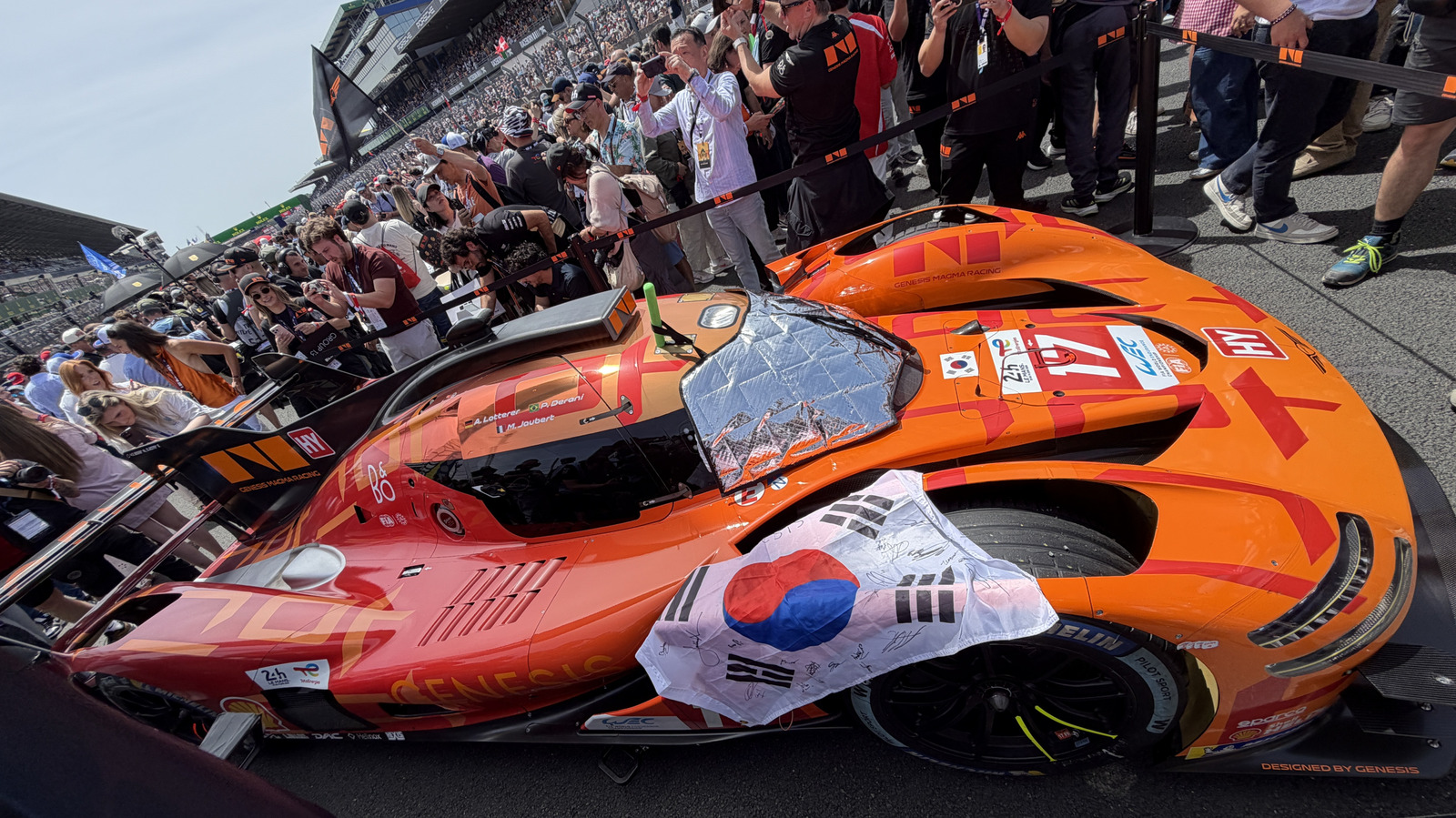


Five hundred days. That’s all the time Genesis needed to go from announcing a racing program to finishing the 24 Hours of Le Mans. The Korean luxury brand, barely a decade old as a standalone marque, put its GMR-001 LMDh prototype on the grid at Circuit de la Sarthe last weekend and brought one of two cars home 13th overall.
For a team making only its third competitive start, that’s not just respectable. It’s a statement.
The other car retired two-thirds of the way through. But the surviving GMR-001 ran consistently in the top ten for much of the race, reaching as high as fourth at one point. It outpaced established endurance outfits like Aston Martin and Peugeot, teams with years of prototype racing under their belts.
Genesis built the GMR-001 with Oreca, the French chassis specialist, and stuffed it with a twin-turbo V8 cobbled together from two rally car engines. Team Principal Cyril Abiteboul, formerly of the Renault F1 operation, ran the show from the pit wall. That’s not an amateur operation.
The racing itself was only part of the weekend’s agenda. Genesis used Le Mans as a launchpad for its broader ambitions, revealing a production-ready Magma GT concept and a GT3 race car variant alongside it. Abiteboul noted that three brands control half the GT3 market, and Genesis intends to muscle in.
Hyundai Motor Group CEO José Muñoz showed up to announce plans for five-fold growth in Europe and a target of 350,000 global Genesis sales by 2030. Chief Creative Officer Luc Donckerwolke, who originally pitched the racing program, was characteristically blunt. “Life without motorsports is a very, very boring life. We are audacious. No one else has managed what we are doing.”
The branding operation alone was worth studying. Genesis’ three-story hospitality building dwarfed the structures of Ford, Aston Martin, Toyota, and Ferrari nearby. The Magma Racing team’s orange gradient livery drew constant attention after running greyscale earlier in the season.
Korean characters for “Magma” stretched across the bodywork. Staff drove the wild Box Buggy concept, a sideways-driving paddock vehicle, around the track all weekend like it was a golf cart from the future.
Genesis U.S. COO Tedros Mengiste didn’t mince words about the commercial logic: “There’s nothing else in business that connects so directly between racing and selling.” Abiteboul backed him up with data, claiming that customers aware of the racing program show greater willingness to pay and higher brand interest. They track it through the entire purchase funnel.
At Spa the month prior, Genesis scored its first WEC points with eighth and thirteenth place finishes. Le Mans was the next step. Abiteboul joked that competitors are already concerned about Genesis’ development pace, worried the company could replicate it in any racing class it enters.
That’s probably the real takeaway from the weekend. Genesis didn’t win anything. It didn’t need to.
The sixth-place qualifying position for the number 17 car, piloted by Pipo Derani, Mathys Jaubert, and André Lotterer, already exceeded expectations. The survival of one car through 24 brutal hours on an eight-mile circuit did the rest.
The field at Le Mans included the gorgeous Peugeot 9X8, the crowd-favorite Aston Martin Valkyrie with its screaming naturally aspirated V12, and Alpine’s A424 running its final WEC season before pivoting entirely to Formula 1. Against that backdrop, a brand-new Korean team finishing the race and outrunning veterans registered louder than any press conference could.
Genesis now turns its attention to GT3, where the real volume play lives. If the Le Mans debut is any indication, the established order in that class should probably start looking over its shoulder. Five hundred days ago, this whole thing was a press release. Now it’s a racing program with teeth.
Share this Story