



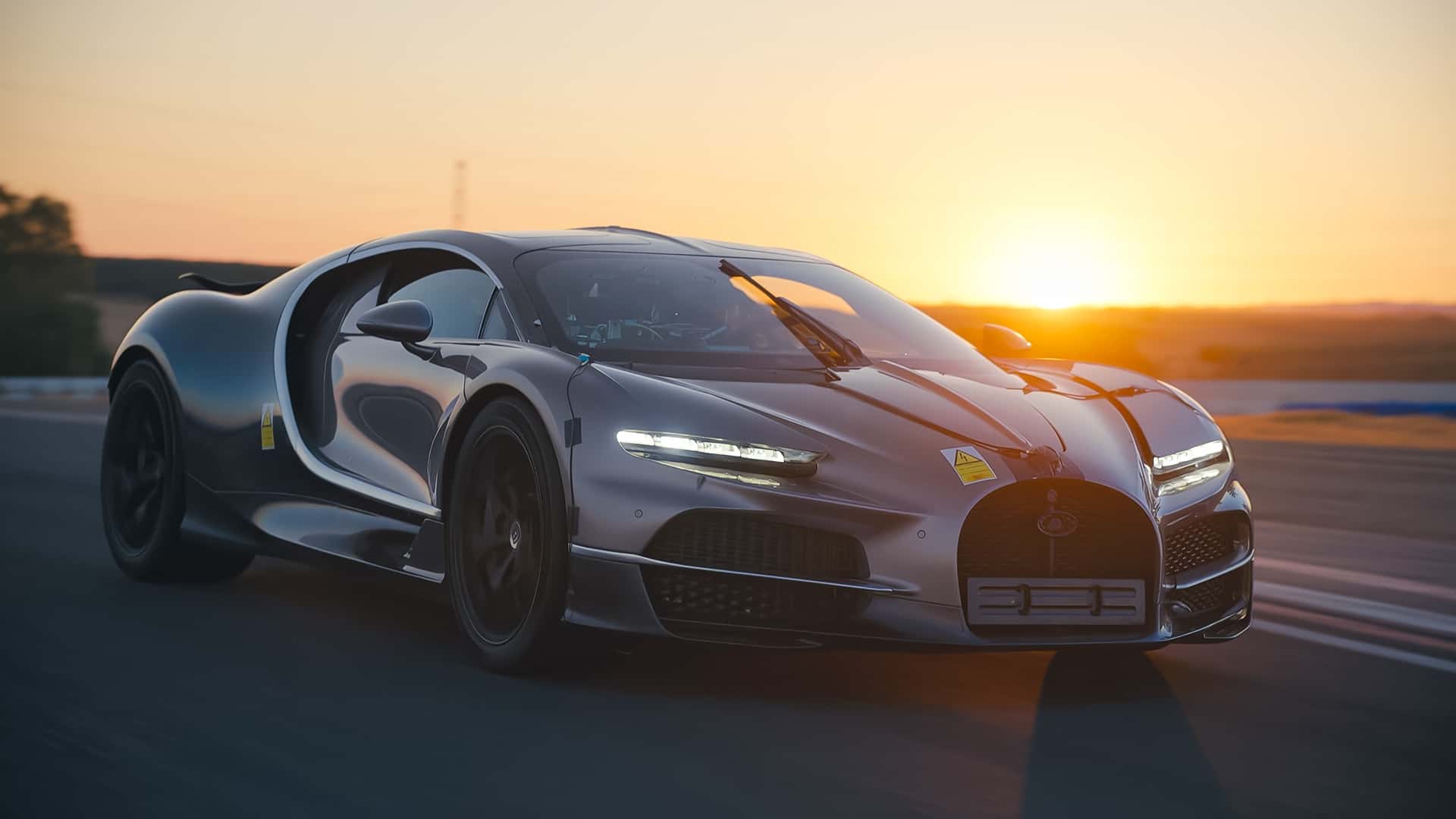
Two hundred thermocouples. That is how many sensors Bugatti wired through a Tourbillon prototype before sending it into the Spanish sun, where track temperatures climbed past 113°F. The exercise was not a publicity stunt dressed up as engineering.
It was the middle chapter of a climate validation program that has already taken the 1,800-horsepower hypercar from the frozen lakes of northern Sweden to the blistering pavement of Dubai.
The Tourbillon combines a naturally aspirated V16 with three electric motors and an 800-volt battery. Two motors drive the front axle, one backs up the engine at the rear. That layout produces enormous thermal stress, the kind that can cook electronics, warp composites, and turn a cabin into an oven.
Bugatti needed to prove its cooling architecture could handle all of it without altering the car’s bodywork.
The Seville test followed a Dubai run roughly 15 months earlier, where an XP prototype endured ambient temperatures exceeding 50°C, or 122°F. On the opposite extreme, winter testing in Arjeplog, Sweden pushed the car to minus 30°C, about 22 below zero Fahrenheit. Braking, low-grip handling, stability systems, and cabin heating all got hammered in conditions that would make most luxury cars beg for a garage.
Daniel Ríos Hidalgo, a vehicle development engineer at Bugatti Rimac, framed the challenge bluntly. “In order not to compromise the shape and the design, we have very clever cooling circuits and cooling systems inside the car to make sure that all the systems remain under controlled temperatures,” he said. The design was locked, and the thermal team had to solve the problem inside the existing bodywork. No extra vents, no bolt-on scoops.
Vehicle development driver Paolo Magrone added a layer that often gets ignored when the conversation turns to 1,800 horsepower. “When you have a lot of power but you don’t feel comfortable on the track or on the road, it’s very difficult to be precise,” he said. Comfort, in his view, is not a luxury feature but a prerequisite for extracting the performance the car promises.
Bugatti split the Spanish program between public roads and a racetrack deliberately. Open roads replicated what an owner in Dubai or Arizona might encounter on a Sunday drive. The track stacked every load at once, with tires, brakes, powertrain, and cooling circuits all pushed to their limits in sustained runs.
Those are two fundamentally different thermal profiles, and both had to pass.
All 250 units are already spoken for. Deliveries start in 2026 and will stretch through 2029, with roughly 80 cars a year rolling out of La Manufacture in Molsheim. Each one carries a starting price of €3.8 million, about $4.26 million before taxes.
At those numbers, a cooling failure is not an inconvenience. It is a brand-ending event.
That calculation explains why Bugatti treats hot and cold testing as two halves of the same validation program rather than separate checkboxes. Simulation gets the car 90 percent of the way. The last 10 percent only shows up when rubber meets asphalt at extremes no computer can fully replicate.
Ríos Hidalgo put the scope in perspective. “We have customers from lots of places that are going to drive the cars in different conditions,” he said. “We need to make sure that these cars perform properly in all these varieties of conditions.” The word “properly” is doing a lot of work in that sentence.
For a car that costs more than most houses, properly means flawlessly, every time, in every climate a billionaire might choose to visit.
Production validation is still ongoing. More test miles, more data, more thermocouples. The first customer car has not yet left Molsheim.



Share this Story