



A one-of-one Bugatti Veyron Grand Sport Vitesse, its entire body sculpted from polished aluminum to create a liquid-mirror finish, has been restored to factory condition through Bugatti’s La Maison Pur Sang program. The car, chassis 8.100, was the most expensive Veyron ever built when it was commissioned in 2014. Now it lives on the French Riviera, and social media footage shows two-time Formula 1 champion Fernando Alonso threading it through Monaco traffic.
Bugatti hasn’t officially named the new owner. But when a company says the car “now resides on the French Riviera” and videos surface of Alonso behind the wheel in Monaco, the press release is doing everything except spelling it out.
The restoration itself was no small undertaking. When this Veyron was originally built, aluminum blocks weighing up to 20 tons were shipped to Bugatti’s Molsheim headquarters to be shaped into body panels that reflect the world around them like chrome-dipped sculpture. The La Maison Pur Sang team stripped away aftermarket modifications added by a previous owner and returned every surface to its original state. That mirror finish, which shows every fingerprint and water spot with ruthless honesty, was brought back to what Bugatti calls “day-one perfection.”
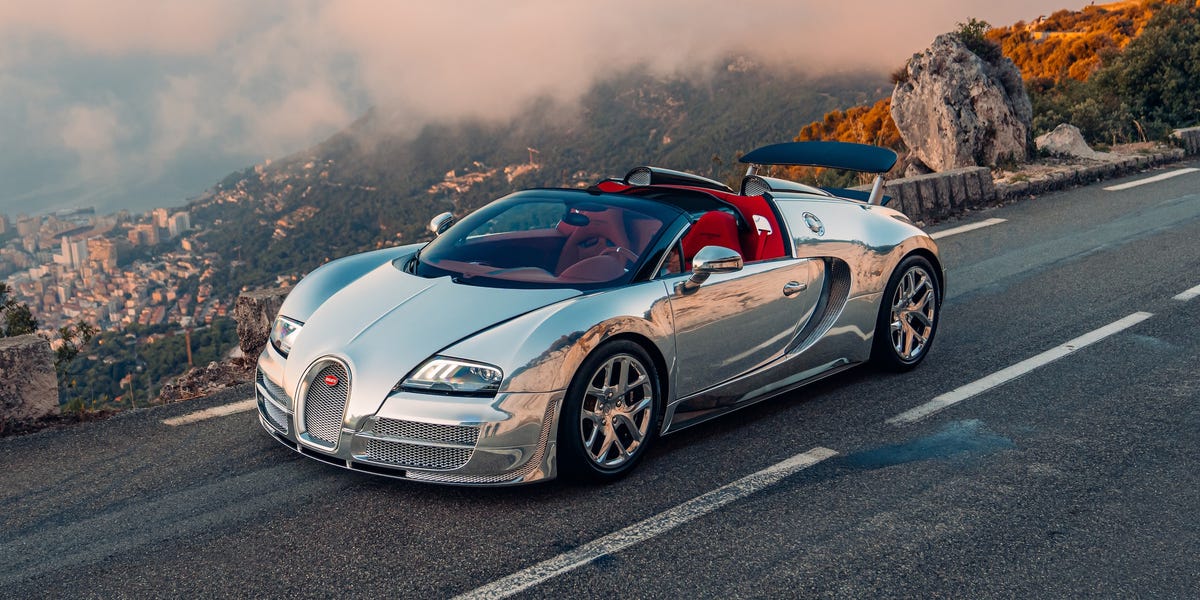
The interior matches the exterior’s commitment to excess. Carmine Red leather covers nearly every surface, punctuated by exposed carbon fiber and more polished aluminum on the center console, steering wheel, and the Bugatti crest between the seats. It is a car that does not know the meaning of restraint, and never pretended to.
Underneath the reflective skin sits the same 8.0-liter quad-turbocharged W-16 engine that made the Veyron Grand Sport Vitesse a record-breaker when the model debuted in 2012. Output stands at 1,183 horsepower, with a claimed top speed of 254 mph. The mechanicals were never the story with this particular car, though. The aluminum bodywork was always the point, a rolling piece of jewelry that happened to have the most absurd powertrain of its generation bolted in.
La Maison Pur Sang is Bugatti’s answer to Ferrari Classiche and Porsche’s factory restoration programs, a certified process that authenticates and refurbishes cars to original specification. For the Veyron, which ended production in 2015 after 450 examples, the program serves a practical purpose. These cars are aging, and their bespoke components and handbuilt construction mean that cutting corners on maintenance is a fast track to expensive problems.
The mirrored Veyron’s journey from an anonymous collector’s garage to Alonso’s Monaco playground says something about where hypercars end up in their second decade of life. They migrate toward people who will actually be seen in them. A car this loud visually does nothing sitting in a climate-controlled vault.
Bugatti continues to lean into its one-off heritage as marketing fuel. Recent projects include the Destrier, a porcelain-clad Mistral, and other bespoke commissions that keep the brand in headlines between major model launches. Each restoration or one-off build reinforces the idea that buying a Bugatti is buying into a permanent relationship with the factory.
Whether Alonso bought this car or is simply borrowing it for the weekend remains technically unconfirmed. But a two-time world champion cruising Monaco in a mirror-finish Veyron is exactly the kind of image Bugatti’s communications team would engineer if they could. And judging by the carefully worded press release, they probably did.



Share this Story