
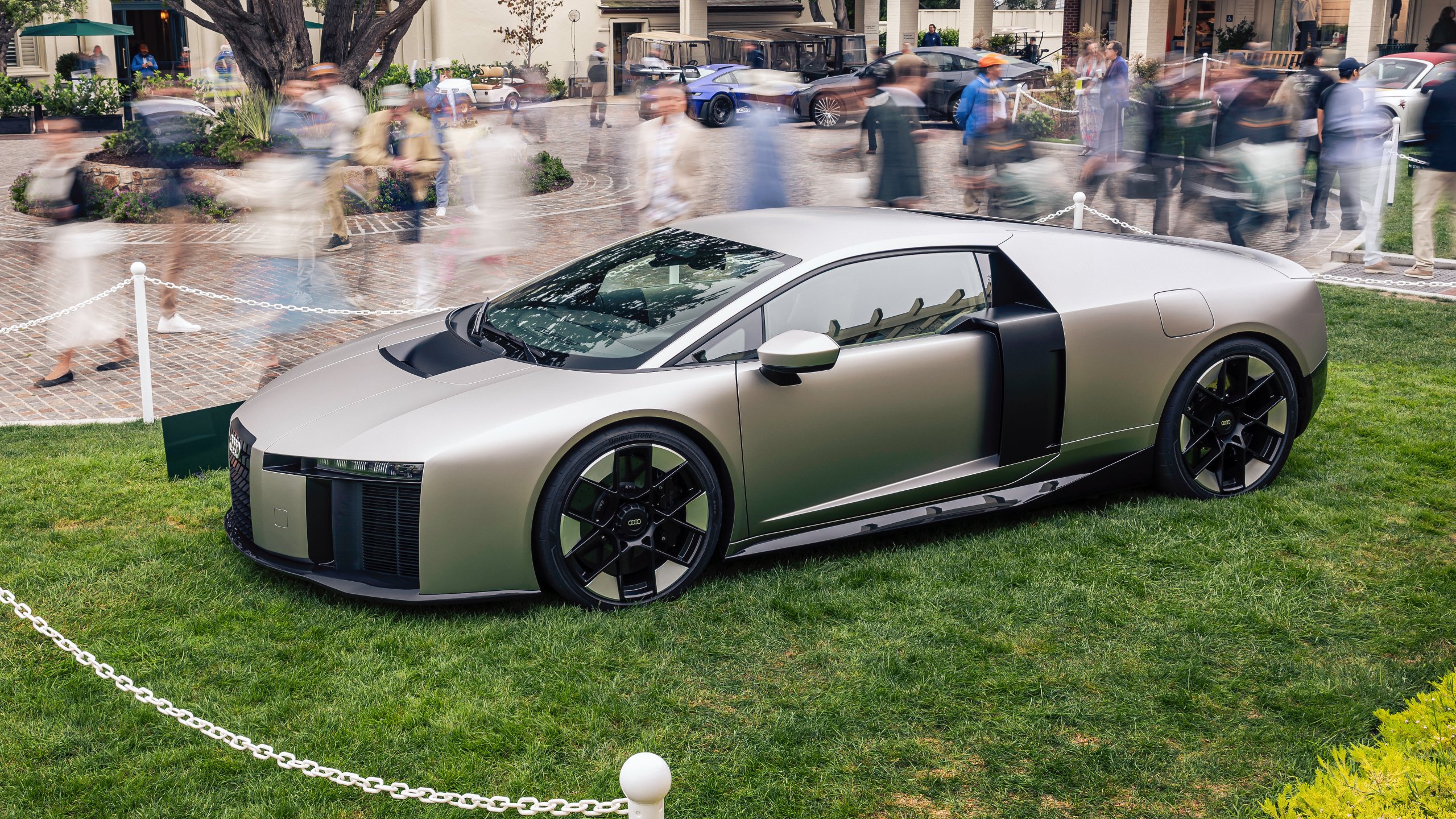


Audi’s 1,000-horsepower Nuvolari looks like an R8. It rides on Lamborghini bones like an R8. It even fills the exact showroom void the R8 left behind. But Audi’s chief technology officer wants you to stop making that comparison, and he has three specific reasons why the company won’t build another everyday supercar.
Rouven Mohr, Audi’s head of R&D, laid out the calculus in a conversation with The Drive. The short version: the Nuvolari exists because of Formula One, not because Audi wanted a successor to its most beloved sports car.
“We really always try to underline that it was never planned as a successor of the R8,” Mohr said. “It’s a different animal because it’s more a halo brand vision related to the Formula One entry.”
The first constraint was the clock. Audi wanted the Nuvolari ready to coincide with its debut F1 season, which meant assembling a small, fast-moving development team instead of the sprawling engineering army that typically builds a production sports car. That speed came with trade-offs.
Carbon fiber was the enabler. Tooling for carbon is quick. Tooling for metal, the stuff volume cars are made of, takes far longer and defines the entire industrialization timeline. “There are aspects that are enabling the short timeline that you cannot transfer to mass production,” Mohr said. Speed demanded carbon, and carbon demanded small numbers.
The second factor was regulatory. Audi needed to squeeze the Nuvolari into the gap between Euro 6 and Euro 7 emissions standards. Missing that window would have forced a costly powertrain re-engineering effort. So the production run has a hard expiration date baked into it by European law.
Third, and perhaps most telling, is the money. Carbon fiber is expensive, and those material costs create a price floor that Audi cannot engineer away with volume. Building 10,000 units would not bring the price down enough to justify the investment, and it would simultaneously destroy the exclusivity that makes wealthy buyers willing to pay in the first place.
“We have chosen the technology, but the technology is then so expensive that it would also not make sense to have a 10,000 volume because the market for 10,000 of this, you lose the exclusivity,” Mohr said.
It is a tidy corporate logic loop. The car is too expensive to build in volume. Building it in volume would kill the exclusivity. Killing the exclusivity would kill demand at that price. So fewer is better, and Audi gets to call it strategy rather than limitation.
The R8 was a different proposition entirely. It democratized the mid-engine supercar, a daily driver that happened to share its guts with a Lamborghini Gallardo. It sold in real numbers across two generations and became the proof point that Audi could compete with Porsche at the top of the food chain.
What Audi has built instead is a marketing device with a steering wheel. A machine designed to land in the same sentence as its Formula One program, sell to collectors who treat cars like assets, and remind the world that the four rings can still make something wild. Whether that is enough to sustain the kind of brand heat the R8 generated for nearly two decades is a question Mohr did not answer. It may be one Audi is not yet ready to face.



Share this Story