
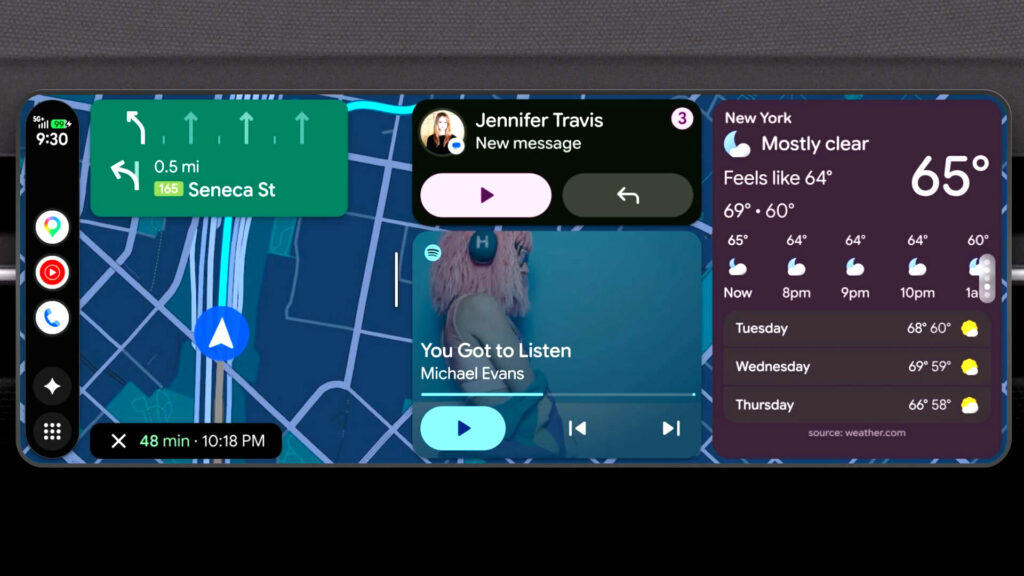


Google just dropped the most significant Android Auto redesign since the platform launched, and the numbers alone tell you why. There are now more than 250 million Android Auto-compatible cars on the road. That’s not a niche anymore — that’s an installed base rivaling some operating systems.
The refresh brings Material 3 Expressive design language, the same visual framework running on modern Pixel and Samsung phones, directly to the dashboard. Edge-to-edge Google Maps, customizable widgets, and a layout engine that adapts to any screen shape, from Mini’s quirky circular display to Mercedes’ panoramic widescreens. Google is done pretending one layout fits all.
Widgets are the quiet power move here. Users can pin weather, favorite contacts, photos, a clock, even a garage door opener shortcut right on the home screen. It sounds trivial until you realize Google is turning the car’s infotainment display into something that feels less like a locked-down appliance and more like your phone.
YouTube video support is coming to Android Auto later this year, rolling out across BMW, Ford, Genesis, Hyundai, Kia, Mercedes, Renault, Skoda, and Volvo. The use case is narrow but real — parked charging sessions, waiting in school pickup lines. Shift into drive and the video kills itself, leaving only audio. Google clearly learned from the liability headaches that plagued early Tesla theater features.
Dolby Atmos support arrives for select apps and vehicles, and both Spotify and YouTube Music get interface overhauls aimed at reducing the number of glances it takes to find what you want. In a cockpit, fewer glances mean fewer accidents. Nobody says that part out loud, but it’s the entire design philosophy.
Then there’s Gemini, Google’s AI engine, now embedded deeper into both Android Auto and vehicles running Google built-in. The pitch goes beyond reading your texts aloud. Google says Gemini can answer model-specific questions — what that dashboard warning light means, whether a piece of furniture fits in your trunk. It’s the kind of feature that sounds gimmicky in a press release and genuinely useful at 9 p.m. in a Home Depot parking lot.
Cars with Google built-in get an additional trick worth watching. Google Maps now offers live lane guidance on some models, tapping the vehicle’s front-facing camera to read lane markings in real time and coach drivers through exits and merges. That’s not just a maps update. That’s Google reaching into the ADAS layer, using camera hardware the automaker installed for a completely different purpose.
Meeting apps like Zoom are also headed to Google built-in vehicles later this year. The car as mobile office isn’t a new concept, but Google is the first to ship it at this scale with this level of integration.
The tension underneath all of this is familiar but intensifying. Every widget, every AI query, every video stream pulls the driver’s digital life further into Google’s ecosystem and further away from the automaker’s own software. With 250 million compatible vehicles and a design language that now mirrors the phone in your pocket, Google isn’t just improving Android Auto. It’s making the car’s native infotainment system feel like the thing you skip past to get to the real experience.
Automakers spent billions building their own platforms. Google just made those platforms feel like a loading screen.


Share this Story