
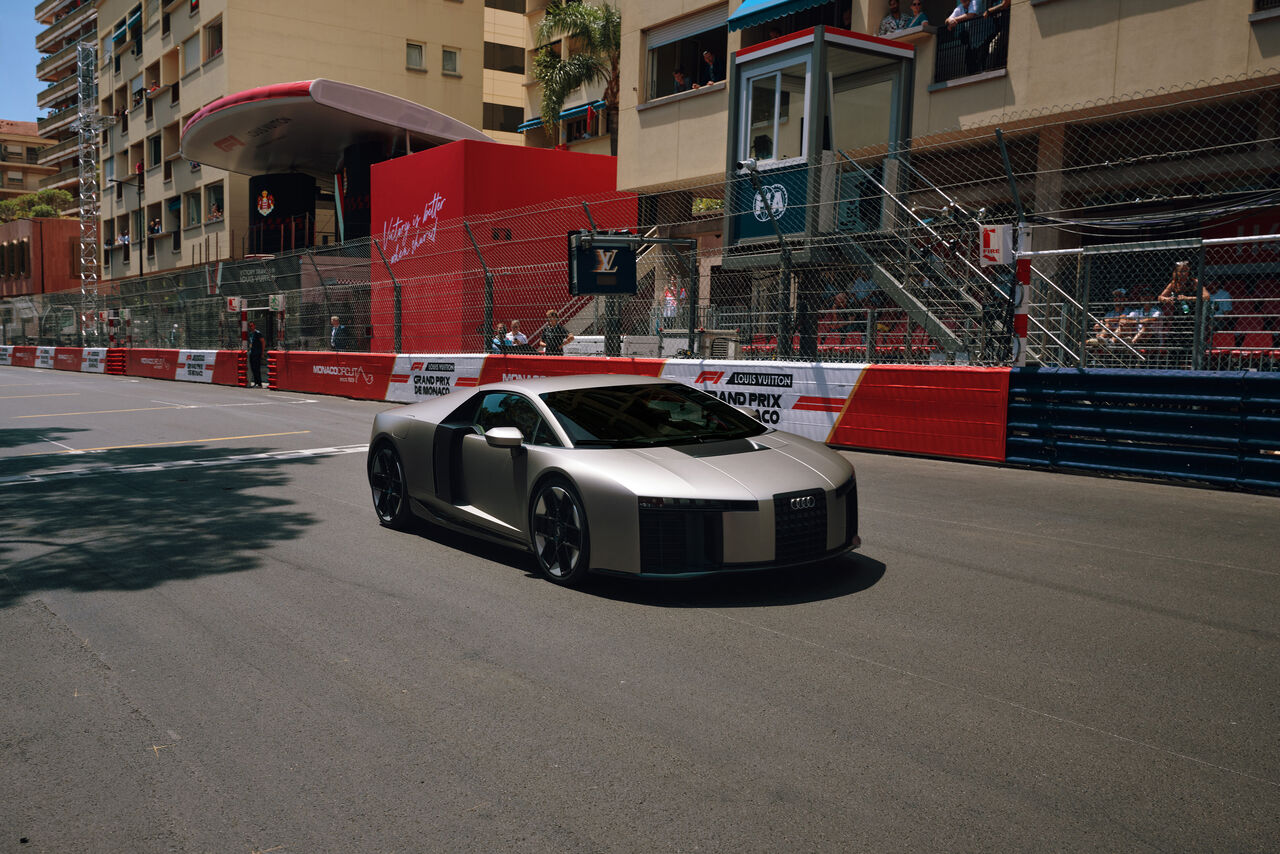


Audi just named a supercar after the greatest driver most people have never heard of, and it’s not messing around with the timeline. The Nuvolari, a hybrid supercar carrying Formula 1-derived technology, is already in near-production prototype form. Order books open in Europe this Q4, with first deliveries slated for the first half of 2027.
That pace, from unveiling to customer cars in roughly a year, is genuinely unusual for a halo car from a German premium manufacturer. Audi is making the speed itself part of the message. Ingolstadt wants the industry to know it can still move fast when it decides to.
The name is a deliberate provocation. Tazio Nuvolari was the pre-war Italian racing legend who drove with a ferocity that terrified even Enzo Ferrari. Audi’s choice to invoke him, rather than another quattro heritage nameplate, signals ambition that reaches beyond the brand’s own history. This isn’t nostalgia. It’s a statement of intent.
Technically, the Nuvolari is a plug-in hybrid. Preliminary figures show combined weighted fuel consumption of 11.3 liters per 100 km and just 7.8 kWh per 100 km of electrical consumption. With the battery depleted, fuel consumption climbs to 14.7 liters per 100 km. CO₂ emissions sit at 270 g/km weighted, firmly in the EU’s Class G, the worst possible rating.
Those numbers tell you this is not a car built for regulatory compliance. This is a car built to put Audi back in a conversation it has been drifting out of for years.
The technology list reads like a parts bin raid on Audi’s F1 program. There’s a high-performance hybrid powertrain and something called “quattro predictive ride,” which suggests an all-wheel-drive system that anticipates road conditions rather than simply reacting. Active aerodynamics and an Audi Space Frame with carbon exterior panels round out the package, a construction philosophy the brand pioneered with the original A8 in 1994, now pushed to its logical extreme.
Prototypes are currently being hammered around the Nürburgring and Nardò, two proving grounds that leave nowhere to hide for chassis engineers. The Nordschleife exposes suspension compromises in the first sector. Nardò’s high-speed bowl punishes aero instability and thermal management. If Audi is publishing that testing schedule, it’s because it’s confident in what the cars are showing.
The bigger picture here is context. Audi has spent the last several years in a painful, public pivot toward electrification, launching the e-tron GT, building out the PPE platform with Porsche, and staking its future on battery-electric volume. The Nuvolari doesn’t contradict that strategy, but it complicates the narrative. A hybrid supercar with Class G emissions is not a concession to regulators. It’s a concession to physics and to the reality that the highest-performing road cars still benefit from internal combustion.
It’s also a brand play. Mercedes has the AMG One. Ferrari has the SF90 and its successor. McLaren has the W1. Porsche has the upcoming hypercar replacement for the 918. Audi has been conspicuously absent from this tier since the R8 quietly faded away. The Nuvolari is its re-entry ticket, and the hybrid architecture gives it a plausible technological reason to exist alongside the brand’s EV lineup.
Production numbers haven’t been announced. Pricing hasn’t been announced. But the speed of the program, concept to customer in what appears to be a wildly compressed development cycle, suggests Audi’s new leadership is less interested in lengthy product planning and more interested in proving a point.
The point being: Audi still knows how to build a car that makes you forget about spreadsheets.
Share this Story