


Fifty years ago, Audi’s engineers faced a simple packaging problem and stumbled into a cult. The inline six wouldn’t fit in the second-generation Audi 100. So they bolted an extra cylinder onto their proven four-pot, gave it a firing order of 1-2-4-5-3, and accidentally created one of the most emotionally charged engine families in automotive history.
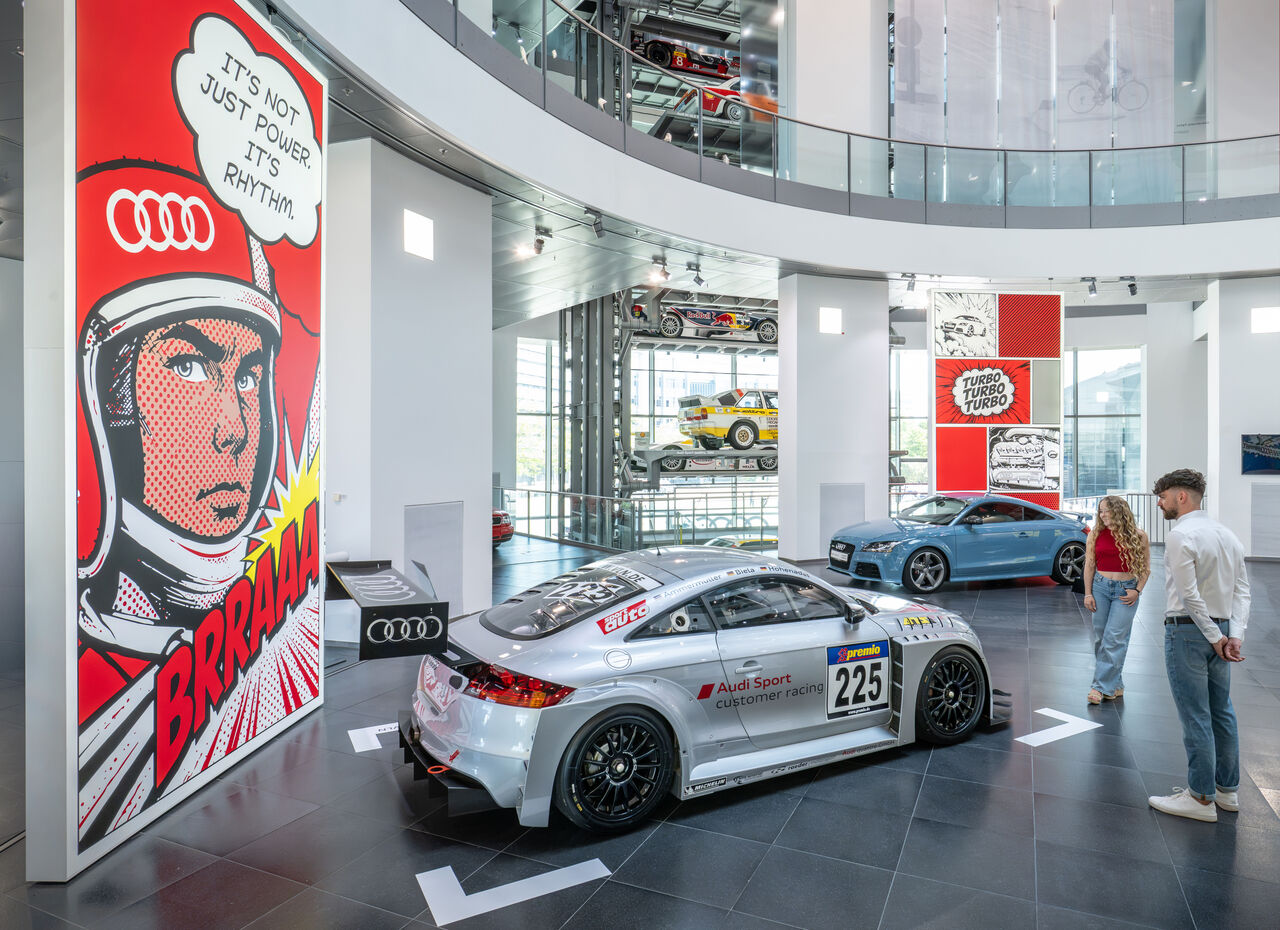
Now Audi Tradition is marking the anniversary with a special exhibition at the Audi museum mobile in Ingolstadt, opening August 1 and running through February 28, 2027. Fourteen vehicles and seven standalone engine displays trace the five-cylinder’s arc from sensible executive sedan motor to rally weapon to modern RS talisman.
The original EA 828, a 2,144 cc unit producing a modest 100 kW (136 PS), debuted in the Audi 100 5E in August 1976. Its odd cylinder count created an asymmetric firing interval of 144 degrees of crankshaft rotation. That’s where the sound came from. Not from the marketing department. From the math.
What happened next was less math and more madness. By 1979, Audi had strapped a turbocharger to the five-cylinder in the Audi 200 5T, squeezing 125 kW (170 PS) from an architecture that couldn’t easily grow in displacement. A year later, the Audi quattro appeared at Geneva with 147 kW (200 PS) and permanent all-wheel drive, and the five-cylinder stopped being an engineering compromise and became a statement.
Rallying made the legend. Two manufacturers’ world championships, two drivers’ titles, and Group B homologation specials pumping out well over 500 PS from that same basic block layout. The 1989 IMSA GTO car hit 530 kW (720 PS). For a motor born because a straight-six was too long, that’s a career trajectory worth studying.
Production cars kept the faith, too. The 1994 Avant RS2, built with Porsche, wrung 232 kW (315 PS) from just 2.2 liters and became the most powerful production wagon on the planet. It also launched the RS badge that now anchors Audi Sport’s entire identity. Both the RS2 and the five-cylinder were present at the creation.
Then the engine died. The mid-1990s shift to V6 power across the Audi range killed the original five-cylinder series by 1997. The last ones rolled out in the Audi S6 and in 2.5 TDI diesel form in the A6. For twelve years, the distinctive warble went quiet.
The resurrection came in 2009, when quattro GmbH dropped a transversely mounted 2.5-liter TFSI into the TT RS. It won “engine of the year” nine consecutive times. That kind of streak doesn’t happen because journalists are sentimental. It happens because the thing genuinely sounds different from everything else on the road, and it makes the kind of torque that rearranges your internal organs.
The exhibition includes the full narrative, from a Megola motorcycle to the RS 3 and a pair of concepts, the RS Q3 and the Audi GT50. Curator Stefan Felber says the show was driven partly by fan demand. People asked for it. That alone tells you something about the emotional real estate this engine occupies.
Five cylinders never made perfect theoretical sense. The configuration is inherently unbalanced compared to a straight-six, heavier than a four, and packaging it transversely required serious engineering work. But the sound, the character, the rally pedigree, all of it added up to something no spec sheet could capture.
Audi’s current trajectory is electric. The five-cylinder’s future as a production engine is anything but certain. Which makes this exhibition feel less like a celebration and more like a wake that nobody wants to call by its real name.

Share this Story