
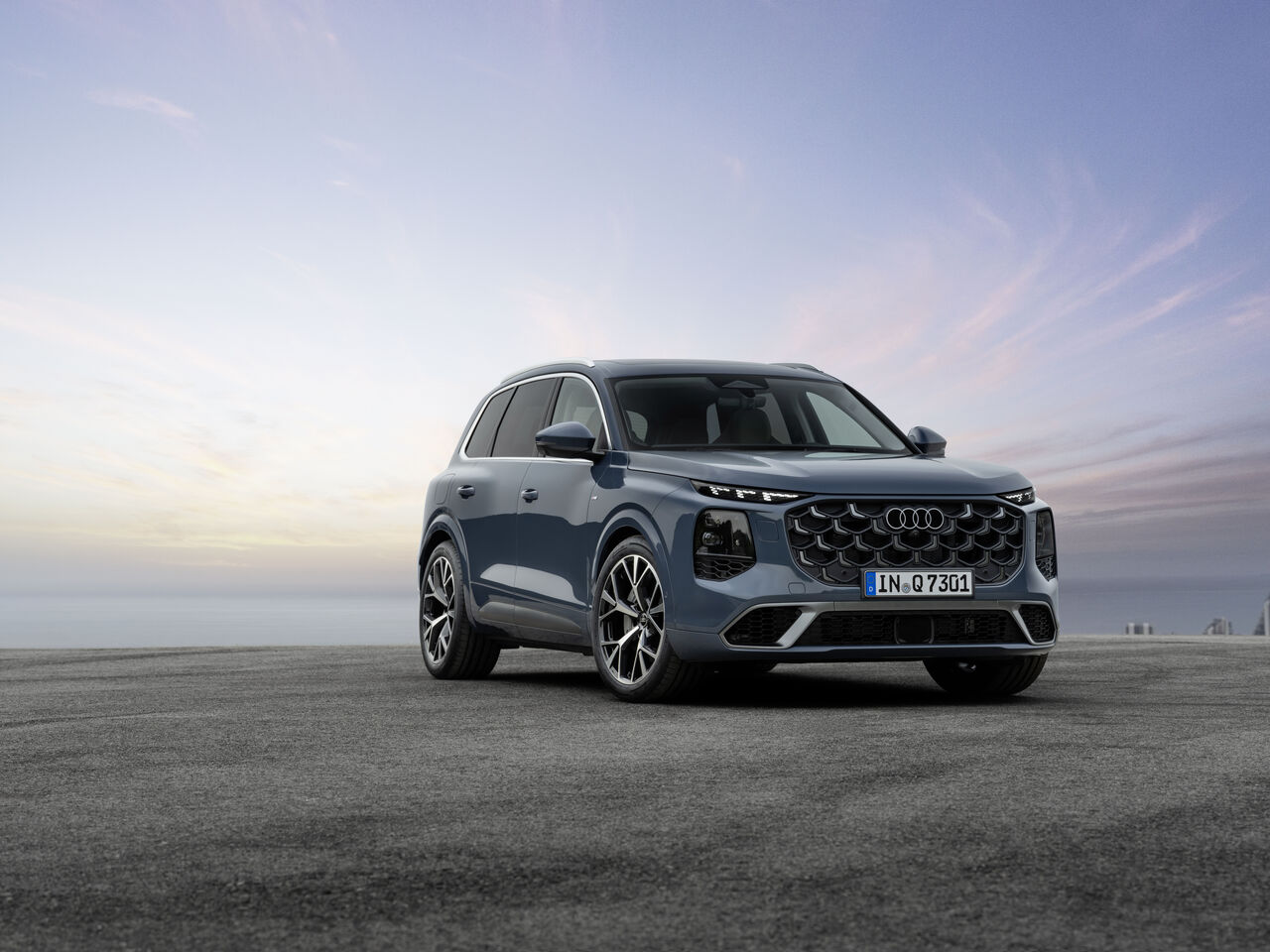


Audi just revealed the third-generation Q7, and the most striking thing about it isn’t the illuminated panoramic roof or the micro-LED headlights. It’s what’s under the hood: a 3.0-liter V6 diesel. Nothing else. No plug, no battery pack, no electrified option at launch.
Starting at 87,900 euros in Germany, the new Q7 arrives with two power outputs of the same turbodiesel — 245 PS and 299 PS — paired with 48-volt mild-hybrid tech Audi calls MHEV plus. An electric-powered compressor sharpens throttle response. A powertrain generator chips in up to 24 PS of supplemental boost. It’s clever engineering, but it’s still a combustion vehicle in 2026.
That positioning tells you everything about where Audi’s head is right now.
CEO Gernot Döllner framed the Q7 as a continuation of a 20-year legacy, calling it “a versatile all-rounder for business, family, and leisure.” The language is deliberate. This isn’t a technology showcase or a stepping stone to full electrification. It’s a declaration that Audi still sees a strong market for large, diesel-powered luxury SUVs — and intends to serve it without apology.
The timing is worth paying attention to. Audi has spent billions developing its PPE electric platform, launched the Q6 e-tron and A6 e-tron, and publicly committed to an all-electric future. Yet the Q7, one of the brand’s most profitable nameplates, gets a clean-sheet redesign built entirely around internal combustion. The message to customers who aren’t ready for EVs could not be louder.
Mechanically, the Q7 gets a new limited-slip center differential with preload for its permanent quattro all-wheel drive, an eight-speed tiptronic, and a choice between steel springs, adaptive air suspension, or a sportier air suspension variant. Combined fuel consumption lands between 7.1 and 8.0 liters per 100 kilometers. CO2 class: G — the worst rating on the European scale.
Audi is clearly betting the Q7’s buyers won’t care.
Inside, the model offers five, six, or seven seats — all electrically adjustable — with a 65/35 split second row that can further divide into a 35/30/35 configuration. Three child seats fit across the middle bench. Trunk space ranges from 722 liters in the seven-seater to 2,075 liters with the rear seats folded flat in the five-seat layout.
The panoramic sunroof gets the most engineering attention. It’s divided into nine switchable-transparency segments, eliminates the traditional roller blind, and integrates 78 LEDs that sync with ambient lighting. It turns opaque automatically when the car is parked. It’s a genuinely impressive piece of glass.
Lighting throughout borders on theatrical. Digital Matrix LED headlights with micro-LED modules project high-resolution patterns. Third-generation digital OLED taillights feature communication lighting and three-dimensional effects. Turn signals project onto the ground at night, and door-opening lights cast a white rhombus as a welcome gesture. Audi now offers up to eight selectable light signatures across front and rear.
Driver assistance includes adaptive cruise with lane keeping, a trained parking feature that memorizes custom maneuvers, and reverse assist for backing out of tight spots. The lane guidance system projects information directly onto the road ahead, merging lighting and ADAS in a way few competitors have attempted at this level.
Production stays at the Bratislava plant that built every Q7 since the original. Orders open in Germany this month. Deliveries begin in September.
The new Q7 is polished, spacious, and impressively detailed. It is also a full-throated bet that the internal combustion engine still has commercial runway in the premium segment — even as Audi’s own corporate strategy says otherwise. Döllner is playing both sides of the aisle, and the Q7 is his hedge.

Share this Story