


Acura just tipped its hand on a two-SUV offensive that would reshape its lineup by the end of the decade. The first, an “adventure-ready” model arriving in early 2028, marks the brand’s first serious off-road play since the forgettable SLX disappeared in the late 1990s. The second, a full-size eight-passenger flagship larger than the MDX, is expected around 2030.
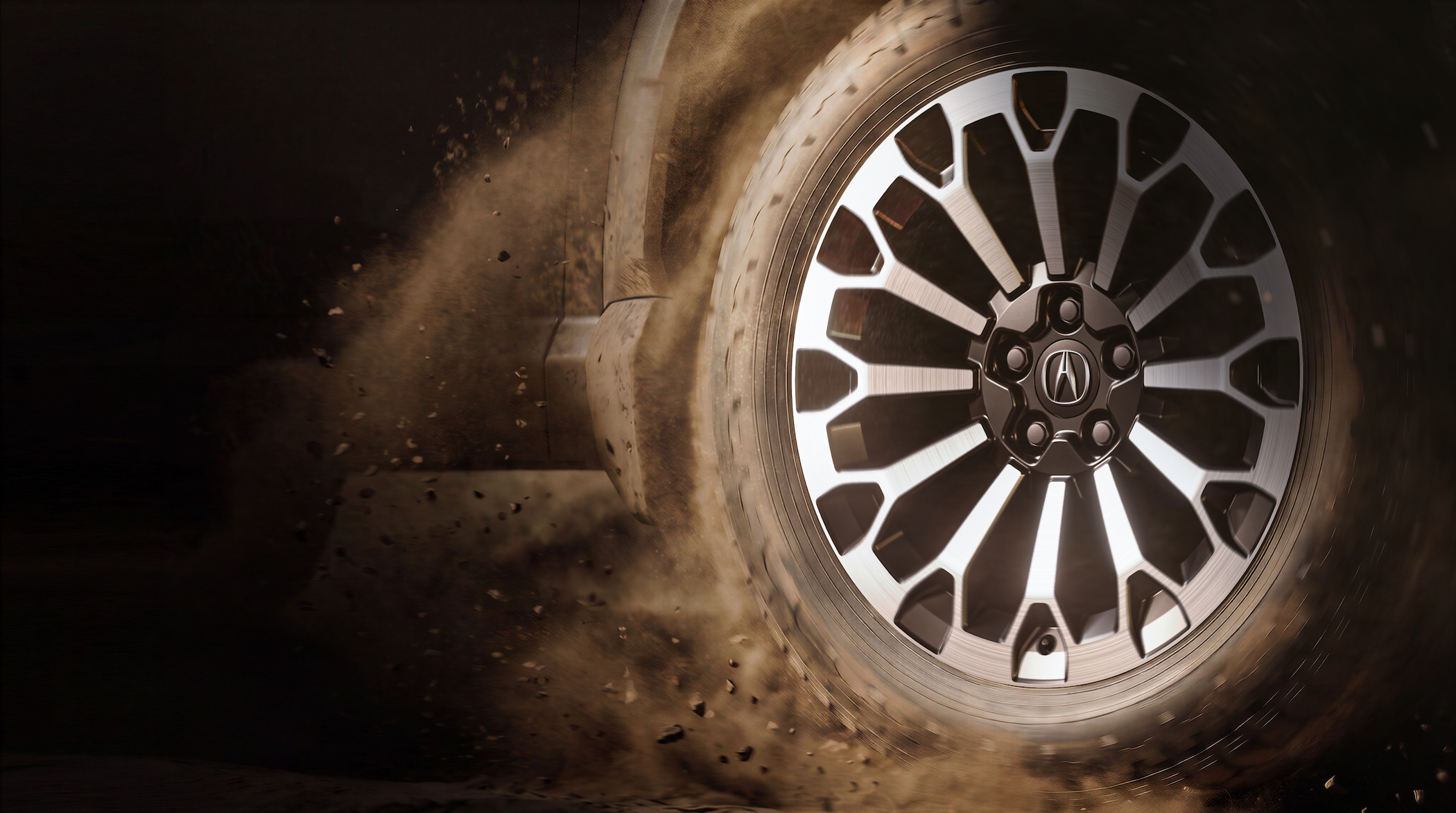
The teaser image Acura released tells a familiar story. A multispoke wheel wrapped in all-terrain rubber, kicking up dirt, with the brand’s caliper logo the only thing distinguishing it from a Honda Passport TrailSport press photo. That’s not a coincidence. Honda and Acura share platforms, and Honda’s TrailSport sub-brand has been selling well enough to justify a luxury cousin.
The timing lines up neatly with Honda’s broader corporate strategy. The parent company is building a hybrid-only factory expected to come online around 2030, which explains why the bigger flagship SUV sits further out on the timeline. Both new Acuras are expected to run a new hybrid V-6 powertrain Honda has already been teasing, a setup pairing up to three electric motors with a six-cylinder and promising a 10 percent improvement in acceleration.
Acura needs this. The brand’s current SUV roster, the RDX and MDX, covers compact and midsize territory competently but unremarkably. There’s nothing at the top of the range competing with the Infiniti QX80, the Lexus TX, or the Genesis GV80. And there’s nothing remotely adventurous in the lineup competing against anything from Jeep or Land Rover or even Lexus’s GX.
That gap has been conspicuous. While Honda has successfully built TrailSport into a credible outdoors brand across the Passport, Pilot, and even the Ridgeline, Acura has been sitting on the sidelines. Adding a rugged SUV and a full-size three-row at the same time would give Acura its widest SUV portfolio ever.
The question is execution. Luxury buyers shopping rugged SUVs have specific expectations. They want genuine capability, not plastic cladding and a marketing campaign.
The Lexus GX succeeds because it sits on a body-on-frame platform with a real transfer case. If Acura’s adventure SUV turns out to be a lifted, re-trimmed Passport on a unibody platform with some skid plates bolted underneath, the reception could be lukewarm regardless of how good the hybrid V-6 feels.
Acura also showed a concept recently hinting at its evolving design language, suggesting both new SUVs could wear a significantly updated face. The brand has been slowly moving away from its controversial beak grille, and new sheet metal offers a clean slate.
The eight-passenger flagship is arguably the riskier bet. Full-size luxury SUVs are a brutally competitive segment dominated by established nameplates with decades of equity. Cadillac’s Escalade, Lincoln’s Navigator, and the redesigned Infiniti QX80 all own pieces of that market. Acura has never competed at that altitude.
Honda’s hybrid-only factory adds another variable. By committing these vehicles to hybrid powertrains exclusively, Acura is betting that buyers in 2028 and 2030 will still want electrified internal combustion rather than full EVs. Given how EV adoption has plateaued in several segments, that may be the smartest read of the market anyone in the industry has made recently.
No pricing, no names, no specifications beyond the hybrid V-6 and seating counts. Acura is still playing this close. But the direction is clear: bigger, tougher, and more ambitious than anything the brand has attempted in at least two decades.
Share this Story