
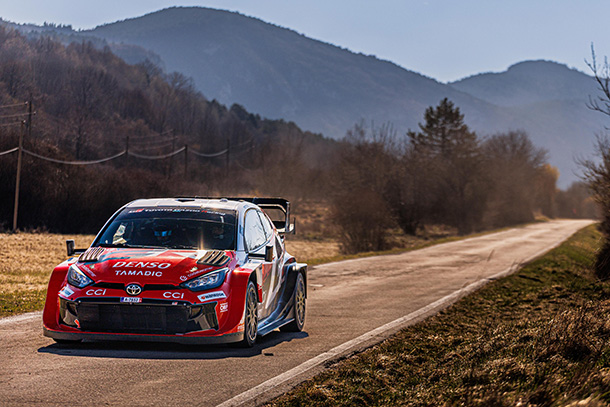


Five wins from six rallies. A 93-point lead in the manufacturers’ championship. All five drivers inside the top six of the standings. Toyota GAZOO Racing arrives at Rally Japan this week not just as the favorite, but as the team everyone else is chasing off a cliff.
Round seven of the 2026 WRC season runs May 28-31 across the narrow mountain asphalt of the Aichi and Gifu prefectures. The question isn’t whether Toyota will be competitive on home soil. It’s which of its drivers will beat the others.
Elfyn Evans leads the championship by 12 points after back-to-back Rally Japan wins in 2023 and 2024. Right behind him sits Takamoto Katsuta, who broke through this season with victories in Kenya and Croatia and now returns to Japan as a genuine title contender rather than a promising hopeful. The homecoming will be emotional, and the pressure will be enormous.
Oliver Solberg, third in the standings and 31 points back, makes his Rally Japan debut in Rally1 machinery after winning his class with the GR Yaris Rally2 last year. Sami Pajari, who scored his maiden WRC podium in Japan last November, has since collected four more. Even Sébastien Ogier, the nine-time champion running a partial schedule, sits sixth after winning in the Canary Islands.
Toyota’s internal battle is the real storyline. When your biggest threat is the driver in the next service bay, the dynamics change. Team principal Jari-Matti Latvala acknowledged the tension with characteristic Finnish understatement: “Of course, Taka’s team-mates have also all been strong on asphalt recently, and they too will want to win.”
The rally itself gets a significant shake-up this year. Moved from its traditional November slot to late May, conditions will be fundamentally different. Higher temperatures will stress tires and change grip levels. The autumn leaves that turned certain stages into ice rinks in previous years will be absent, but Japan’s approaching rainy season could deliver its own chaos.
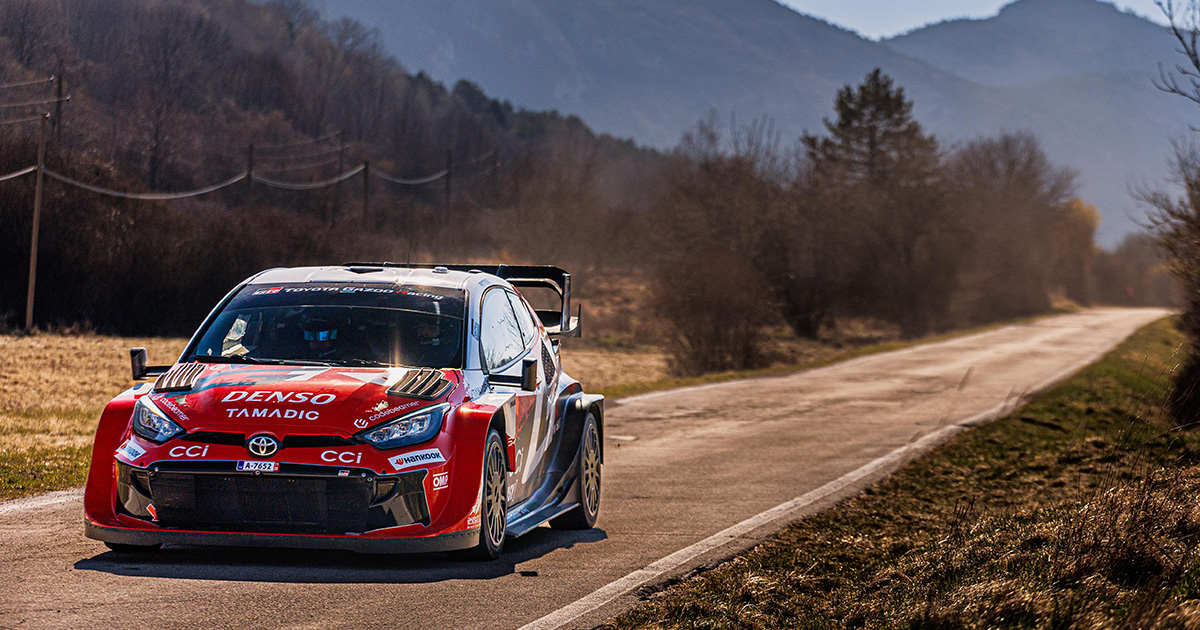
New for 2026 is a ceremonial start at Nagoya Castle on Thursday evening, bringing the WRC into the heart of Japan’s fourth-largest city for the first time. Friday features a loop of three stages run twice east of Toyota City, including the fan-favorite Isegami’s Tunnel. Saturday is the marathon day, pushing crews northeast for six stages plus a new super special at Fujioka. Sunday closes with the familiar Nukata and Lake Mikawako tests.
The WRC2 class adds another layer, with seven GR Yaris Rally2 entries including TGR WRC Challenge Program driver Yuki Yamamoto and defending Rally Japan WRC2 winner Alejandro Cachón. Three Japanese Rally Championship regulars — Hiroki Arai, Norihiko Katsuta, and Fumio Nutahara — also compete on home ground.
What Toyota has built in 2026 is less a team and more an occupation force. Evans is metronomic. Katsuta has found a new gear. Solberg brings raw aggression. Pajari is maturing fast. Ogier remains Ogier. The depth is staggering, turning the manufacturers’ fight into a formality while making the drivers’ championship a five-way family feud.
Rally Japan has grown in popularity every year since returning to the calendar in 2022. This edition — with Katsuta arriving as a winner, the date shift bringing unpredictable conditions, and Toyota’s dominance creating a fascinating internal war — could be the biggest yet.
Latvala’s team lost in Portugal last time out, their lone stumble this season. He called it bad luck. His rivals would call it an opening.
On Japanese roads, surrounded by home fans and corporate expectation, Toyota will be determined to slam that door shut. The rest of the WRC field has to hope the weather, the heat, or simple mathematics eventually catches up with a team that currently looks untouchable.

Share this Story