
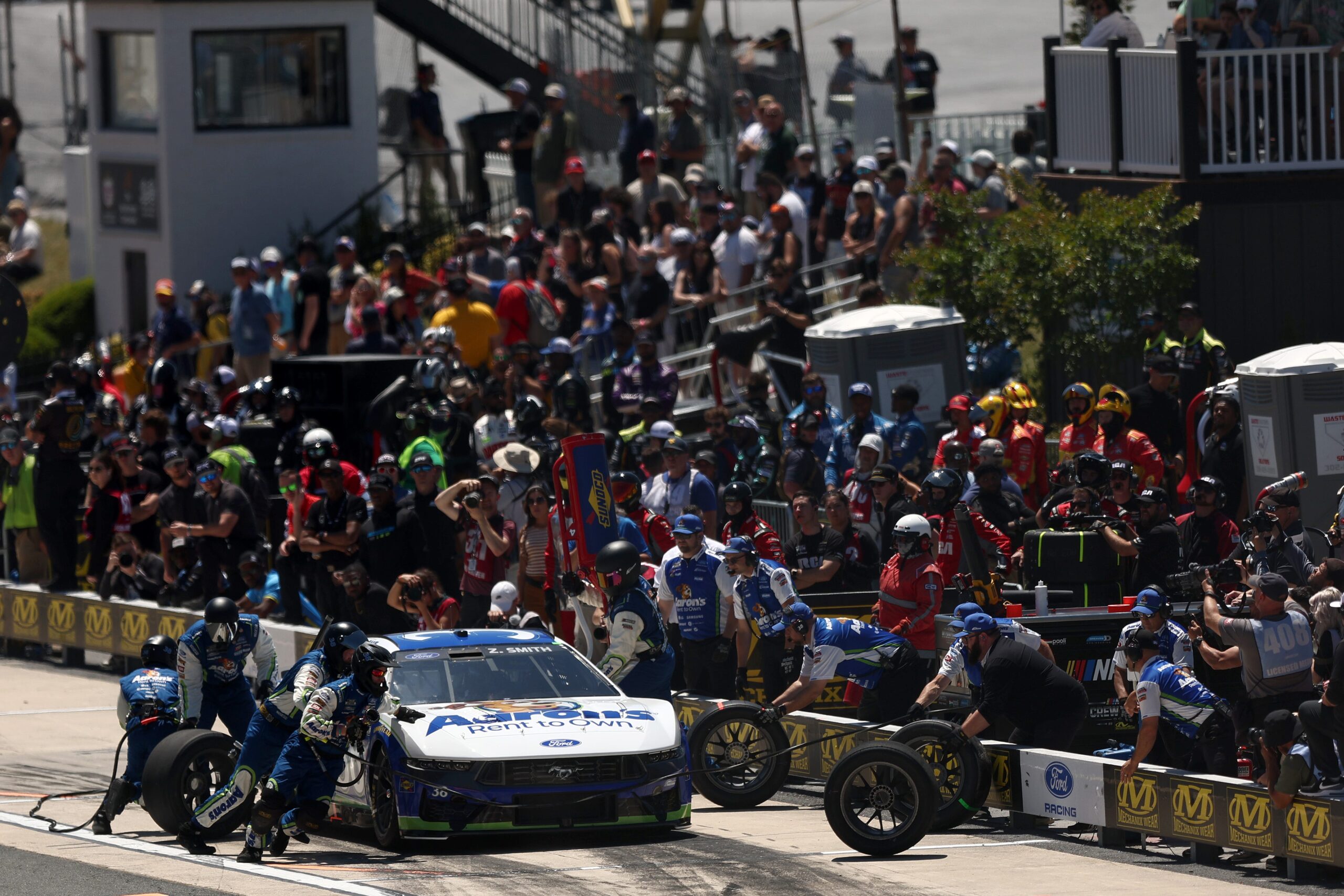


For 56 consecutive years, Dover Motor Speedway hosted points-paying Cup races. That streak ended when NASCAR shipped its spring date to Rockingham and handed the 1-mile concrete oval the All-Star Race instead. The move felt less like a gift and more like a going-away card.
But the qualifying format Dover got in the deal was genuinely clever.
Each driver ran a warm-up lap, a hot lap, pulled into pit road for a full four-tire stop, then sprinted back to the line. Combined time set the grid. The fastest pit stop also won the traditional Pit Crew Challenge and its $100,000 prize, plus pit stall selection for the race.
Charlotte has used a similar hybrid before, but never one where the stop itself carried this much weight across multiple outcomes.
The real payoff was on the broadcast. As each car slowed to pit-lane speed, Fox Sports introduced every crew member individually — name pronunciations, families, college backgrounds. In a normal race weekend, maybe four or five crews get that treatment across three hours. Here, every single team in the garage got its moment.
The No. 38 Front Row Motorsports Ford crew shocked the field with a 12.612-second stop, beating Trackhouse Racing’s No. 97 team for Shane van Gisbergen and RFK Racing’s No. 17 squad for Chris Buescher. Front Row isn’t the organization most people pick to win anything against the sport’s superpowers. The crew knew it.
“It means everything to us,” fueler Ray Hernandez told Fox Sports. “We take a lot of pride in our job. We work hard; everybody at our company does. So to be able to do it on the one chance that you get for the whole season, it’s a big deal.”
Hernandez added that the team had posted a strong stop the previous year but finished third. Redemption, in 12.6 seconds.
On the driving side, Denny Hamlin claimed the overall pole despite spinning on his warm-up lap while trying to build tire heat. His hot lap was fast enough, and his crew delivered the fifth-quickest stop, giving him the best combined time. Hamlin, who has three Dover wins in 35 starts, downplayed the result with characteristic nonchalance.
“This is not my forte of going out and getting all these little metrics in one shot, especially overnight when you’re doing it. Very cold,” Hamlin told FS1. He did allow that his car felt strong the day before. For a driver who won the 2015 All-Star Race from the pole, the modesty felt practiced.
NASCAR has spent years trying to elevate the profile of pit crews, those anonymous athletes who can swing a race in four seconds or destroy one in two. The sport tinkered with standalone pit crew competitions and in-race graphics, but nothing stuck the way this format did. By tying crew performance directly to qualifying position and prize money, Dover’s session made the over-the-wall guys co-stars rather than extras.
It also made for better television. Every stop carried stakes. Every crew member had a name. For a sport that leans hard on driver personalities to sell itself, spending 90 minutes reminding fans that these are six-person teams was a welcome shift.
Whether Dover gets another chance to host anything at this level remains an open question NASCAR hasn’t answered. But the qualifying format it debuted deserves to outlive whatever happens to the track. The pit crews earned that much.
Share this Story