
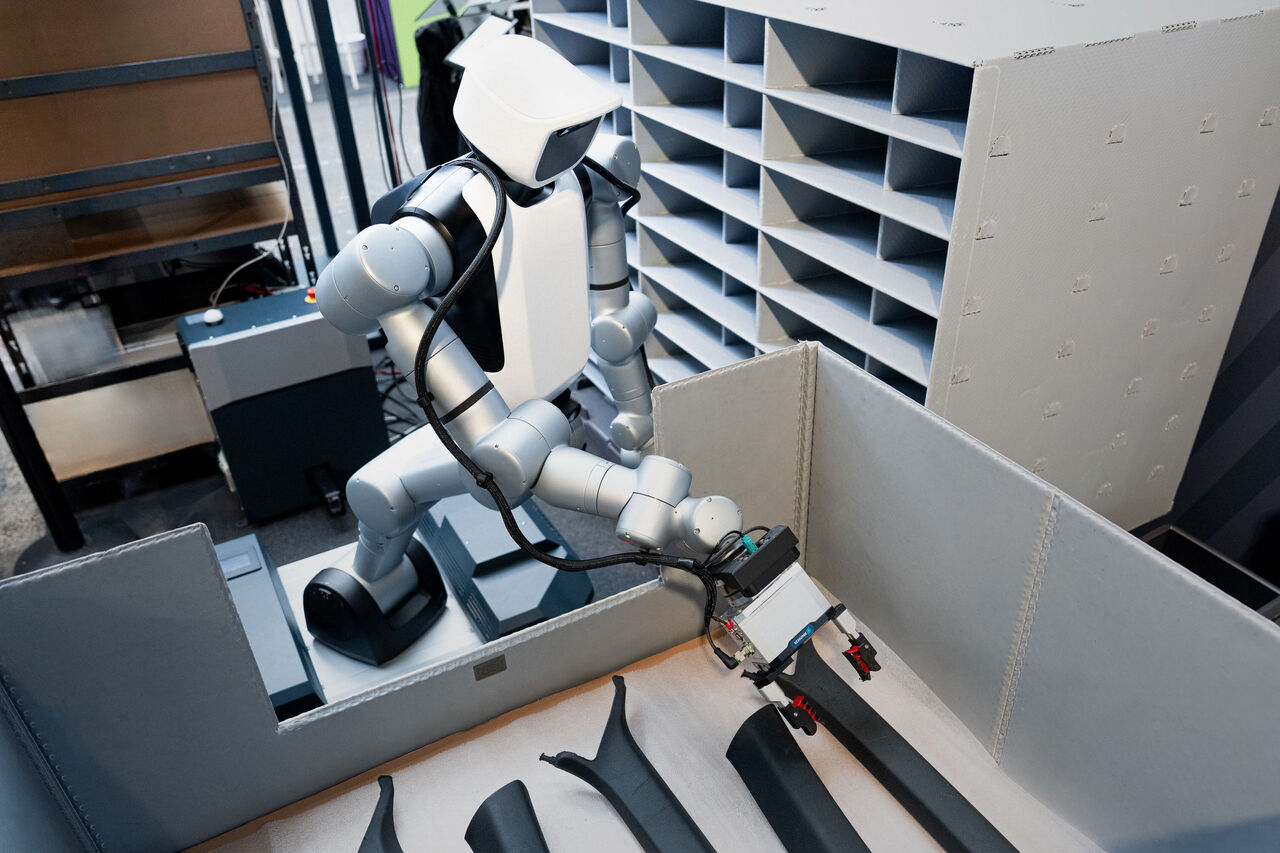


One million picks per day. That is what it takes to keep Audi’s Ingolstadt assembly lines fed with the right parts, in the right order, at the right time. It is the kind of grueling, high-variance logistics work that has stubbornly resisted automation for decades.
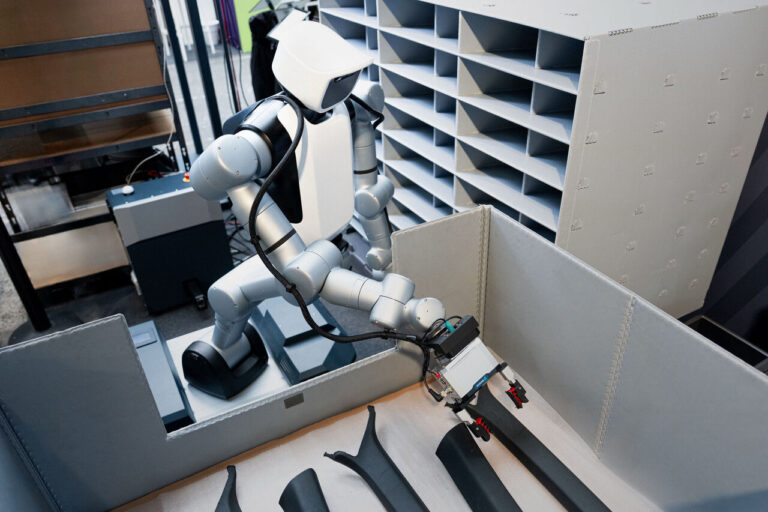
Now Audi thinks humanoid robots can crack it. The German automaker announced a proof-of-concept with Munich-based Agile Robots, Dassault Systèmes, and NVIDIA to deploy mobile humanoid robots in its sequencing operations. The machines are already being tested inside Audi’s Production Lab, picking parts from containers and placing them in correct assembly order for its premium vehicles.
This is not a press event dressed up as progress. The project targets what insiders call the hardest nut in automotive logistics: handling high-variant, semi-rigid parts jumbled in mixed containers. Traditional fixed-arm robots cannot cope with the sheer randomness of the task, so human workers have always been the only option.
Agile Robots’ humanoids work at human height with dual-arm manipulation, slotting into existing factory layouts without requiring costly infrastructure changes. AI-driven perception lets them identify, grasp, and sequence components even when stored in varying positions and packaging. The company, founded by researchers from the German Aerospace Center, already has more than 20,000 robotic installations worldwide and over 650 patents filed.
Before the robots ever touch the production floor, Dassault Systèmes builds a virtual twin of the logistics environment using its DELMIA platform. Feasibility, timing, ergonomics, and safety get validated digitally first. The company claims its AI-powered virtual companion can compress what used to take months of commissioning work into days, with NVIDIA’s Omniverse libraries providing the physical simulation backbone.
Gerd Walker, Audi’s board member for production and logistics, framed the challenge bluntly: “For decades, picking within the sequencing process has remained one of the toughest automation challenges in automotive logistics.” He is not wrong. Kitting and sequencing have been the white whale for every major automaker chasing lights-out logistics.
BMW, Mercedes, and Toyota have all invested heavily in warehouse automation. But the last mile of parts delivery to the line, where component variety explodes and packaging is inconsistent, has remained a manual operation almost everywhere.
Agile Robots CEO Zhaopeng Chen positioned the collaboration as proof of “Physical AI,” a term the industry increasingly uses to describe robots that perceive and adapt to the real world rather than follow rigid programming. NVIDIA’s Deepu Talla echoed the point, noting the system tackles “one of automotive logistics’ toughest workflows with minimal changes to existing operations.”
The economics matter here. Audi employs more than 88,000 people worldwide, and sequencing work is repetitive, physically demanding, and prone to error under fatigue. Automating it would not just cut costs but free workers for tasks requiring judgment and flexibility, at least in theory. Whether displaced workers actually move to higher-value activities depends on retraining investments that rarely match the ambition of the technology rollout.
This is still a proof-of-concept, not a production deployment. The gap between lab success and reliable, high-volume factory operation is vast, littered with the wreckage of automation projects that worked beautifully in controlled conditions and fell apart under the chaos of real manufacturing.
But the partners involved suggest Audi is serious. Dassault brings industrial simulation depth. NVIDIA brings compute muscle. Agile Robots brings hardware with real-world traction. And Audi brings a million daily picks worth of unsolved problems.
Whether humanoids can actually survive the relentless pace of a German premium assembly plant remains an open question. The robots are in the lab now. The factory floor is next.

Share this Story