
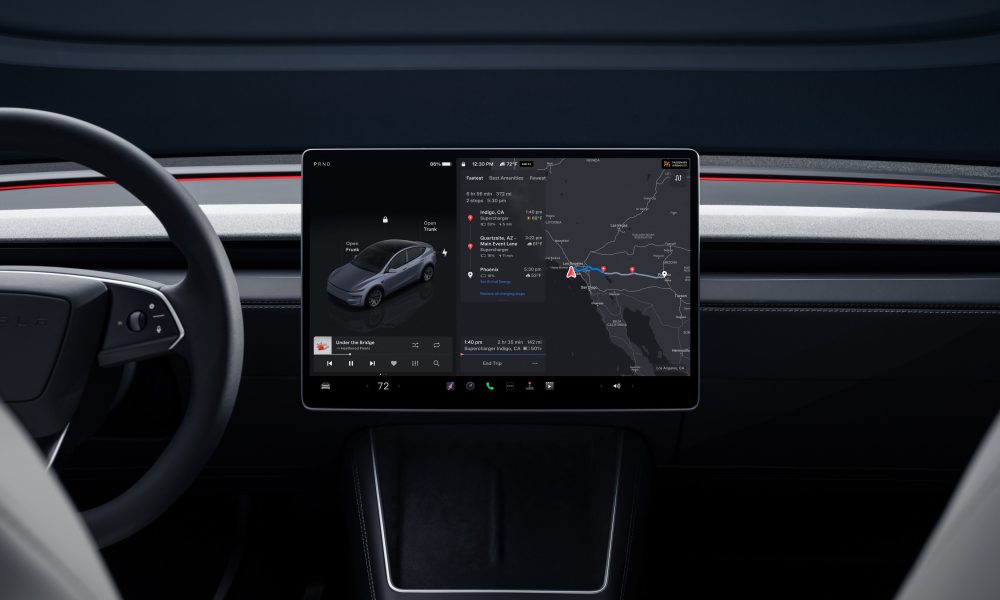


A crescent moon icon now sits in the bottom right corner of Model Y Robotaxi screens in Dallas. Tap it, and the display goes dark. No map, no media player, no Grok prompt — just a single line reading “Arriving soon” and your destination.
A video posted Thursday by a rider named Spencer shows quiet mode running on a nighttime trip through what appears to be Dallas. The feature blacks out everything a dozing passenger doesn’t need while keeping pull-over controls, cabin temperature, volume, and a support button visible. One tap anywhere on the screen brings it all back.
Tesla first rolled out quiet mode in the Cybercab last week. Pushing it to the Model Y fleet signals the company is treating its retrofitted sedans and the purpose-built robotaxi as a single service platform, not separate experiments.
It’s a small software toggle. It also happens to be the realization of something Elon Musk has been talking about for twelve years.
In October 2014, Musk predicted passengers could fall asleep in a self-driving Tesla within five or six years. By 2017, speaking at TED, he acknowledged the real threshold: a car that crashes once in a thousand trips still isn’t safe enough for a nap. “You shouldn’t be, certainly,” he said.
The promise resurfaced at the We, Robot event in October 2024 and again on Tesla’s first quarter 2025 earnings call, when Musk called it “the acid test.” Can you go to sleep and wake up at your destination? He said it would be available in many U.S. cities by year’s end.
Tesla launched driverless Model Y rides in Dallas and Houston last April. The company is now offering free first trips to new riders in both cities, according to in-app screenshots shared by fleet tracker Ethan McKanna. On its third quarter earnings call, Tesla said Cybercab rides would begin in Dallas next month.
Quiet mode is not the only cabin refinement. Spencer also reported on October 25 that robotaxi turn signals now chime for the first four blinks, then go silent. Tesla published no release notes for either change, which fits the company’s habit of shipping updates without documentation and letting riders discover them.
The feature itself is dead simple. But a quiet mode button presumes a level of trust between passenger and machine that didn’t exist six months ago. It presumes someone will actually close their eyes in a car with no steering wheel operator, no safety driver, no human backup of any kind.
Whether passengers are ready is another question. Driverless rides remain limited to two Texas cities, and Tesla has not disclosed trip volumes, disengagement rates, or incident data in any detail. The National Highway Traffic Safety Administration continues to monitor autonomous vehicle deployments across the industry.
Musk set the bar himself when he said 99.9 percent reliability wasn’t good enough for sleep. Tesla has never publicly stated what reliability level its robotaxi fleet has achieved.
A dark screen and a moon icon don’t answer that question. But they do tell you Tesla is betting passengers will stop asking it.
Share this Story