
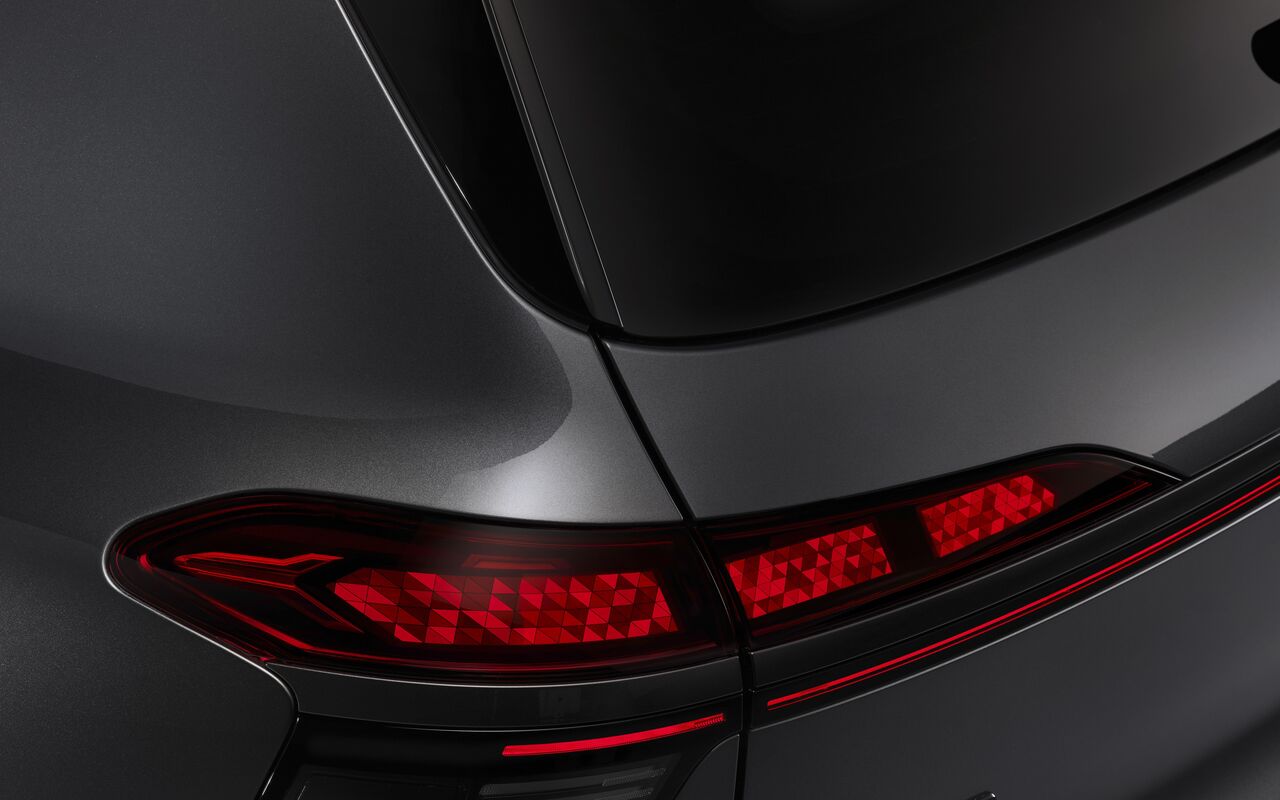


The carrier glass is 0.1 millimeters thick. That’s roughly the width of a human hair, and Audi is bending it into three-dimensional curves for the rear lights of the new Q9. It is, by any measure, a strange thing to obsess over. But a decade into its OLED lighting program, Audi has turned taillights into something closer to a theological pursuit than an engineering checkbox.
The Q9 marks the production debut of curved digital OLED panels, a first in the automotive industry. The ultra-thin glass bends to a radius of 200 millimeters, wrapping around the SUV’s rear haunches rather than sitting flat against them. Six OLED panels carry 512 individually controllable segments. The largest single panel, the curved outer unit, contains 99 segments, making it the biggest OLED panel Audi has ever fitted to a production car.
The functional argument is straightforward. Wrapping the light source around the body improves lateral visibility. Other drivers and pedestrians can see brake lights and turn signals from wider angles.
The communication light function, which Audi introduced in its second-generation digital OLED system, now projects warning symbols for breakdowns and accident zones into the taillight signature itself.
Audi has been building toward this moment with meticulous patience. OLEDs first appeared on the TT RS in 2016 as a design novelty. The Q5 got the first digitally segmented version in 2020.
The Q6 e-tron in 2024 brought a tenfold increase in controllable segments and the first real safety communication features. Now the Q9 adds curvature and 3D visual effects to the repertoire.
Stefan Berlitz, head of lighting development at Audi, frames the trajectory in terms of safety, calling it “an intelligent means of communication.” That is true enough. But Audi is also playing a branding game that no other manufacturer has matched with this level of commitment.
Up to eight selectable digital light signatures at front and rear, available in static, active, and semi-active modes, turn a regulatory device into a personalization tool. Your taillights, your identity.
Up front, the Q9 carries Digital Matrix LED headlights using a micro-LED module packing 25,600 individual LEDs into a space roughly 13 millimeters wide. Each micro-LED measures about 40 micrometers. The system projects lane lighting, orientation paths, and dynamic turn signals onto the road surface.
In narrow construction zones, it automatically reconfigures light distribution to help the driver center the vehicle in the lane.
The Q9 is not an electric vehicle. Audi lists fuel consumption for the TDI quattro at 7.4 to 8.0 liters per 100 kilometers, with CO2 emissions between 194 and 209 grams per kilometer, landing it squarely in CO2 class G. That a diesel SUV in the worst emissions category is debuting the most advanced lighting technology in the industry carries its own quiet irony.
Audi says the third-generation digital OLED technology will also appear on the Q7 model line in 2026. The curved variant, for now, belongs exclusively to the Q9. Whether other manufacturers pursue similar thin-glass bending techniques or dismiss the whole exercise as over-engineering remains to be seen.
Audi has spent ten years and four generations of hardware proving that the taillight is not a solved problem. The Q9 suggests they are far from finished.
Share this Story