
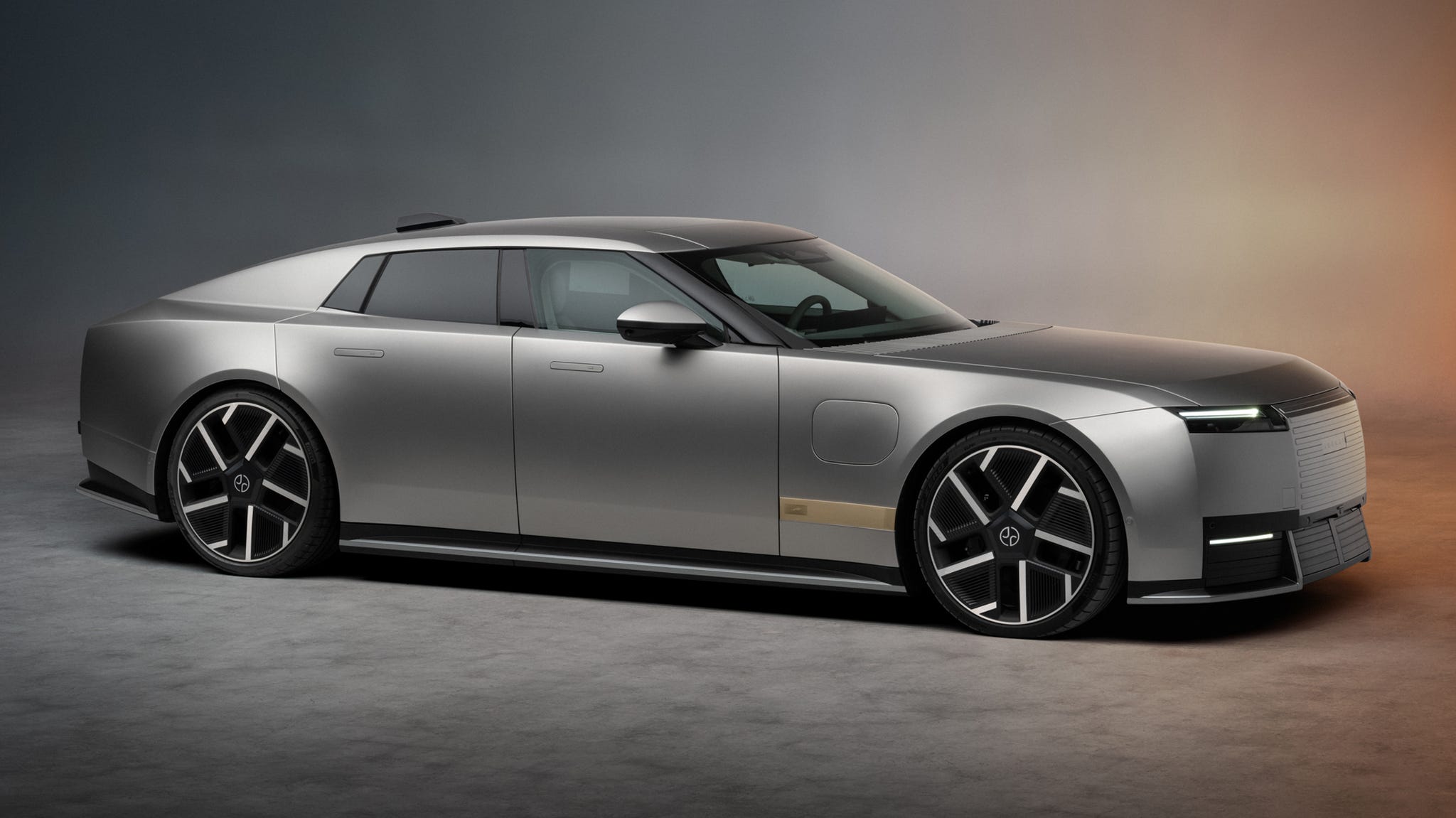


Jaguar stopped building cars in December 2025. Just stopped. Not a gradual wind-down, not a parallel production run.
The factory went dark while the brand bet everything on a single electric grand tourer that looks nothing like any Jaguar before it.
The Type 01 is now fully revealed after two years of drip-fed teasers, prototype drives, and the kind of theatrical rollout that made the internet lose its collective mind. With 1,016 horsepower, a 118-kWh battery, and a claimed 400 miles of EPA-rated range, the numbers alone would be enough to raise eyebrows. But the real story isn’t the spec sheet.
It’s the corporate high-wire act behind it.
Not since Henry Ford shuttered River Rouge for six months in 1927 to pivot from the Model T to the Model A has an automaker fully paused vehicle production for a model changeover. JLR did exactly that, voluntarily walking away from revenue while pouring resources into a car that will cost roughly twice what any recent Jaguar sold in the U.S.
“This is a big moment for us,” said Jaguar boss Rawdon Glover, calling it one of the most important launches in the brand’s 90-year history. The U.S. is expected to be the Type 01’s largest market. That means Jaguar’s survival now hinges on American buyers who, for the past decade, largely ignored the brand in favor of SUVs from BMW, Mercedes, and Porsche.
The car couldn’t be built on any existing platform. Not JLR’s own MLA-Flex architecture that underpins the new Range Rover Electric, and not anyone else’s, either. So Jaguar created JEA, the Jaguar Electrical Architecture, from scratch.
Chief engineer Jon Darlington, a 31-year JLR veteran, recalled his first reaction to the Project Pantera clay model that would become the Type 01: “This is really different; this is going to be pretty challenging.”
Challenging is generous. The design demanded an ultra-long hood, ultra-low roofline, and ultra-sheer surfaces while somehow packaging a battery big enough to deliver 400 miles of range. Darlington’s breakthrough was recognizing that the car’s extreme dash-to-axle ratio created space ahead of the front passenger bulkhead for battery cells and power electronics, provided crash safety could be solved.
The solution was a pair of complex aluminum structures called tri-axis nodes, positioned at the outer edges of the bulkhead. They redirect crash loads around the passenger compartment, allowing 32 of the battery’s 200 prismatic cells to sit forward of the bulkhead. That keeps the under-floor battery section at just 5.9 inches deep and mounted low.
The engineering is clever. The ambition is staggering. But this is still a brand that sold fewer than 23,000 cars in the U.S. in its last full year of production, competing in a luxury EV segment that now includes Porsche, Mercedes, BMW, Rolls-Royce, and a dozen well-funded startups.
When the Type 01 hits American roads in mid-2027, it won’t just be selling a car. It will be selling a completely reinvented identity to buyers who may not have considered a Jaguar in years, if ever. Glover and his team have no ICE models to fall back on, no SUV lineup to cushion a slow start, no second act waiting in the wings.
The factory is already committed. The platform exists for this car alone. Every dollar JLR spent says this will work, but the market hasn’t weighed in yet.

Share this Story