
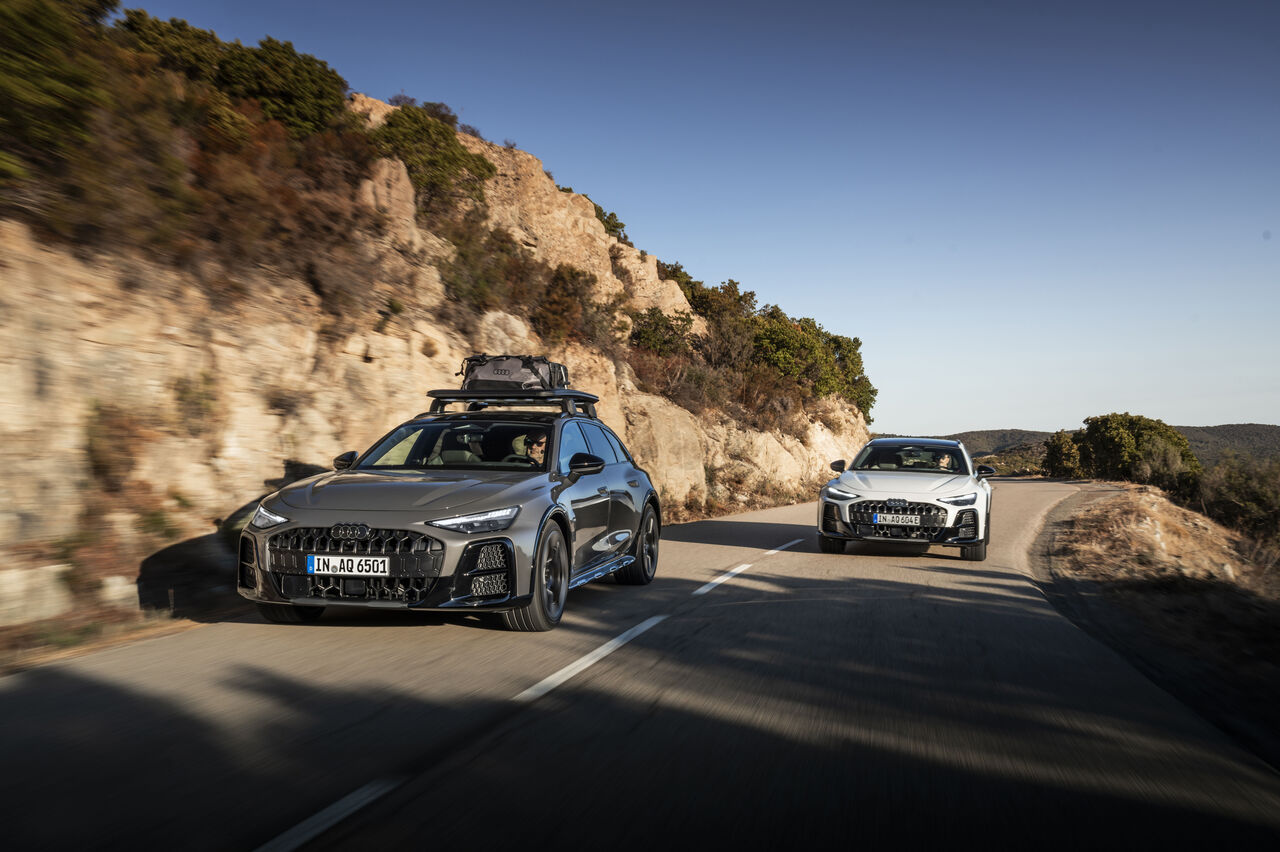


The new Audi A6 allroad is now on sale across Europe with a first for the nameplate: a plug-in hybrid powertrain. Pricing starts at €77,250 for the V6 diesel and €80,250 for the e-hybrid. Both versions lean on Audi’s quattro ultra all-wheel-drive system to thread the needle between traction and fuel economy.
That system is the real story here. Quattro ultra uses two electronically controlled clutches, one at the transmission output and another in the rear differential, to physically disconnect the entire rear drivetrain when all-wheel drive isn’t needed. No driveshaft spinning. No parasitic drag. Just front-wheel drive sipping fuel until the road, the weather, or the driver’s right foot says otherwise.
Audi claims the reconnection process takes roughly 200 milliseconds, with the system’s predictive algorithms working about half a second ahead of the moment all-wheel drive is actually required. It reads steering angle, lateral and longitudinal acceleration, body movement, friction coefficient, and throttle demand. It even learns from the driver. Cruise gently and it stays in front-drive mode longer. Push hard and it keeps the rear axle on standby more aggressively.
“The transition between different operating modes of the all-wheel-drive system is imperceptible to the driver,” said Rouven Mohr, Audi’s board member for technical development. That’s the pitch: permanent quattro feel without permanent quattro losses.
The e-hybrid pairs a 270 kW powertrain with the ultra system, returning weighted combined fuel consumption of 2.8 to 2.3 liters per 100 km and electric consumption of 17.0 to 16.2 kWh per 100 km. Those numbers look impressive on paper, as plug-in hybrid figures always do. With a dead battery, consumption jumps to 7.7 to 7.0 liters per 100 km and the CO2 class drops from B to F. That’s the reality check that matters.
The V6 TDI variant makes 220 kW and uses mild-hybrid tech along with an electrically powered compressor. Combined consumption lands between 6.4 and 5.8 liters per 100 km. Honest numbers for a lifted, cladded wagon with all-wheel drive.
Under hard acceleration on dry pavement, Audi says more than 70 percent of torque can be routed to the rear wheels. That’s a meaningful rear bias for a system that defaults to front-drive, and it signals that the allroad isn’t just playing at ruggedness. The torque split adjusts continuously based on traction demands, cornering loads, and comfort parameters.
Quattro ultra first appeared in 2016 in the A4 allroad and has since spread across the Premium Platform Combustion lineup, showing up in the A5, A6, and Q5. Audi has built more than 15.6 million quattro-equipped vehicles since 1980, a third of its total production over that span. The brand’s identity is welded to all-wheel drive, but the engineering reality has shifted. Full-time mechanical quattro systems are giving way to electronically managed compromises that chase efficiency targets while trying not to dilute the badge.
Whether quattro ultra truly feels like the permanent mechanical systems that built the brand’s reputation is a question best answered on a wet Alpine pass, not in a press release. Audi is betting most buyers will never notice the difference. The small minority who would are probably already shopping for something with a Torsen center diff, and Audi knows it.
The allroad e-hybrid marks the first time Audi has combined its raised wagon formula with plug-in capability. Whether European buyers treat it as a proper PHEV or just another company car tax optimizer remains an open question.

Share this Story