
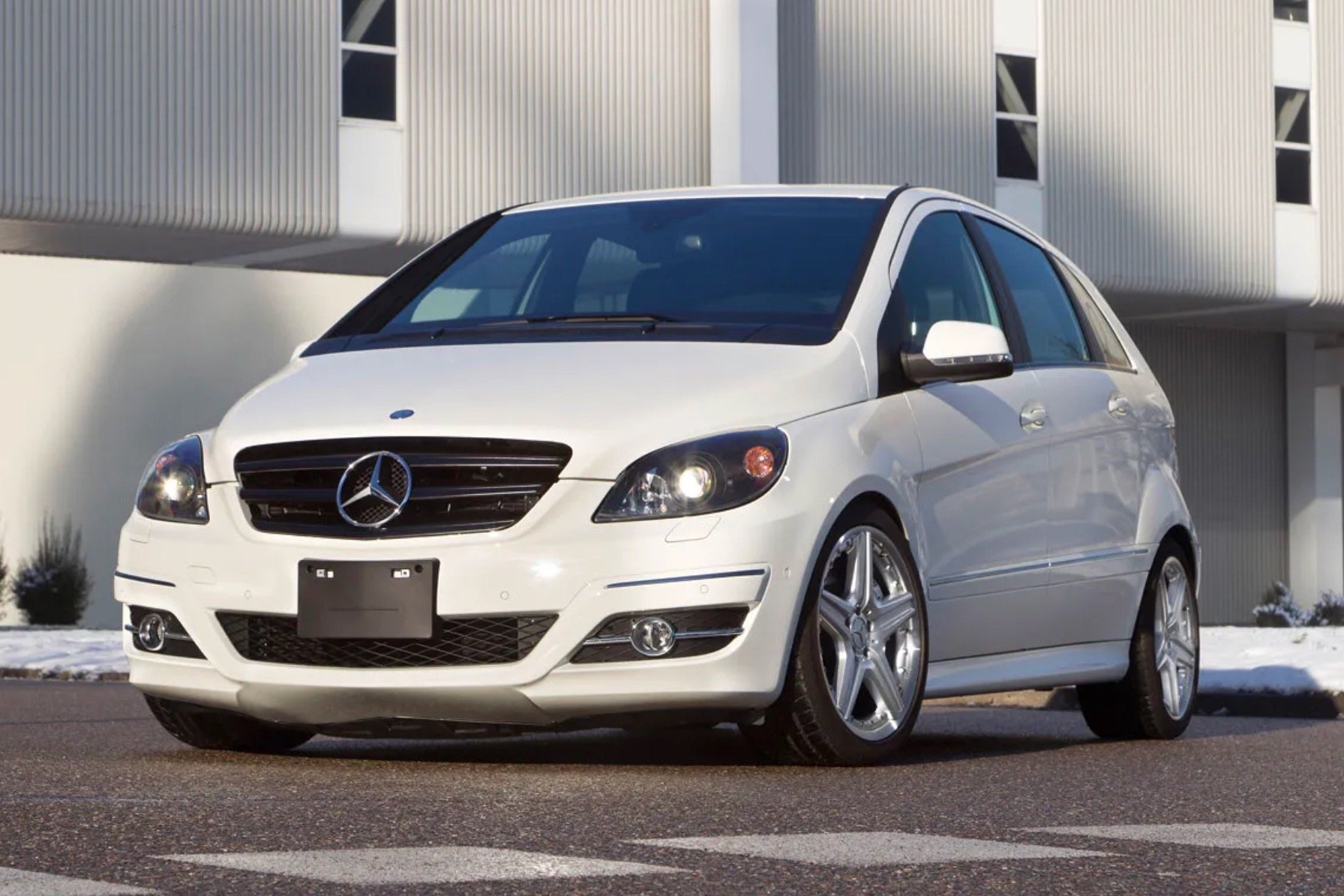


Back in 2009, a group of apprentices at Mercedes-Benz’s Rastatt assembly plant in Germany took a diesel B-Class hatchback, ripped out its modest four-cylinder, and dropped in a naturally aspirated 5.5-liter AMG V8 making 388 horsepower and 391 lb-ft of torque. They called it the B55, and it could smoke its rear tires with the best of them.
The project started with a conversation between Rastatt plant manager Peter Wesp and vocational training foreman Andreas Würz. Wesp wanted a trainee project built around the B-Class, which rolled off the line at that very facility. Würz grabbed a tape measure, checked the engine bay, and confirmed the V8 would physically clear.
The challenge handed to the trainees was deceptively simple: make it work without cutting up the body shell.
They started with a B200 CDI diesel that had already been earmarked for training duty. The 5.5-liter V8 slotted in without drama, but everything around it fought back. Packaging the steering and exhaust required creative problem-solving.
The trainees fabricated a custom exhaust from spare parts, running dual tips out the center of the rear bumper. A rear axle from a W210 E-Class was selected because it was the best dimensional match, mounted on a custom subframe. Brakes came off a C32 AMG, and K&W coilovers replaced the stock suspension.

The interior wasn’t an afterthought. Alcantara lined the headliner, and leather and Alcantara covered the seats. This was no stripped-out track hack but a proper sleeper, looking like any other frumpy B-Class from the outside while hiding a drivetrain that belonged in something twice its price.
The finished car tipped the scales at an estimated 3,571 pounds, roughly 396 pounds heavier than stock. Würz figured it could crack zero to 62 mph in under six seconds. For a tall, boxy front-drive hatchback turned rear-drive V8 bruiser, those numbers are borderline absurd.
The timing tells its own story. By 2009, the 5.5-liter V8 was already being pushed aside by AMG’s 6.2-liter M156. Within a few more years, emissions pressure would kill the big naturally aspirated motors entirely, replaced by the twin-turbo 4.0-liter units that power every AMG product today. The B55 caught a moment right before the door closed on that era.
German automakers have a long tradition of apprentice builds, and the best ones share a common trait: they take something the company would never approve for production and prove it works anyway. Mercedes was simultaneously chasing volume with small front-drive hatchbacks and chasing performance with hand-built AMG V8s. Nobody in Stuttgart’s product planning department would have married those two strategies.
But a plant manager, a training foreman, and a group of trainees with a tape measure and a parts catalog did exactly that. The B-Class itself is still sold in some markets, still wearing its distinctively tall roofline. Mercedes never offered anything remotely like the B55 from the factory.
The car reportedly still exists at the Mercedes-Benz Museum, which recently highlighted it on Instagram. Whether anyone at Rastatt still has the tape measure is another question.
Share this Story