
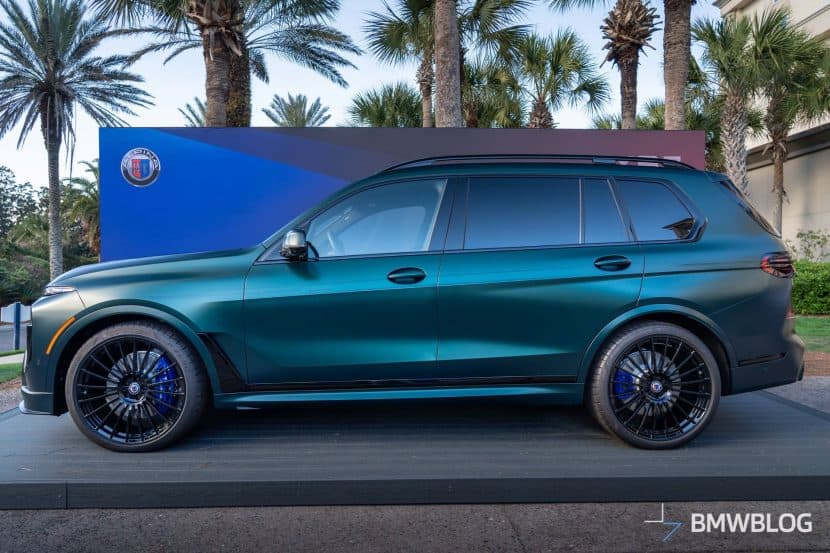


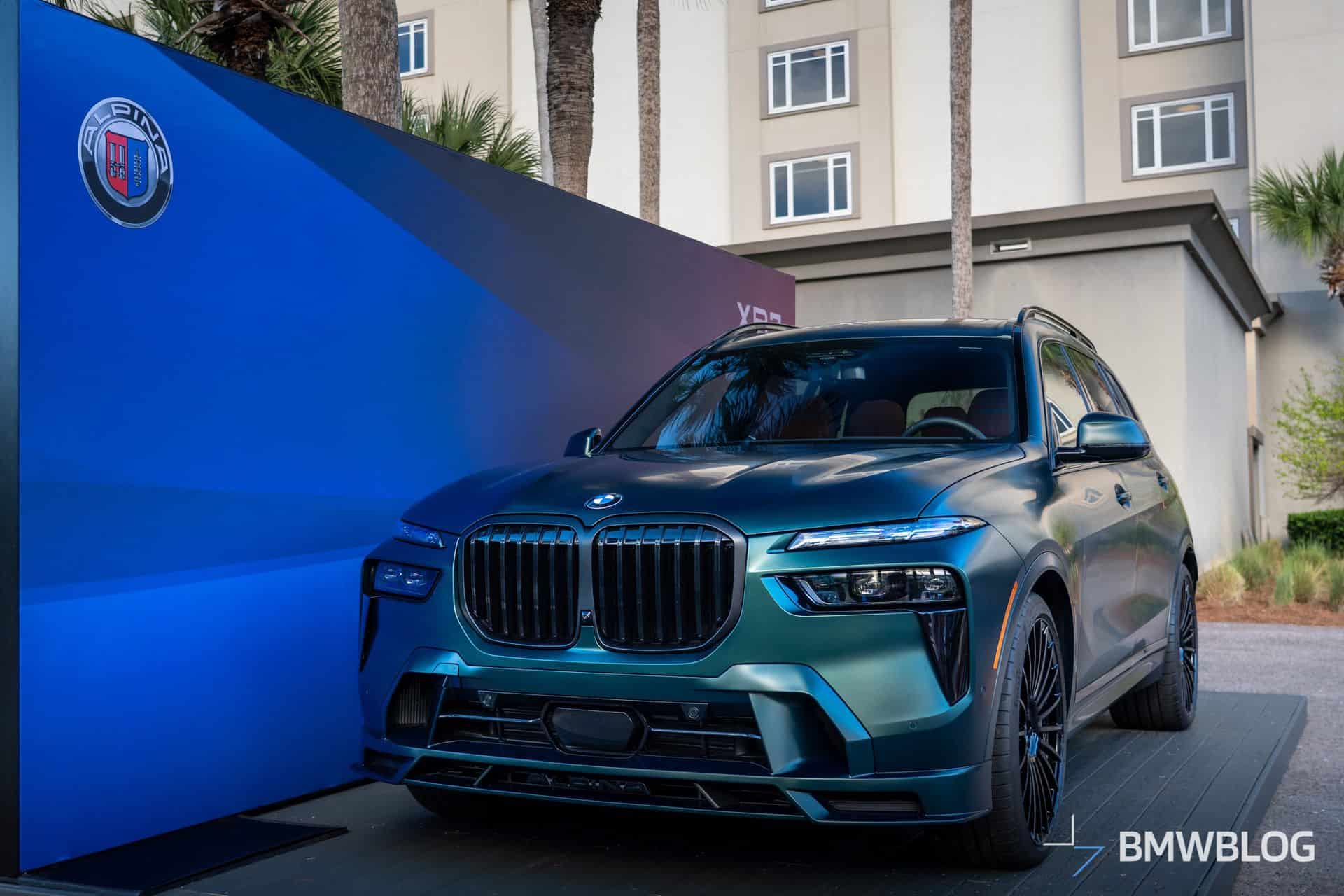
BMW will build exactly 120 units of the ALPINA XB7 Manufaktur for the U.S. and Canada, priced at $180,000 plus $1,550 destination, with deliveries starting in the fourth quarter. Two matte colors, Frozen ALPINA Green or Frozen ALPINA Blue. No configurator, no options list, no decisions beyond the paint.
It is also the last ALPINA the Bovensiepen family approved for this market before BMW’s acquisition of the name took effect on January 1, 2026.
The mechanical package carries over unchanged. The 4.4-liter twin-turbo V8 makes 631 hp and 590 lb-ft, runs through an eight-speed with ALPINA’s Switch-Tronic paddles, and gets to 60 mph in a claimed 3.9 seconds. Air suspension tuned by ALPINA at both axles, electromechanical anti-roll bars, rear-axle steering, and a 7,500-pound tow rating. Not a single new part under the skin.
What you’re paying the $25,550 premium over the standard XB7’s $156,000 sticker for is cosmetic: gloss-black 23-inch ALPINA Classic wheels, a double pinstripe down each flank, Manufaktur badges on the B-pillars and tailgate, a numbered interior plaque, headrest embroidery matched to the exterior color, and two handmade weekender bags in brown Lavalina leather tucked into the cargo area.
The real value proposition has nothing to do with the luggage. BMW never built an X7 M, and for six years the XB7 quietly filled that space with an approach M Division would never have taken. Where M chases lap times, ALPINA added torque and ride quality and left the aggression alone.
That philosophy traces back to the E38 B12 era, and it disappears from the price list after car number 120 rolls off the line at Spartanburg.
Its replacement, coded G69, will split off from the next-generation G67 X7 under its own model designation, a structural change that signals wider differentiation and, almost certainly, a higher price. BMW is repositioning ALPINA as its answer to Mercedes-Maybach, with the first BMW-developed ALPINA due in 2027 on the 7 Series platform. There are also rumblings of an electric ALPINA X7.
The cabin shift matters just as much as the brand shift. The current XB7 still has a physical iDrive rotary controller on the console, a 12.3-inch instrument cluster in a binnacle directly ahead of the driver, and a dashboard oriented around one seat. The G67 X7 is expected to adopt BMW’s Panoramic iDrive, which replaces the traditional cluster with a projection across the windshield base and almost certainly kills the rotary controller.
The driver-focused cockpit gives way to a lounge.
Andreas and Florian Bovensiepen, meanwhile, have moved on. Their new venture, Bovensiepen, is building a Zagato coupe making 611 hp, limited to 99 units at €369,495. The family’s fingerprints remain on the XB7 Manufaktur, but the name on the building in Buchloe now belongs to Munich.
A fully loaded XM Label undercuts this car by roughly $12,400 and makes more power. On pure specification, the Manufaktur loses that comparison. But the XM has spent its entire existence defending its own existence, while the XB7 has spent six years generating almost zero controversy.
BMW is charging a final-edition premium for a car about to be replaced by something more expensive and more capable, and buyers writing those checks understand that calculus perfectly. They are not buying a depreciation hedge or a track weapon. They are buying the last moment before ALPINA stops meaning what it meant for 60 years and starts meaning whatever BMW decides it should.
The first 120 people to figure that out get matte paint and monogrammed luggage. Everyone after that gets a different company.

Share this Story