
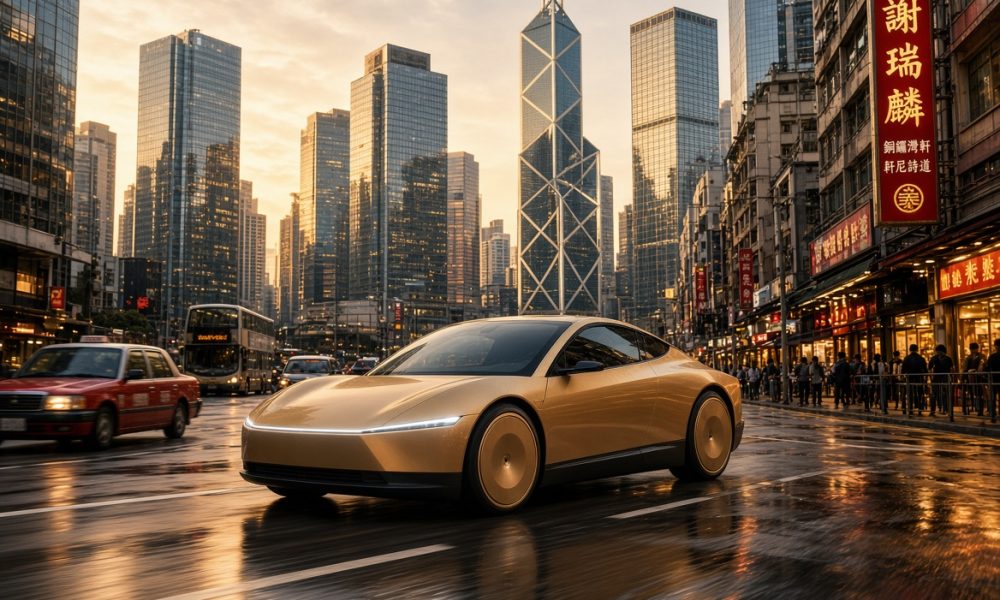


Tesla’s Cybercab is heading to four Asian cities this month, just hours after the company flipped the switch on its first public rides in Austin, Texas. The official Tesla Asia account posted on X Thursday inviting fans to “come experience the future of autonomy in Hong Kong, Tokyo, Beijing & Shanghai.”
No dates, no venues, no mention of test rides.
Tesla Hong Kong confirmed a static display is coming soon. Tesla Japan pointed followers to a sign-up page. Neither hinted at anything resembling actual robotaxi operations. Based on Tesla’s past playbook, the European tour in late 2024 and the U.S. shopping center stops that December, these will be look-but-don’t-ride showcases parked inside Tesla stores or public venues.
The timing is calculated. Austin’s launch gives the Asia tour a live proof point to reference, even if the two events are separated by 8,000 miles and vastly different regulatory landscapes. Tesla last brought the Cybercab to Asia at the China International Import Expo in Shanghai last November, where Tesla’s regional general manager framed the vehicle as a symbol of the company’s broader mission.
That mission now has a formal name. Tesla‘s Master Plan Part IV describes autonomous vehicles as the path to “dramatically improve the affordability, availability and safety of transportation while reducing pollution, particularly in our increasingly dense global cities.” The Cybercab and the Optimus humanoid robot sit at the center of what Tesla calls its “sustainable abundance” strategy, the hardware layer behind an AI push to cut the cost of transportation and labor at scale.
Whether any of that translates to actual rides in Asia is another matter entirely. China’s autonomous ride-hailing market didn’t wait for Tesla. Baidu’s Apollo Go and Pony AI have been running driverless services across multiple Chinese cities for years, building regulatory relationships and operational data that Tesla hasn’t begun to accumulate in the region.
Tokyo and Hong Kong present their own dense regulatory thickets.
Back in the U.S., Tesla’s expansion trajectory is moving, but not without friction. Nevada granted the company a robotaxi permit in August, then immediately capped the fleet at ten vehicles inside a tight geofence along the Las Vegas Strip. Rides are banned on roads above 45 mph, pickups within a quarter mile of Harry Reid International Airport require separate authorization, and every vehicle must carry visible “Robotaxi” markings.
The permit also mandates “appropriate human supervision,” language that suggests Nevada isn’t ready for fully unsupervised rides. Zoox, Amazon’s robotaxi operation, has already scaled to roughly 100 vehicles and 350,000 rides along the Strip. That track record almost certainly informed the NTA’s conservative starting point for Tesla.
Tesla has said it won’t meaningfully scale its robotaxi fleet anywhere until FSD v15 ships, expected in late 2026 or early 2027. That makes the Nevada cap more of a formality than a bottleneck, at least for now. But it also underscores the gap between the marketing push and the operational reality.
Austin is live. Nevada is permitted but idle. Europe got displays. Asia is next in line for the same.
The four-city tour reads as brand building, not market entry. Tesla is generating global awareness for a product that currently operates in exactly one American city. The Cybercab exists as a rideable vehicle in Austin and as a museum piece everywhere else.
What happens when Tesla actually tries to compete with Baidu on its home turf, or navigate Japan’s regulatory framework, or satisfy Hong Kong’s transport authority, remains a story that hasn’t started yet.
Share this Story