
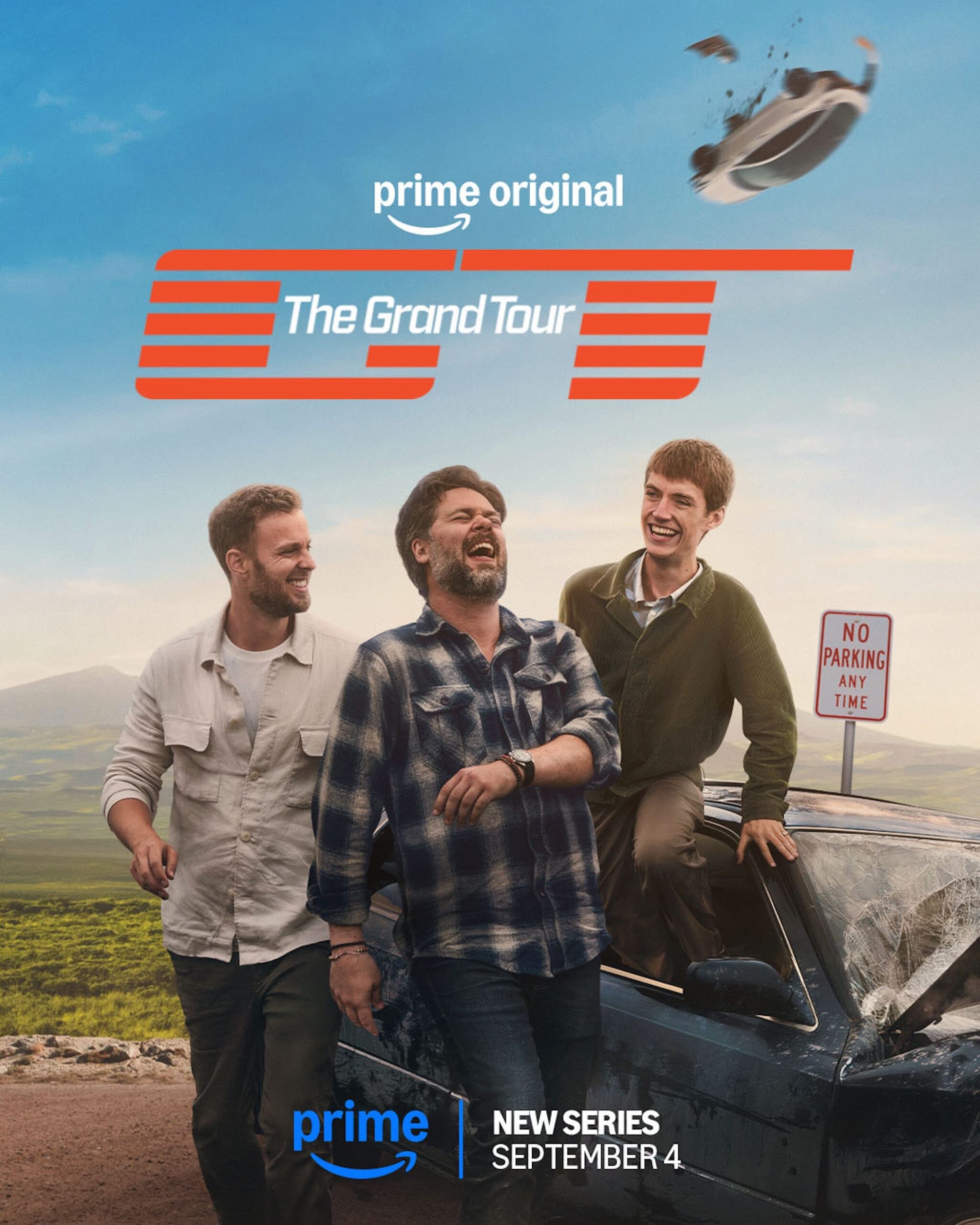


The Grand Tour returns September 4, 2026, with three hosts who have never appeared on a major automotive television show before. Amazon Prime Video handed the keys to James Engelsman and Thomas Holland of the Throttle House YouTube channel, plus Francis Bourgeois, a social media personality best known for his obsessive enthusiasm about trains.
Not cars. Trains.
Car and Driver squeezed a seven-minute interview out of the trio during a London press junket this week, and the conversation revealed a group that is self-aware, genuinely quick-witted, and maybe a little starstruck by the production apparatus surrounding them. The first episode sends them to California’s Salton Sea in American muscle cars before racing jets. Bourgeois reportedly topped 200 mph during filming, which his co-hosts confirmed with a mix of admiration and annoyance.
“You know how some people have a natural sense for how a car handles?” Holland said. “Francis has got that, whatever it is.”
The casting is a calculated bet. Throttle House has built a loyal following on YouTube with polished reviews that, as Holland put it, “inadvertently reverse-engineered what a high-level TV show could look like.” They did their own stunt driving for their channel. They know cameras. But stepping into roles vacated by Jeremy Clarkson, Richard Hammond, and James May is a different kind of pressure entirely.
The original trio’s final Grand Tour special aired in 2024. Top Gear, the BBC show where that chemistry was born, wrapped even earlier. For roughly two years, big-budget automotive television went quiet. Now both franchises are attempting comebacks simultaneously, with Top Gear also announcing new, still unnamed hosts.
Holland seemed genuinely welcoming of the competition. “More car content is better for everybody,” he said. Engelsman was blunter about the vacuum: “We don’t want quiet.”
What came through in the compressed interview was how much creative control the new hosts negotiated. Every episode concept required unanimous approval from all three hosts plus the production team, a “six yeses” arrangement that suggests Amazon learned something from the old regime’s occasional controversies. The editorial collaboration was described as tight, not top-down.
Bourgeois, for his part, leaned into his outsider status. Asked to choose between a 1932 Ford Deuce, a Lucid Sapphire, and a 1983 Honda Civic, he grabbed the Civic without hesitation. When asked how many trains viewers can expect this season, he offered a carefully diplomatic tease about “glancing coincidences” and “planned railway interactions.”
The train thing is not a gimmick they are running from. It is the gimmick they are running toward.
Production-wise, the show clearly operates on a different plane than YouTube. Holland acknowledged the gap honestly, noting that unless Throttle House hires 40 more people and a helicopter, there is not much they can bring back from the experience. Bourgeois joked about not hauling a professional ARRI camera onto a train platform anytime soon.
A full season is already in the can, which means Amazon has committed real money before seeing a single viewership number from this new lineup. That is either confidence or desperation dressed up nicely.
The original Grand Tour worked because three middle-aged British men had spent 20 years building chemistry so combustible it survived a network change, a format overhaul, and a pandemic. Chemistry like that is not engineered. It is discovered, usually by accident, usually over years.
These three have one season to prove they found it faster.
Share this Story