
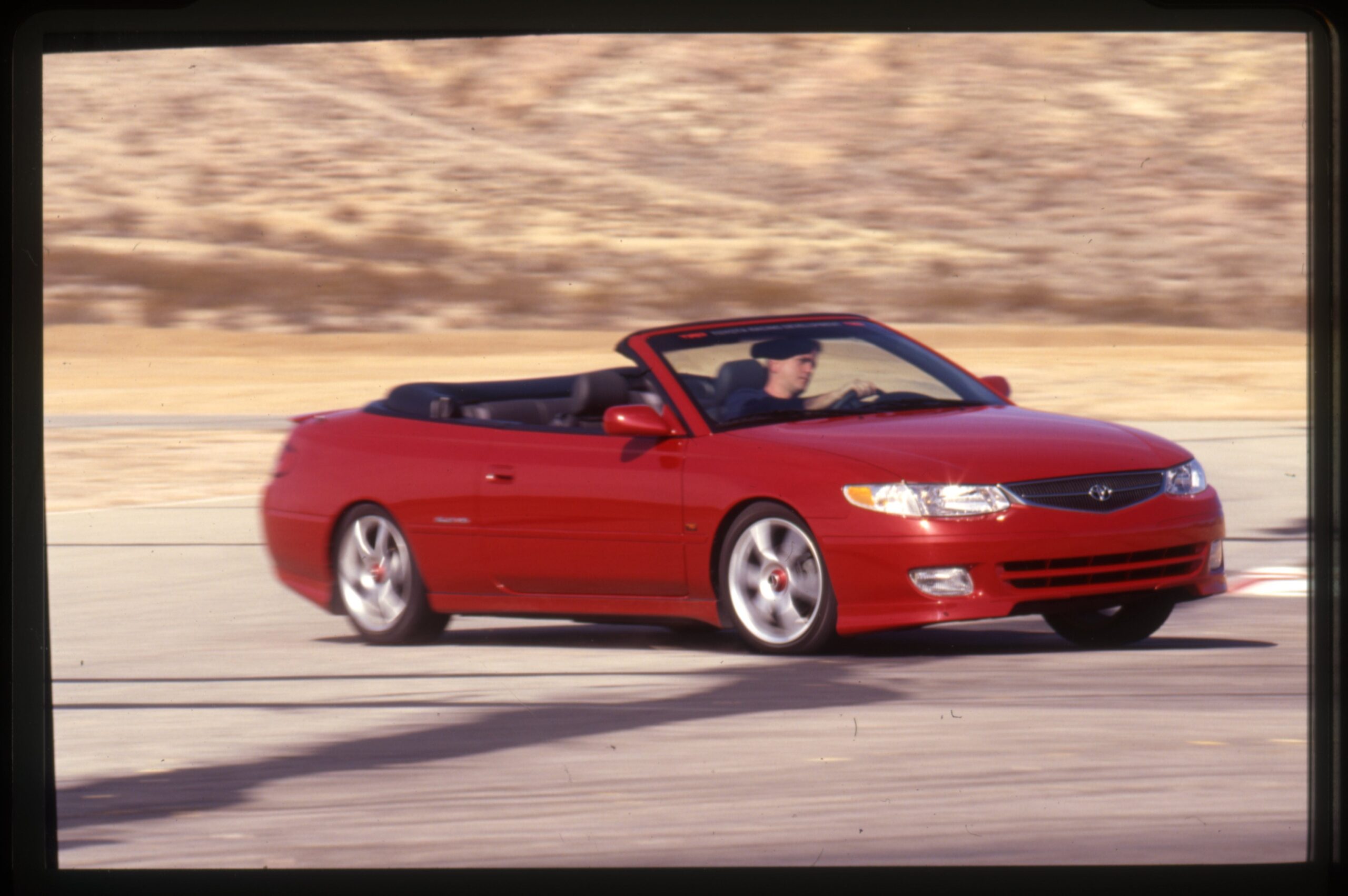


A supercharged V-6 making 247 horsepower, Bilstein monotube struts, a seven-piece body kit, and 17-inch center-lock wheels. This wasn’t a Supra. It was a Camry Solara convertible, and in 2001, Toyota Racing Development thought it could transform a golf-course cruiser into something worth driving hard.
Car and Driver’s late Tony Swan tested the TRD Stage 3 Solara more than two decades ago, and the results tell a story Toyota has been wrestling with ever since. How do you inject genuine performance into a platform engineered for comfort and reliability above all else?
The Eaton supercharger was the centerpiece. Bolted directly onto Toyota’s 3.0-liter DOHC V-6 with just 4.5 pounds of boost, it required no compression changes and no ECU recalibration. The kit cost $3,500 and took about two and a half hours to install.
Output jumped from 198 to 247 horsepower, with torque climbing 30 pound-feet to 242. Nearly V-8 territory from a straight bolt-on. That was legitimately impressive engineering for the era.
The numbers backed it up. Zero to 60 fell to 7.3 seconds, shaving 1.2 seconds off the stock car. The quarter-mile came in at 15.6 seconds at 96 mph.
Five full seconds disappeared from the 0-to-100 run. For a front-wheel-drive convertible weighing 3,520 pounds, those were respectable figures.
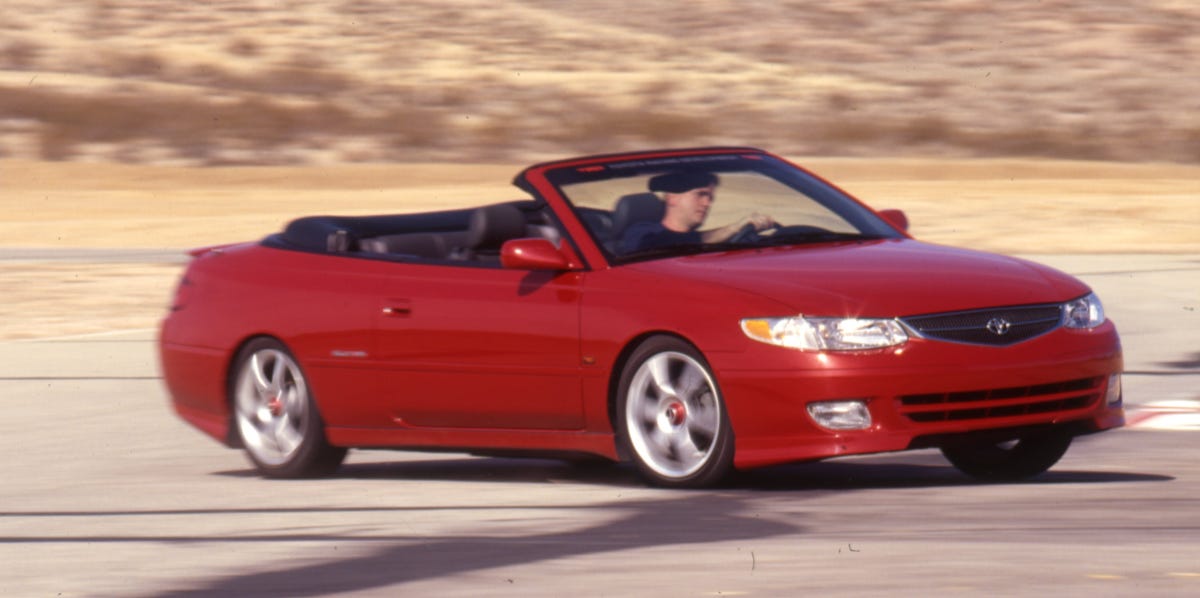
The chassis work told a more complicated story. TRD’s lowered springs — 1.25 inches in front, 1.75 in the rear — combined with the Bilsteins and wider Toyo Proxes rubber to produce 0.86 g on the skidpad and a 172-foot stop from 70 mph. Both figures beat every production convertible in Car and Driver’s comparison test that month.
But Swan, characteristically, didn’t let the numbers obscure reality. The stiffer suspension hammered ride quality and amplified chassis flex — the convertible’s eternal weakness. He raised the specter of long-term buzzes, squeaks, and rattles, noting it was “hard to believe the result would be good.”
The Solara’s unibody was never designed to handle this kind of stress with its roof sawed off.
Then there was the four-speed automatic, which Toyota programmed with a jarring pause during the one-two upshift to protect the transmission from the extra torque. No manual was offered. In 2001, a company selling a $40,000 performance convertible without a stick shift was telling you exactly who this car was really for.
And $40,000 was the number. The TRD Stage 3 package added $8,110 to the Solara’s price, pushing it into territory where buyers could cross-shop a Mustang GT convertible or a used Boxster. Toyota was asking serious money to make a Camry derivative feel “far more entertaining” — Swan’s words — than its civilian counterpart.
The TRD Solara existed in a strange no-man’s-land. Too aggressive for the country club set, not aggressive enough for anyone who actually wanted a sports car. It was a proof of concept for a customer who may not have existed in meaningful numbers.
Toyota never released sales figures for the TRD packages, which tells you plenty.
What makes this car fascinating now isn’t what it was but what it represented. Toyota’s performance ambitions have always bumped against the company’s institutional caution. The TRD Solara was a supercharged compromise — genuinely faster, measurably better in the corners, and still a Camry at its core.
Swan captured that tension perfectly, praising the car’s improved dynamics while never pretending it had become something it wasn’t. Twenty-four years later, Toyota still sells TRD-badged versions of its mainstream cars. The formula hasn’t changed much, and neither has the question: is the badge worth the premium when the bones underneath remain sensible?
Share this Story