
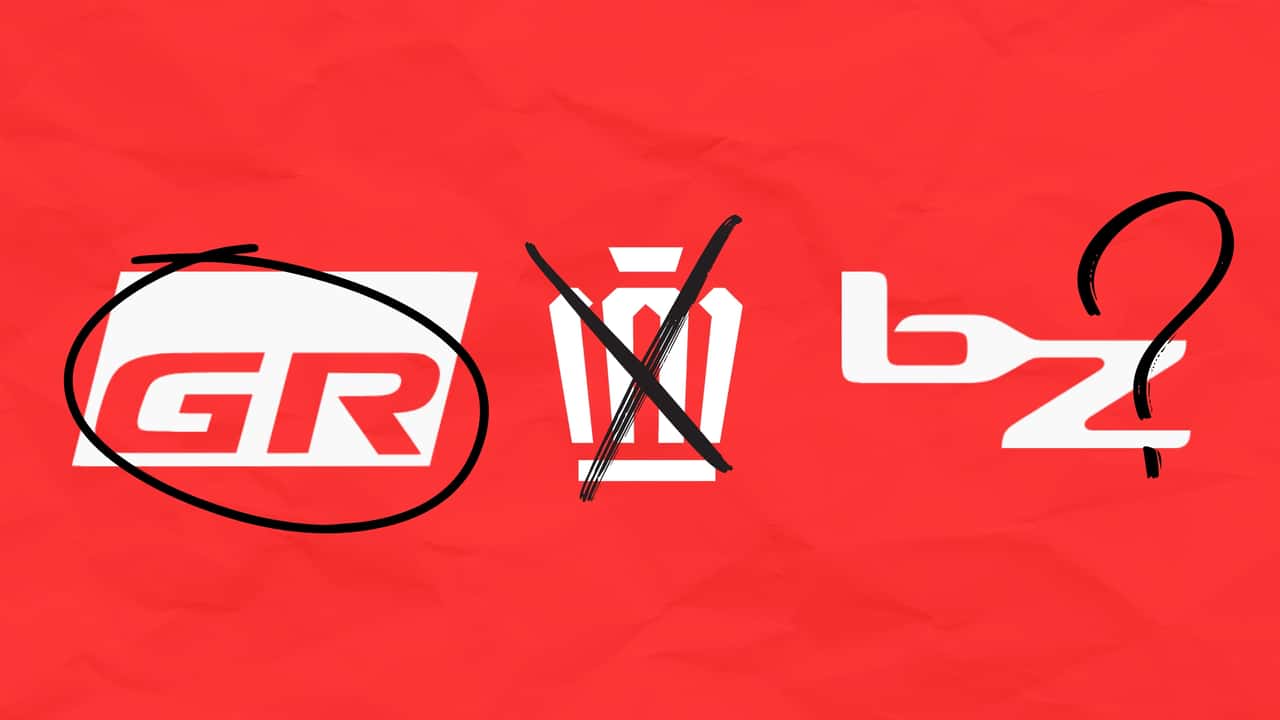


Twenty-one nameplates. That’s what Toyota currently sells in the United States, not counting the off-road, performance, and plug-in variants that splinter the lineup even further. Globally, the number balloons to nearly 80 unique models. And the guy who just took over as CEO thinks that’s a problem.
Kenta Kon, Toyota’s newly appointed chief executive, recently admitted what anyone walking a Toyota dealer lot already knows: the lineup is too crowded. Some of these vehicles are selling in numbers that wouldn’t justify a second shift at a regional bakery, let alone a global automaker’s production line.
Start at the bottom. The Mirai, Toyota’s hydrogen fuel-cell sedan, moved 210 units in all of 2025. That’s not a typo. Two hundred and ten.
Toyota can be bullish on hydrogen all it wants, but the Mirai isn’t a production car at this point. It’s a rolling science project with a VIN.
The GR Supra, already confirmed dead, managed just 2,953 sales before bowing out. The GR86, beloved by enthusiasts and ignored by everyone else, scraped together 9,940. The Crown sedan, Toyota’s odd attempt at a high-riding quasi-luxury four-door, landed at 12,309.
Its SUV sibling, the Crown Signia, did marginally better at 20,550. For context, the RAV4 sold 479,288 units in the same year.
Then there’s the curious case of the C-HR. Toyota killed the original after a five-year run of disappointing sales, then inexplicably revived it as a funky electric crossover for 2026, right alongside the bZ, its other compact electric crossover. Two EVs occupying the same space, from a company that has been openly skeptical of going fully electric.
The core lineup, though, remains a fortress. The Camry moved 316,185 units and held its crown as America’s best-selling sedan. The Corolla pushed 248,088.
The Tacoma did 274,638 despite a model-year transition. The Tundra cleared 147,000 even while battling well-documented twin-turbo V6 reliability headaches. The Grand Highlander and 4Runner each hit 136,801 units. The Sienna cracked six figures.
These are the vehicles that fund Toyota’s experiments, and the experiments are getting expensive to justify. The Sequoia sold just 26,186 units, which isn’t catastrophic, but it’s concerning when a new electric Highlander is about to give Toyota three overlapping three-row SUVs. The Sequoia lacks the interior space and refinement of the Tahoe and Expedition, and recent reliability stumbles have done nothing to help its case.
A ruthless product planner could cut seven nameplates tomorrow: Mirai, Crown, Crown Signia, GR86, Sequoia, C-HR, and the already-dead Supra. That would tighten the US portfolio to around 14 models, still a full lineup by any reasonable standard. It would also eliminate the dead weight dragging down dealer attention, marketing budgets, and engineering resources.
Kon’s admission is refreshing but also overdue. Toyota spent years bolting on nameplates in pursuit of coverage, a sedan here, a niche crossover there, a hydrogen experiment nobody asked for. The result is a showroom that confuses customers and dilutes the brand’s identity.
The counterargument is that Toyota can afford to carry slow sellers because the profit machines subsidize everything else. That’s true, up to a point. But every model requires parts inventory, dealer training, marketing spend, and warranty infrastructure.
Complexity has a cost, even when the balance sheet looks healthy. Toyota’s strength has always been discipline, building the right car, at the right price, with ruthless efficiency. Twenty-one nameplates in a single market isn’t discipline.
It’s sprawl. Kon seems to know it. The question is whether he’ll actually do something about it, or whether the next CEO will be saying the same thing five years from now with 25 models on the floor.

Share this Story