
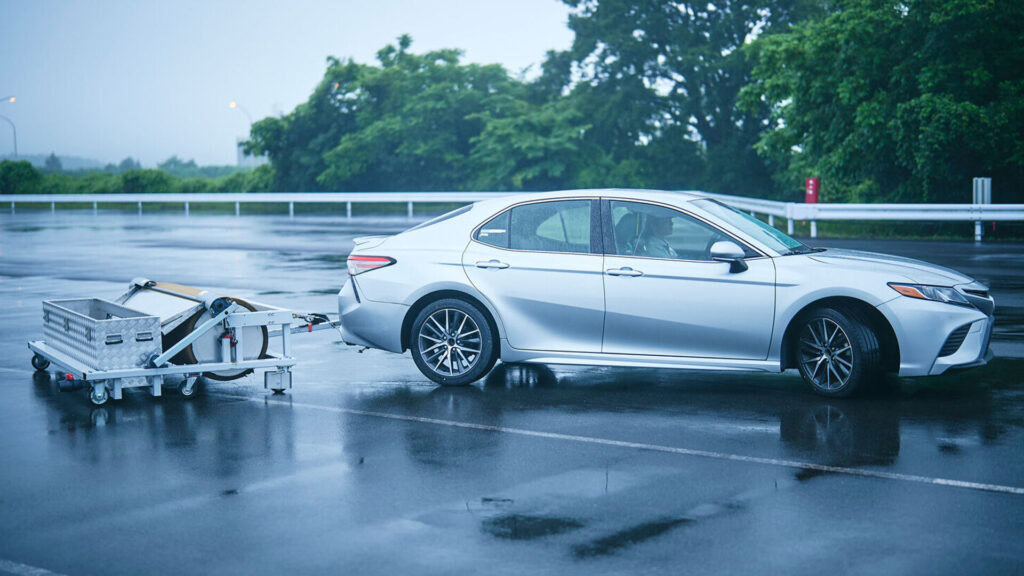


Engineers at Toyota’s Higashi-Fuji Technical Center were losing their weekends to wet pavement. In 2023, teams working on automatic braking systems logged weekend shifts more than three times as often as employees in other departments. The culprit wasn’t a software glitch or a supply chain bottleneck. It was rain.
Straight No.3 at the facility is shared by three separate teams developing pre-collision braking technology. Every test requires dry road surface. When it rained, engineers either waited hours for the track to dry or came back on Saturday.
So a small group of employees did what engineers do. They built something.
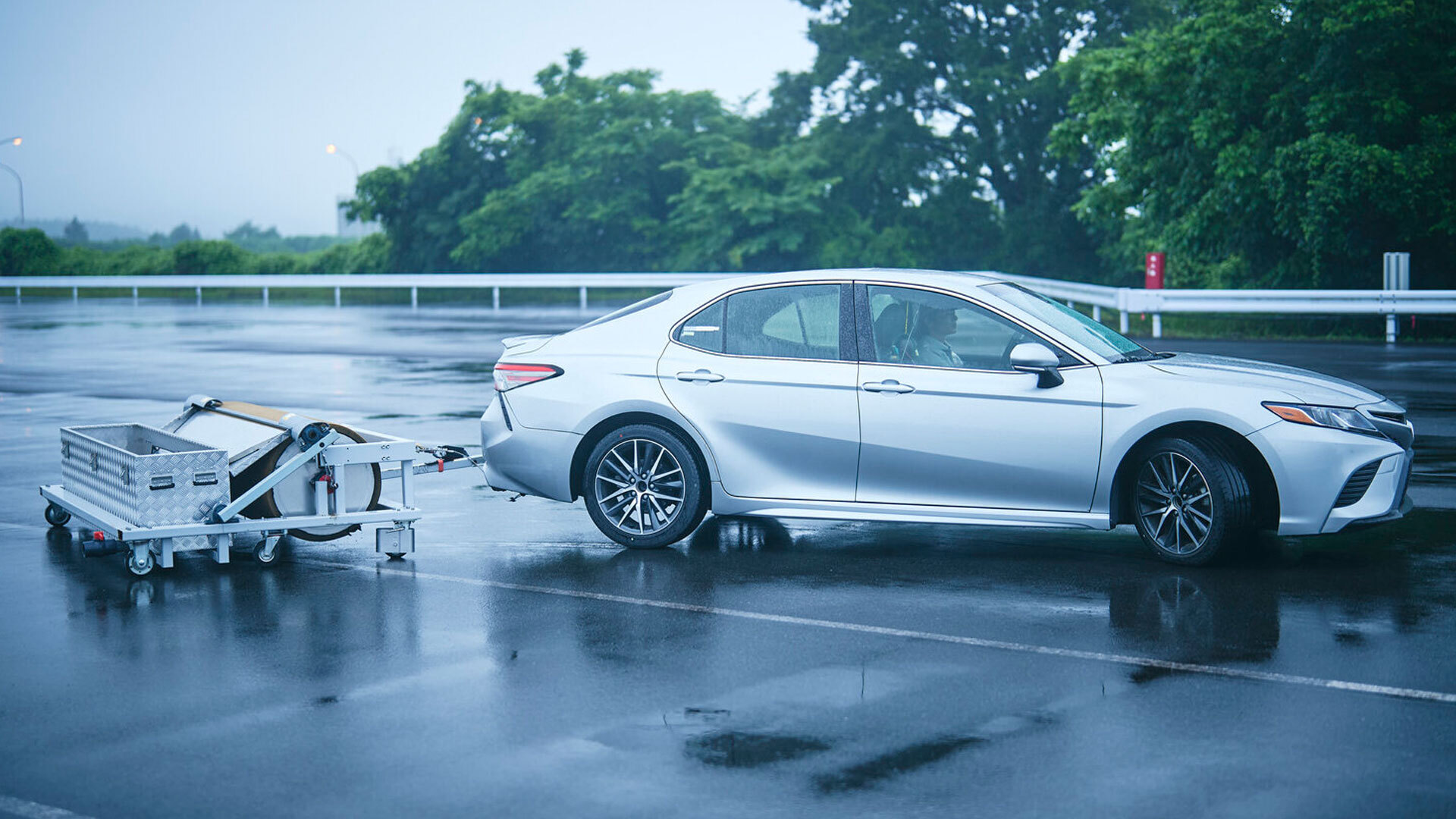
The solution is almost comically simple: a giant sponge roller, nearly 6.6 feet wide, mounted on a cart and towed behind a car. As it rolls across the wet track, the sponge absorbs water. A steel rod at the top squeezes the sponge continuously, channeling water into a rear collection tank that holds roughly 84.5 gallons.
When the tank fills up, it empties quickly, and the roller goes back to work. Getting there wasn’t quite as straightforward as the final product suggests. The team cycled through heaters, blowers, vacuums, and what Toyota described as “wiper-like contraptions.”
The vacuum approach actually performed best in testing, but the prototype was too small for the job. Scaling it up would have been prohibitively expensive, which is a polite way of saying management would have killed it on sight.
Seven iterations of the sponge concept followed before they landed on the version now in use. Toyota deployed it in March 2024, and it gets pulled out once or twice a month depending on weather conditions.
There is something refreshing about a company that spends billions developing autonomous driving technology solving one of its most persistent workflow problems with a piece of foam on wheels. The braking systems being tested on that track represent some of the most sophisticated sensor fusion and decision-making software in the auto industry. The thing that was holding up the whole operation was a puddle.
Toyota has long cultivated its reputation for kaizen, the philosophy of continuous improvement through small, practical changes. No one got a massive R&D budget. No one filed a patent for a breakthrough drying system. A few people who were tired of working Saturdays found an 84.5-gallon answer to a multimillion-dollar bottleneck.
The roller is still in regular rotation at Higashi-Fuji. Three teams still share the same stretch of track. The difference is that now, when it rains on a Thursday, Friday’s test schedule doesn’t automatically slide to the weekend.
It also raises a question that rarely gets asked in an industry obsessed with complexity: how many other expensive delays across the auto business could be solved with something this blunt and this cheap? Toyota’s sponge won’t show up in any earnings call or product launch. But somewhere in Shizuoka Prefecture, an engineer is home on a Saturday for the first time in months.
Share this Story