
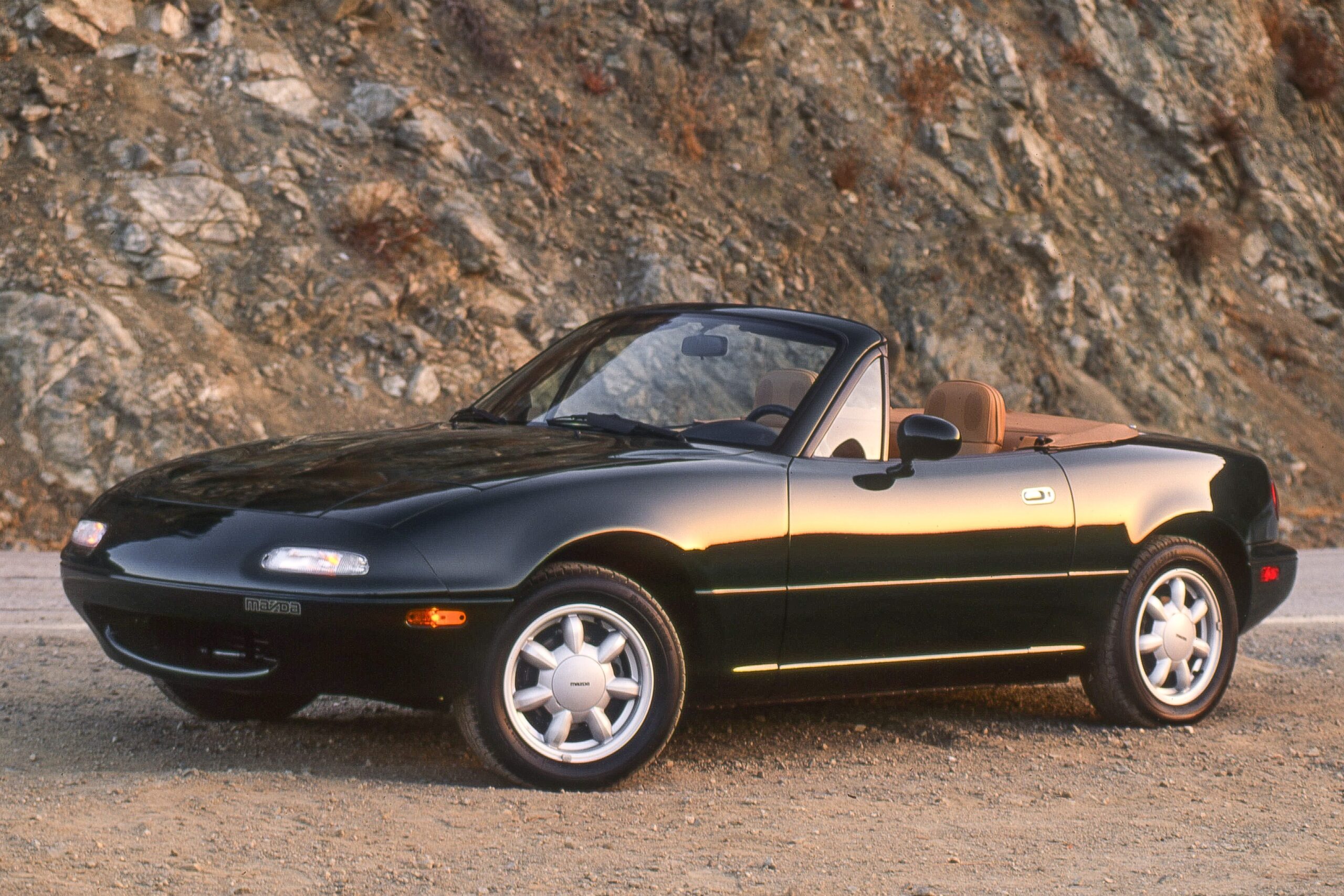


A black soft top on a British Racing Green sports car with beige leather. That was the aesthetic fumble Mazda delivered with the 1992 MX-5 Miata Special Edition, a car that wanted desperately to be a baby Jaguar but couldn’t quite commit to the bit.
Car and Driver’s August 1991 review, now resurfaced from the archive, reads like a love letter interrupted by repeated throat-clearing about that mismatched roof. John Phillips and crew clearly adored the Miata’s bones. They just couldn’t stomach the $19,599 ask, nearly five grand above a standard model, for a car whose “special edition” credentials amounted to cosmetics and convenience features rather than mechanical substance.
The package was long on atmosphere. Stainless-steel door sill scuff plates nodded to Jaguar’s Browns Lane factory. A polished Nardi wood shift knob sat ringed with a clever rubber strip to keep your hand from slamming into the radio.
Wood graced the handbrake grip. Beige leather covered the seats, though every other beige surface in the cockpit was vinyl. The distinction mattered to anyone spending Jaguar-adjacent money on a Hiroshima two-seater.
Mazda packed in cruise control, a CD player, and speakers mounted in the headrests. The cruise control struck the testers as particularly misguided on a car they described as “skittish” on Interstates. A beige vinyl tonneau cover required what Phillips memorably called “a ten-minute Jane Fonda workout” to install and could cost you a fingernail in the process.
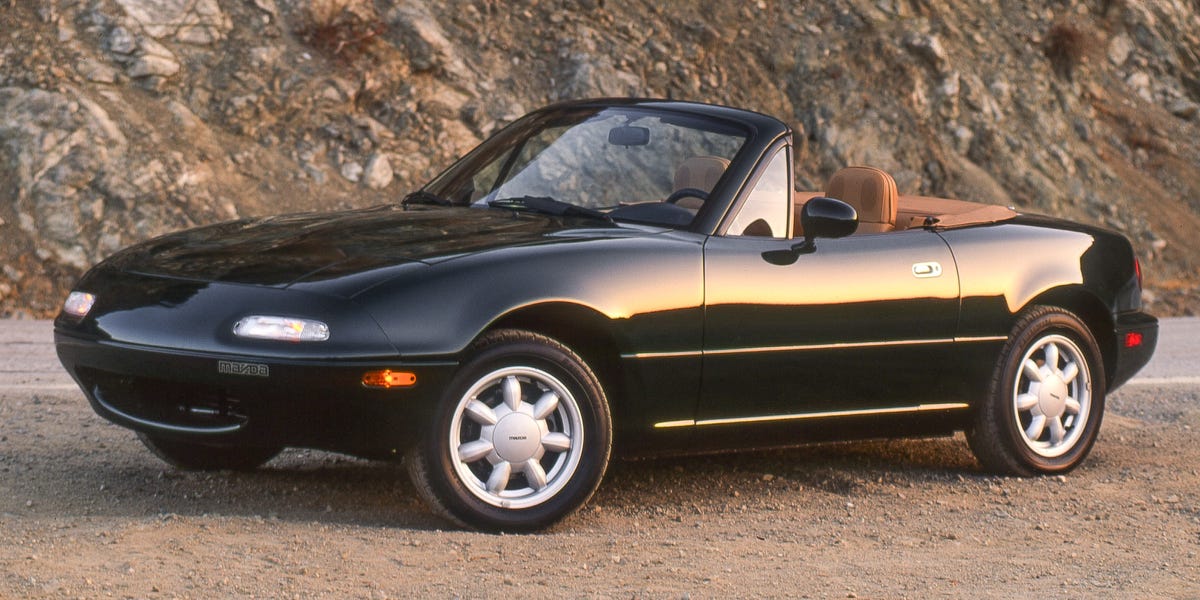
The numbers told the real story of what the Special Edition was and wasn’t. Under the hood sat the same 1.6-liter DOHC four-cylinder making 116 horsepower. Zero to 60 took 8.4 seconds, the quarter-mile fell in 16.5 seconds at 82 mph, and top speed was 117 mph.
The limited-slip differential was welcome, but power steering was the only meaningful mechanical addition to the standard car. It pulled 0.83 g on the skidpad and stopped from 70 mph in 189 feet.
For a car trading on exclusivity, 4,000 units stretched the definition of “limited.” Phillips and his colleagues made the point with precision: if Mazda had squeezed another 20 or 30 horsepower out of the engine and genuinely restricted production, the Special Edition would have been something worth collecting regardless of color coordination. Instead, the company charged a $4,949 premium for leather, wood, and a paint job.
The automatic transmission option deserves its own mention, if only for the reaction it provoked. Mazda priced the auto-equipped version at $20,039 and treated it as a separate model, stripping the limited-slip differential. The Car and Driver crew declared themselves ready to lobby for federal legislation criminalizing automatic transmissions in Miatas. That was 1991, and the argument hasn’t aged a day.
What Mazda built was a trim package dressed up as an event. The base Miata was already one of the purest driver’s cars on the market at roughly $15,000. Wrapping it in BRG paint and beige leather created something undeniably pretty to look at, but the gap between visual promise and mechanical delivery was wide enough to park a Jaguar XJ-S in.
Time has proven Phillips both right and wrong. The 1992 Special Edition didn’t offer the performance upgrades he wanted. But those 4,000 BRG Miatas with their mismatched black tops have become exactly the collectibles he said they shouldn’t be, commanding premiums in the used market that would make Mazda’s original pricing team blush.
The collector market, it turns out, doesn’t always reward engineering. Sometimes it just rewards scarcity and a good color.

Share this Story