
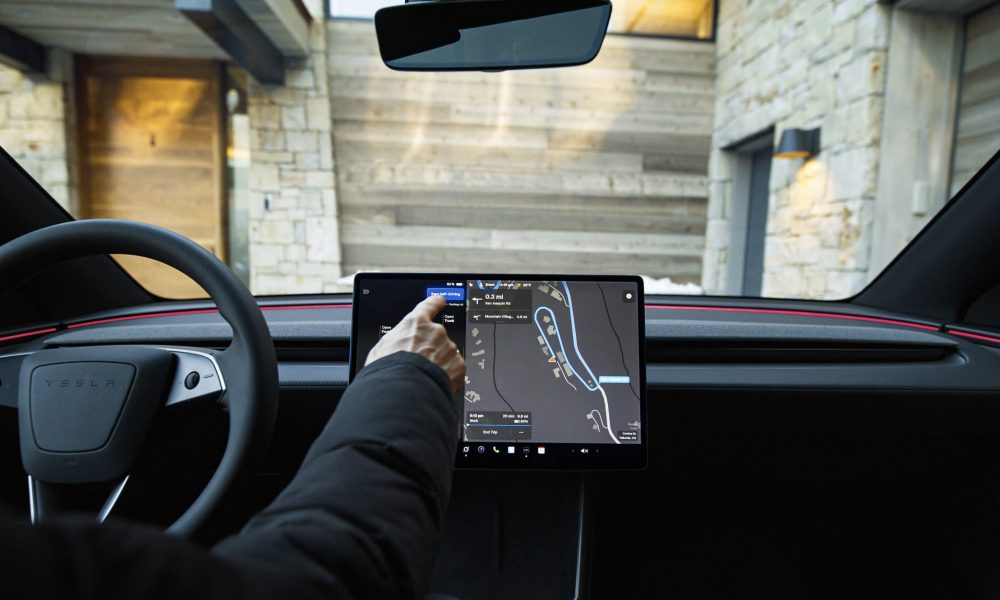


Pierre Ferragu wants you to believe Tesla’s Full Self-Driving is about to change the world the way the iPhone did. Meanwhile, in Miami, Tesla’s unsupervised robotaxi fleet launched with two cars.
Two. Cars.
The New Street Research analyst, a longtime Tesla bull, laid out his thesis this week with the kind of grand historical analogy Wall Street loves. The iPhone seemed expensive at $600 until people realized it wasn’t a phone — it was a life tool. Tesla at $35,000 plus $100 a month for FSD seems expensive until you realize it’s not a car — it’s a stress-free commute machine.
He says Tesla needs two more quarters of development before the inflection point arrives, though he declined to specify what exactly happens then. It’s a compelling pitch. It also runs headlong into the stubborn details of Tesla’s actual autonomous deployment.
Tesla confirmed this week that its Miami robotaxi service, launched June 3, is operating fully unsupervised — no safety drivers, no remote operators, just the neural network and whatever South Florida throws at it. Ashok Elluswamy, Tesla’s head of AI, confirmed it on X. Miami becomes the second U.S. city after Austin to offer driverless rides from day one.
That’s genuinely significant. Vision-only autonomy in a city known for aggressive drivers, sudden rainstorms, and chaotic pedestrian behavior is no small technical feat. Industry watchers who spent years dismissing Tesla’s camera-only approach have grown quieter as the system handles increasingly complex urban environments.
But the scale tells a different story than the vision. License plate tracking and field reports indicate just two unsupervised Model Y vehicles were active on launch day, growing to three within 48 hours. The geofence covers a modest 10-to-14-square-mile patch of western Miami-Dade County — no downtown, no Miami Beach, no airport, no Coral Gables.
A staging lot near Miami International Airport reportedly holds dozens of Cybercabs and additional Model Y units, suggesting Tesla can scale up. Suggesting and doing remain different verbs.
This is the tension at the heart of the Tesla autonomy story in mid-2026. The technology is advancing at a pace that surprises even skeptics. The deployment remains cautious to the point of invisible.
Ferragu’s iPhone comparison assumes a product so obviously superior that mass adoption becomes inevitable. Apple sold a million iPhones in 74 days. Tesla has three robotaxis in Miami after five weeks.
The average new car transaction price now sits above $49,000, according to Kelley Blue Book. Tesla sells several models below that mark. But Ferragu’s own framing acknowledges the problem: a $35,000 car with a $100 monthly FSD subscription is still too expensive for most buyers “as a car.
His argument is that it stops being expensive once people experience what it can do. That requires people to actually experience it — at scale, in their cities, on their routes.
Waymo currently operates thousands of paid rides per week across San Francisco, Los Angeles, Phoenix, and Austin. It’s far from perfect and far from profitable, but it’s available. Tesla’s unsupervised service exists in two cities with a handful of vehicles and tight geofences.
Apple didn’t have its iPhone moment by shipping six phones to Cupertino. It launched in nearly 200 AT&T stores on day one with massive inventory and a marketing blitz. Tesla doesn’t advertise.
It has a CEO whose public persona has become a polarizing liability in key markets. And its robotaxi fleet in America’s seventh-largest metro could fit in a single parking space.
The FSD technology may indeed be approaching something transformative. Ferragu might even be right about the timeline. But inflection points require more than capability — they require contact with actual customers. Right now, Tesla’s iPhone moment is still a prototype running in a very small sandbox.
Share this Story