
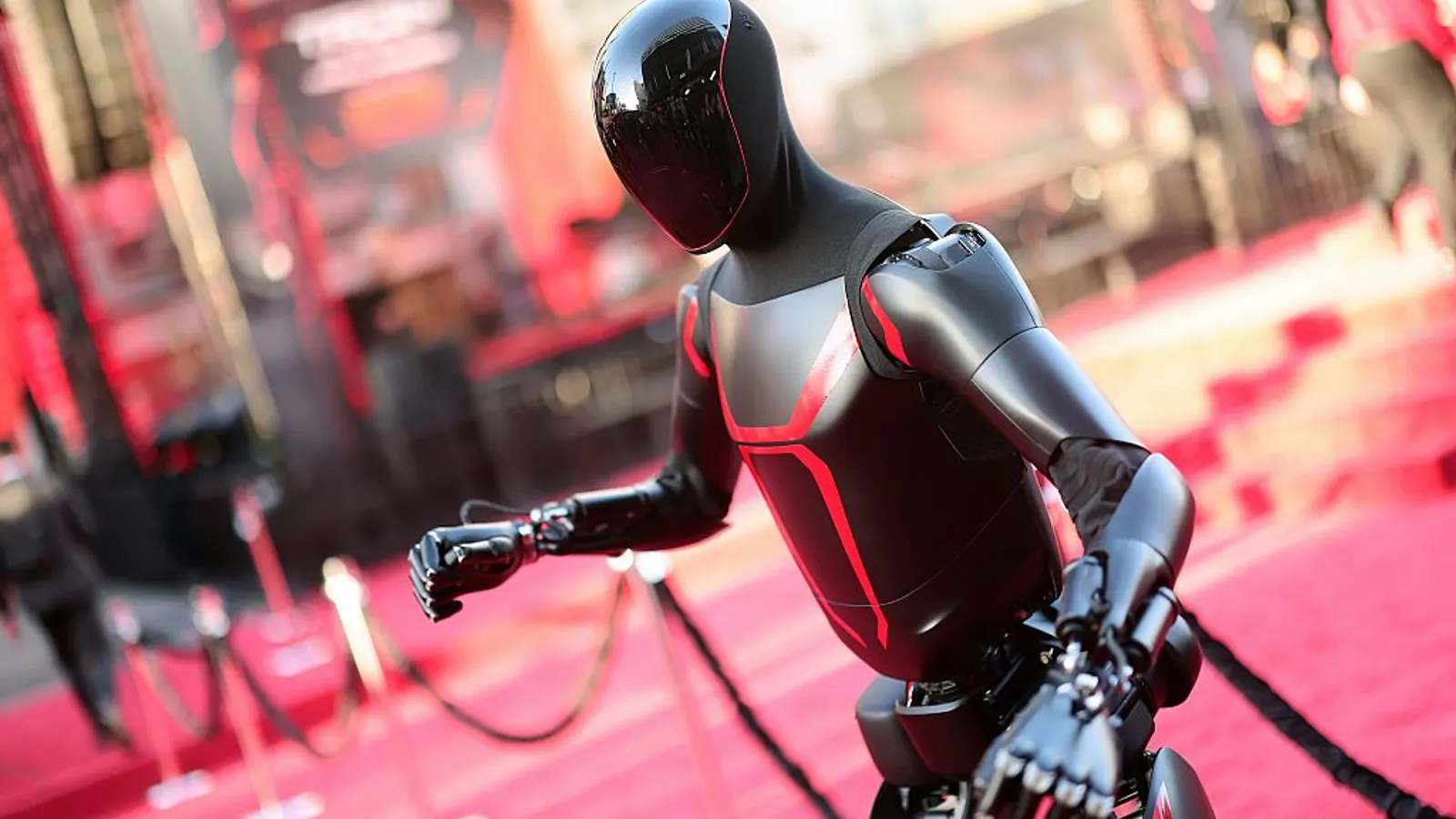


Tesla has started early production of its Optimus humanoid robot at its Fremont, California factory, CEO Elon Musk announced on a third quarter earnings call last week. Customer shipments, he said, could begin by late next year.
The automaker claims it has installed the “vast majority” of a robotics production line capable of churning out one million units annually. Reaching that rate, Musk conceded, would take “a year, maybe longer” as Tesla iterates through production design configurations.
A million humanoid robots a year. From a company that still struggles to hit consistent vehicle delivery targets.
The timing matters because Tesla is no longer alone in this race. Toyota announced plans to deploy 400,000 robots as part of a $6.4 billion annual investment push to automate its assembly lines. Toyota’s research division has built a foundational AI model for its in-house humanoid, awkwardly named ELEY, that learns factory tasks by watching human workers do them first.
Boston Dynamics, owned by Hyundai, just opened a robotics center in Savannah, Georgia, dedicated to testing and training its Atlas humanoids for deployment across Hyundai’s automotive plants. The company plans to expand into other industry sectors next year.
Three of the world’s largest automakers are now building humanoid robots. That is not a coincidence. It is a bet that the future of mobility companies extends well beyond vehicles.
Tesla’s core challenge is data. Its autonomous driving program feeds on billions of miles logged by customer vehicles. No such pipeline exists for Optimus. Musk acknowledged as much, saying the company needs to “bootstrap” the robot’s intelligence through self-play.
The plan is to build what Tesla calls an Optimus Academy, a training fleet of 10,000 to 20,000 robots that practice tasks and generate data to improve performance in a feedback loop. Musk compared the robot’s current developmental stage to that of a toddler. “Initially, they’re sort of wobbly and they don’t know how to do things,” he said.
Toyota’s approach is different. Rather than building a massive fleet to train itself, ELEY observes experienced factory workers and mimics their movements through its foundational model. Two philosophies, brute force versus observation, racing toward the same finish line.
Tesla’s next-generation AI5 chip, manufactured at its Terafab facility in Texas, will be integrated into Optimus by April. The chip promises substantially more onboard computing power, a necessity if the robot is going to operate on its own in unpredictable environments.
Early Optimus customers will use the robots for industrial work, handling dangerous or repetitive tasks. Home use, Musk said, comes later as production scales. He promised a marketing video in coming weeks showing the robot performing tasks that are not preprogrammed.
“I’d be stunned if anyone has a robot that is remotely competitive with Optimus when we start delivering it to customers,” he said.
The global humanoid market is still tiny. Nearly 7,000 humanoid robots were purchased last year, according to the International Federation of Robotics. Compare that to 603,000 total robots, including industrial arms, quadrupeds, and warehouse bots, added across all industries during the same period.
Seven thousand units in a market where Tesla is building a line for a million. Either Musk sees something the rest of the industry hasn’t caught up to yet, or that production line is going to sit very quiet for a very long time.
Share this Story