


The cheapest new Toyota Hilux in Thailand sits lower than the rest. At 599,000 baht, about $17,600, the rear-drive Hilux Travo Z Edition undercuts the high-riding version by 175,000 baht.
Toyota launched it alongside a race car.
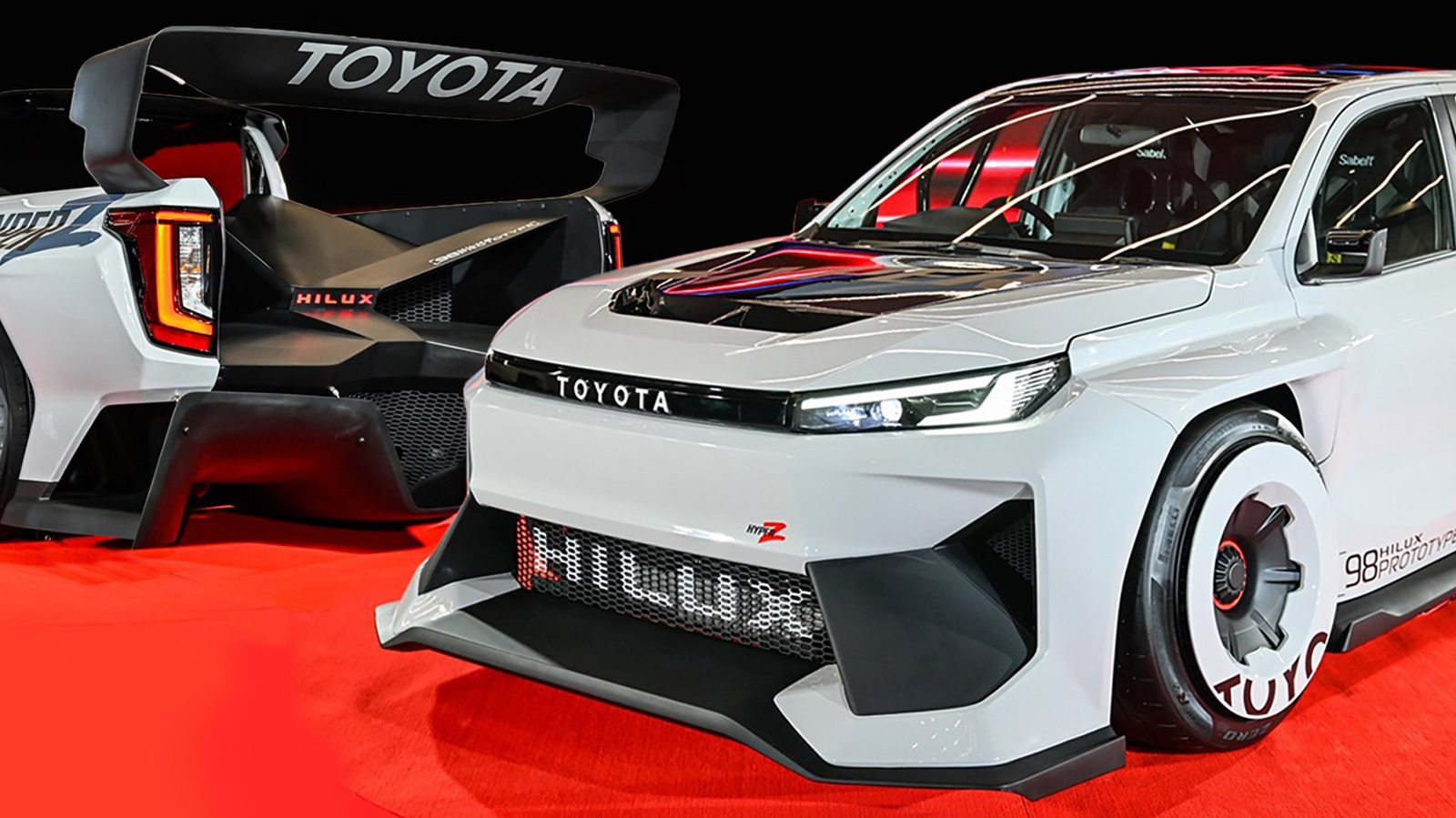
The Hilux Travo Hyper Z concept is a one-off, and it looks nothing like a ladder-frame workhorse. Toyota’s Australian design studio helped build it. The project started in 2024 and draws on Thailand’s street truck scene, where pickups get lowered, widened and polished rather than lifted and muddied.
Very little of the standard body survives. A new front bumper carries a big splitter and aggressive intakes. These flow into sculpted fender extensions that make the truck far wider than stock.
The rear wing looks like it came off a Formula 1 car. Below it sits a huge diffuser and a reworked bed with built-in vents and an illuminated Hilux emblem.
There’s a second spoiler on the roof, plus racing mirrors and aircraft-style fins on the rear overhang. The rear quarter windows have been reshaped to run into flying buttresses. White aero covers dress the wheels, which wear ultra-wide tires.
The hardware underneath is real. Photos show Öhlins remote-reservoir coilovers, Swift springs and upgraded suspension arms. The result is almost no ground clearance, wider tracks and negative camber up front.
Inside are Sabelt racing buckets with yellow belts, a three-spoke wheel, a Race Dash digital cluster and a roll cage.
What Toyota didn’t share was an engine spec. Nobody outside the company knows what powers the Hyper Z. A single tailpipe confirms combustion, and that’s it.
Toyota calls the concept mostly a styling exercise. It also says the truck could lead to motorsport projects and future accessories. That second part is where the money is.
The Z Edition is the one customers can actually buy. It gets lower ground clearance, a road-focused suspension tune, a front bumper extension, a body-colored rear bumper and special decals.
The wheels are 16 inches, and they look small under those wide fenders. The plastic arch cladding is gone, though Toyota will happily sell it back to you as an option.
Standard Cab, Smart Cab and Double Cab bodies carry over from the previous generation. The 2.4-liter turbodiesel makes 148 hp and pairs with a six-speed manual or automatic.
The 2.8-liter turbodiesel makes 201 hp. In the low-rider, it comes only with the manual and only as a Standard Cab. Every low-floor Travo is rear-wheel drive.
The pricing ladder says plenty. The low-riding Travo starts at $17,600, while the high-riding Prerunner, 4Trex and Overland trims start at $22,600. The fully electric Hilux Travo-e tops the range at 1,491,000 baht, roughly $43,700, more than double the entry truck.
Toyota knows Thai buyers keep spending after they drive off the lot. At the launch, it brought a row of modified Hilux trucks built with local shops, each one a parts catalog on wheels.
A white dual-cab ran a black hood and white alloys. A grey truck paired a tubular bed rack and front nudge bar with body-colored fender flares. A red single-cab wore a towering steel cage over the bed and bronze wheels.
A neon-green truck carried an aerodynamic box canopy on polished alloys. One lifted truck, with roof LEDs and chunky tires, broke up the low-slung lineup.
Toyota also showed renderings of a Hilux camper with an awning and a refrigerated box van for trade buyers.
The Hyper Z won’t be sold. The parts inspired by it might be.


Share this Story