
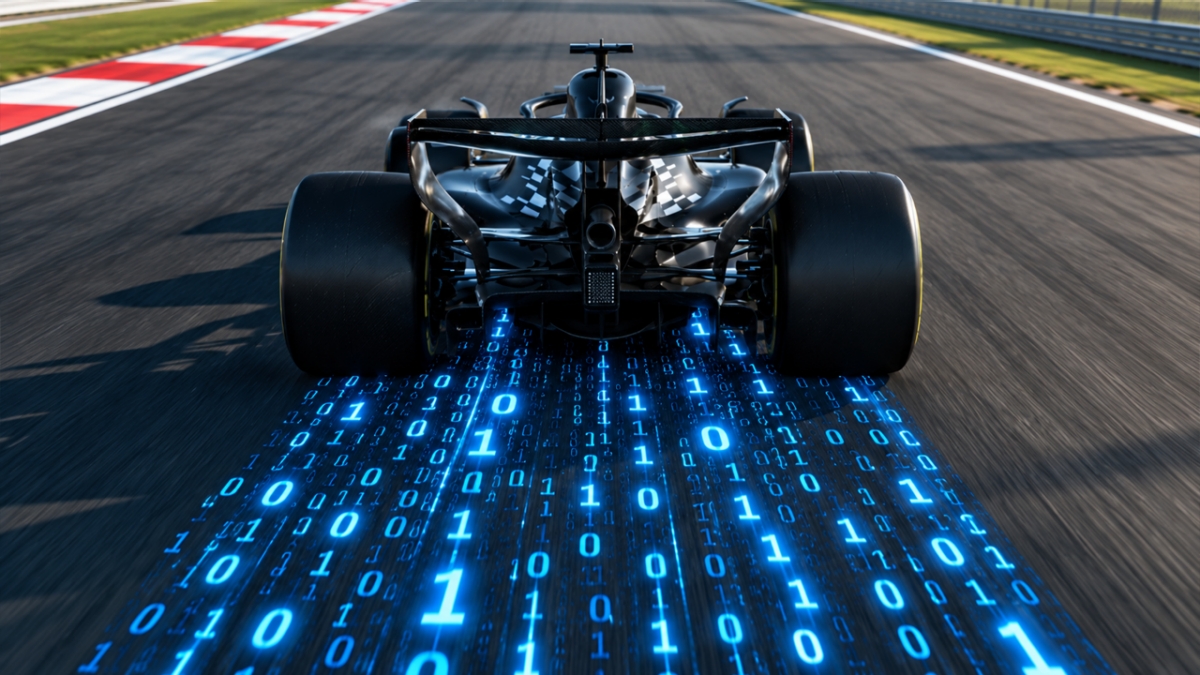


More than ten miles of wiring runs through the Cadillac Formula 1 Team MAC-26 race car. That is not a typo. Every inch of it exists to measure, record, and transmit data from a machine hurtling around a circuit at speeds that would liquefy most people’s concentration.
GM’s YouTube series “What Makes Fast” has pulled back the curtain on the data infrastructure connecting the Cadillac F1 operation across two continents in real time. Sensors embedded throughout the car track engine power output, tire pressures, aerodynamic airflow, and directional changes down to the millisecond. That torrent of information flows simultaneously to engineers trackside, at the team’s base in Silverstone, England, and at GM’s motorsports facility in Charlotte, North Carolina.
The scale of the operation tells you something about where F1 competition actually lives now. It is not just in the driver’s hands or even in the garage. It lives in server rooms and simulator bays thousands of miles from the starting grid.
Charlotte houses GM’s “Driver In Loop” simulator, which ingests real race data to let drivers and engineers rehearse for upcoming events with a fidelity that older generation teams could not have imagined. The feedback loop is continuous: race data shapes simulator sessions, simulator findings shape car setup, and the whole cycle repeats every race weekend.
Ryan Tincher, IT Operations Manager at GM Motorsports, does not sugarcoat the pressure. “It’s definitely a weight on our shoulders,” he said. “But it’s not anything the team shies away from. It’s part of what brings everybody back every weekend.”
That kind of understatement is standard issue in motorsport IT circles, where a dropped data packet or a lag in telemetry relay can cost a team the difference between a podium finish and midfield anonymity. In modern F1, the pitwall’s ability to read live data and call real-time strategy adjustments is as decisive as tire compound selection or aerodynamic philosophy.
For GM and Cadillac, the messaging here is deliberate. This is an American manufacturer entering F1 not just with a name on the car but with a deeply embedded engineering operation spanning two countries. Silverstone gives them proximity to the European racing calendar and the F1 talent pool. Charlotte connects them to GM’s broader engineering and simulation resources.
The 11th team on the F1 grid has spent years building toward this moment, and the infrastructure story is the one they clearly want told. Horsepower and downforce make for better television. But the teams that win championships over sustained periods are the ones that process information faster and act on it more decisively than their rivals.
Ten miles of wiring is a vivid number. It is also a proxy for something harder to quantify: the sheer organizational commitment required to compete at the front of a sport where ten established teams have spent decades refining exactly this kind of capability. Red Bull, Mercedes, McLaren, and Ferrari did not build their data operations overnight.
Cadillac is betting that GM’s engineering depth, its simulation technology, and its ability to run a transatlantic operation in real time can compress that timeline. Every sensor in the MAC-26 is collecting evidence that will either validate or challenge that bet, one millisecond at a time.



Share this Story