
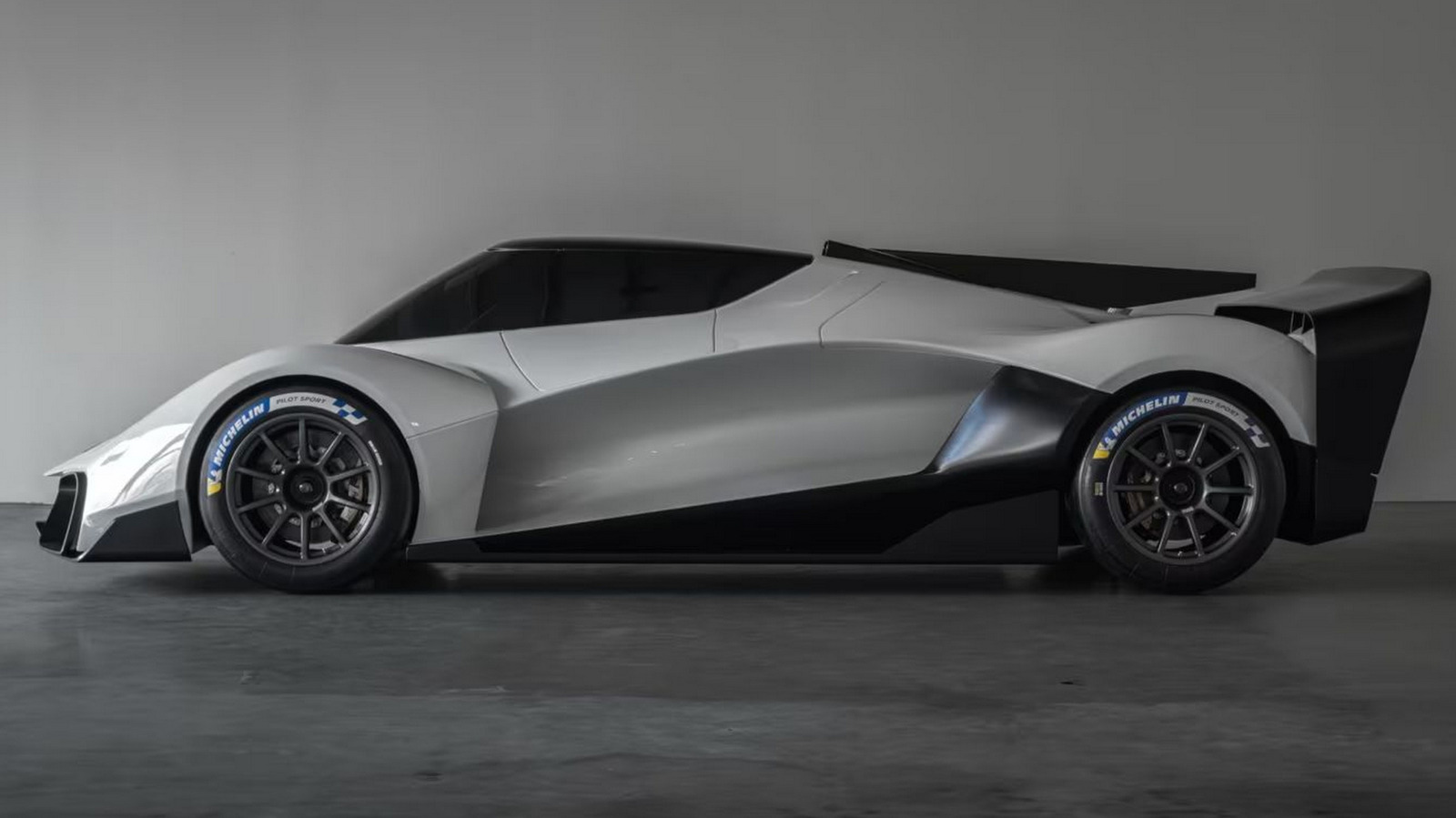


The driver of the Sanrivatti One does not sit. They straddle a seat, lie on their chest, and reach forward for the wheel like a rider tucked behind the screen of a superbike.
That is the pitch from Dutch newcomer Sanrivatti, which has released the first images and details of its debut supercar. Strip away the posture, and the rest of the spec sheet reads like a familiar wish list.
Founder Santiago Sánchez says he wanted to give drivers the connection a motorcyclist feels with a bike. His answer was to throw out the cabin entirely.
The One is a single-seater built strictly for the track. Freed from road car regulations, Sanrivatti could rethink how a person operates a car, and it chose to put that person head-first and prone.
The idea is not new. Chevrolet and McLaren both explored similar layouts with their Vision Gran Turismo concepts, cars that lived on a PlayStation and never had to survive a crash test, a customer, or a balance sheet.
What Sanrivatti claims is new is the intent to actually build one. No proposed production car has pushed the concept this far.
The engine is where the radicalism stops. Sanrivatti says the One will use a naturally aspirated 5.5-liter V10 from British racing specialist Judd.
Judd’s résumé is legitimate. The firm built the 5.2-liter V10 that screams inside the limited-run McLaren Solus GT, another track-only single-seater aimed at buyers with deep pockets and private circuit time.
In the One, the larger Judd unit is expected to make around 800 horsepower and 516 lb-ft of torque. Power goes to the rear wheels through a Hewland six-speed sequential gearbox, motorsport hardware through and through.
Sanrivatti targets a dry weight of 2,425 lbs (1,100 kg) and quotes a top speed of 205 mph (330 kph). It offers no acceleration figures.
For an 800-horsepower car weighing about as much as a compact hatchback, that silence stands out. Either the numbers aren’t ready, or nobody has driven it hard enough to get them.
The body follows the boutique exotic playbook: low nose, aggressive aero, a prototype-style shark fin, a huge rear wing, and a deep diffuser. It looks the part, which is the easy part.
The hard part is everything after the reveal. Sanrivatti has shown images and a full-scale model, but not a running car, a price, a production timeline, or a list of backers.
This business has a long memory of small firms that arrived with wild renderings and bold numbers, then quietly vanished. Building a conventional supercar is brutal enough.
Building one that asks a driver to lap a circuit at 200 mph lying face down piles on engineering, safety, and ergonomic problems nobody has solved at production scale. Think about crash structures, head support under braking, and how a marshal extracts a driver from a car they entered chest first.
Sanrivatti will need serious money to get the One onto a grid of customer track days. It will also need buyers willing to trust a startup with their ribs, their neck, and their seven-figure deposit.
So far, Sanrivatti has not said how many it plans to build, or who has already signed up to try.


Share this Story