
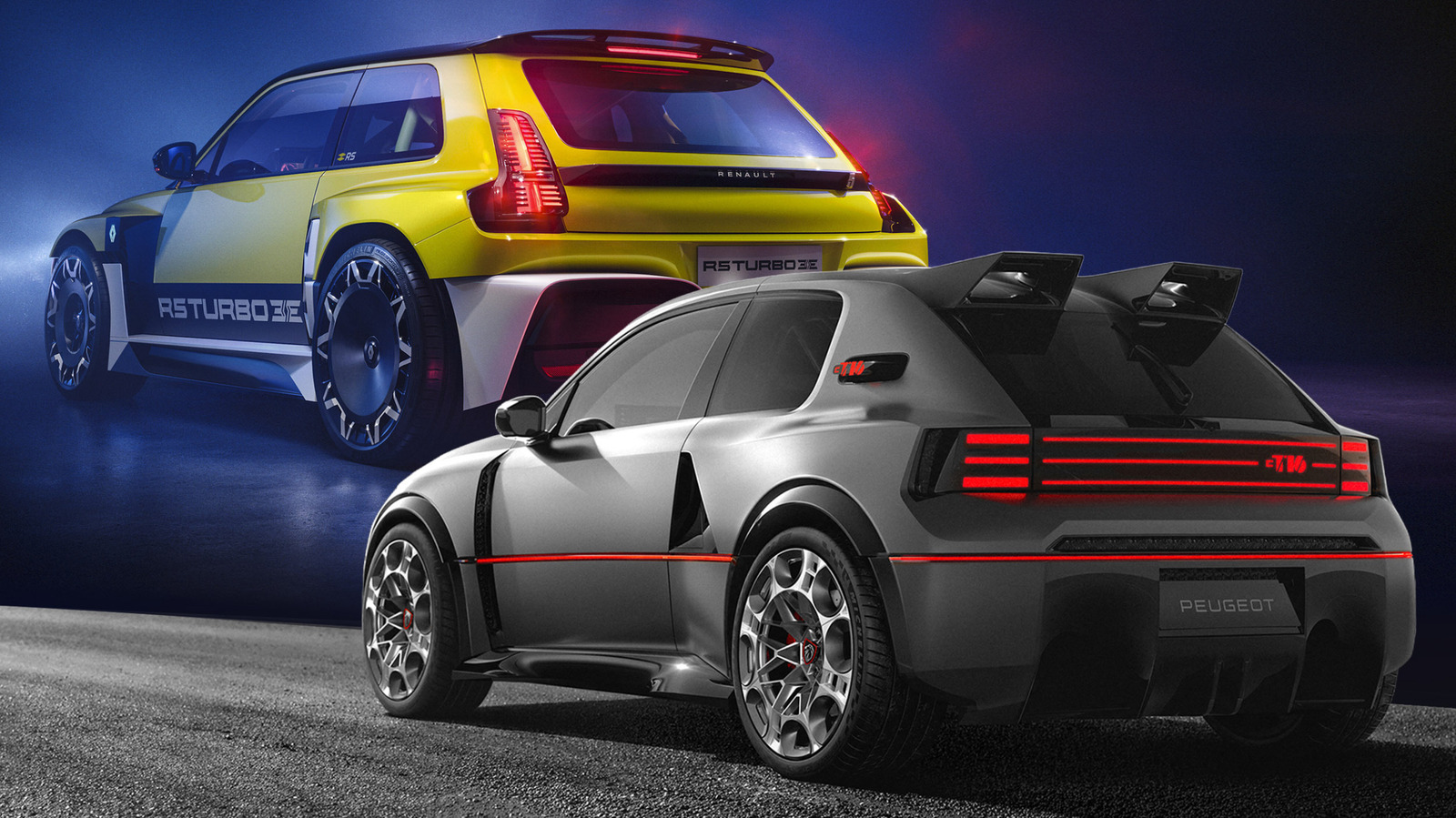


Renault will sell you a Group B revival for €160,000. Peugeot will only show you one.
That’s the gap between the Renault 5 Turbo 3E and the Peugeot e-T16, two electric hyper hatchbacks chasing the ghosts of the R5 Maxi Turbo and the 205 T16. On paper, the Peugeot wins almost every fight. On the road, only one of them has a delivery date.
The Renault took the long way here. It appeared as a retro concept in 2022 and became a 1,980-unit production car in 2025, with orders open across Europe, the UK, the Middle East, Japan and Australia. First customers get their keys in 2027.
The Peugeot debuted as a concept in 2026. Its CEO says it could reach production as early as 2027. Could.
Look at the hardware and the Peugeot’s case gets loud. Three electric motors, 816 hp, all-wheel drive, 0 to 100 km/h in 2.5 seconds. Peugeot also claims its 85 kWh battery will survive three consecutive laps of the Nürburgring.
The Renault answers with 555 hp from two motors, rear-wheel drive like the original, and a sub-3.5-second sprint. That’s a full second slower. On a spec sheet, it reads like a loss.
Then you check the scales. Renault quotes 1,450 kg on a bespoke aluminum tubular chassis developed by Alpine, with a floor-mounted 70 kWh battery and a 43/57 weight split that mimics the mid-engine original.
Peugeot hasn’t published a curb weight. It quotes a power-to-weight ratio under 2 kg per horsepower, which caps the car at roughly 1,632 kg. That’s a ceiling, not a figure, and the gap leans toward the Renault either way.
The platforms tell the rest. Renault went bespoke. Peugeot built the e-T16 on Stellantis’ new STLA One global architecture, and the car doubles as a heavily disguised preview of the next 208, due in 2027.
The three-slot LED graphics front and rear are flagged as a signature for future Peugeots. The Hypersquare steering wheel with its integrated display is pure showroom theater. This is a homage with a marketing job on the side.
None of that makes it a bad idea. The 205 T16 itself existed to sell 205s.
The cabins share more than either brand might like to admit. Both get two seats, deep bolstered buckets, painted roll cages, and a vertical hydraulic handbrake for flicking the tail into hairpins. Both keep three doors when every production supermini has moved to five.
The Renault gets a conventional wheel, a digital cockpit lifted from the R5 E-Tech, and an actual boot. The Peugeot’s entire rear bodywork tilts open to expose motors and suspension. It’s a great party trick that may not survive the trip to production.
Charging is a draw. Both claim roughly 15 minutes on the right charger, Renault from 15 to 80 percent, Peugeot from 10 to 80.
Styling splits on philosophy. The Renault reads as the old Maxi Turbo dragged forward, with 20-inch wheels and fender flares intact. The Peugeot runs 21-inch wheels with wider rubber at the rear, and treats the 205’s greenhouse, red stripes and boxy taillights as references rather than a template.
Nobody has driven them back to back. Nobody can yet.
Renault has a price, a production run, a weight and a delivery window. Peugeot has 816 hp, a CEO’s projection, and a car that still won’t say what it weighs.
Share this Story