
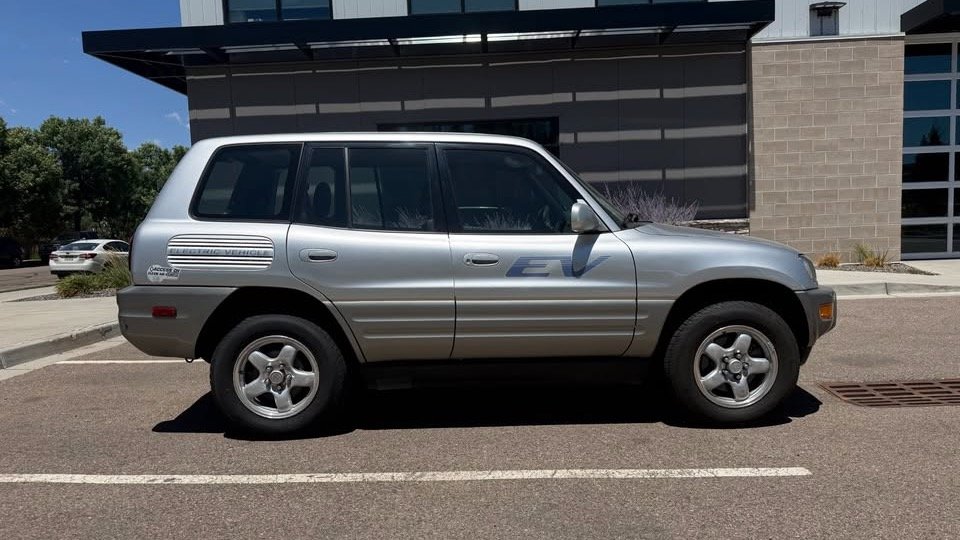


Two thousand dollars. That is the asking price for a 2002 Toyota RAV4 EV in Fort Collins, Colorado, still running on the battery pack it left the factory with.
The listing surfaced in the Obscure Cars For Sale Facebook group. The seller calls it a project car and tells anyone interested to bring a trailer.
Fair enough. The battery is more than two decades old.
But it runs and it drives. According to the seller, every EV-specific component works, and so does everything Toyota borrowed from the gasoline RAV4.
That last part, the seller shrugs, is “kind of expected for a ’90s RAV4.” The electric part is the story.
The cosmetics are rough. “Pretty much every body panel” carries a dent, ding, or scratch, per the listing. The seller says it has never been crashed, has no structural damage, and still wears its original stickers.
Some compromises have crept in. The tires, fitted in August 2024, come from the gasoline RAV4 because EV-spec rubber is no longer made. The windshield may not be the original heated unit, and it has a rock chip.
Under the floor sits a 27.4-kWh nickel-metal-hydride pack, rated by the EPA for 95 miles of range. The chemistry is close to what Toyota used in its hybrids until recently.
That is 95 miles from a model Toyota put on sale in 1997.
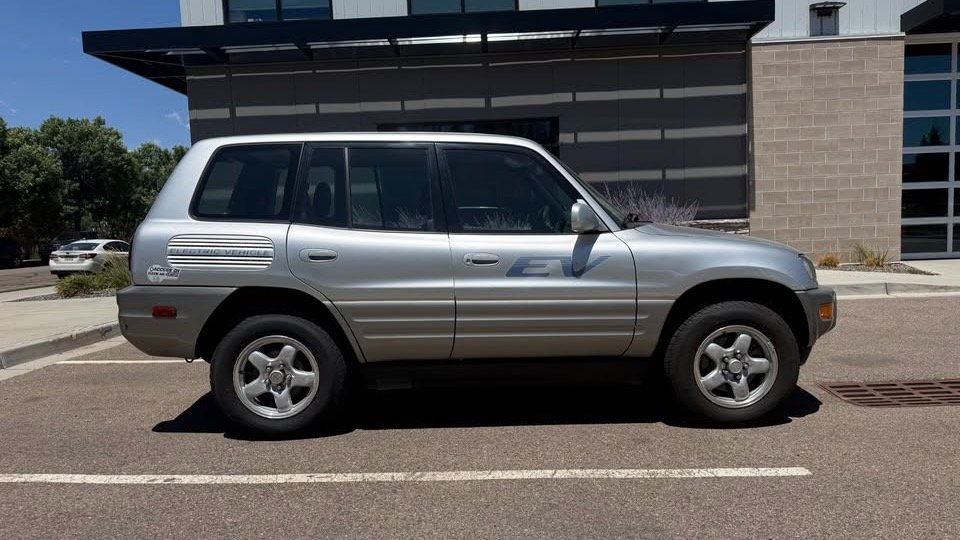
The RAV4 EV exists because California forced it into existence. The state’s zero-emission vehicle mandate in the 1990s pushed the biggest automakers to build small batches of electric cars and trucks.
Most of them have been forgotten. Forgotten is not the same as gone.
For most of the RAV4 EV’s life, only fleets could get one. Retail sales opened shortly before production ended in 2003, and just 328 reached private owners.
Charging is a period piece. The first-generation RAV4 EV uses the MagneCharger, the same paddle system found on the GM EV1. You slide a paddle into a slot instead of plugging in a cord.
The sale includes two MagneChargers wired to NEMA 14-50 plugs, and the seller says the car’s onboard charging hardware works. Paddle chargers are nearly impossible to find today. For a car this rare, they may be worth more than the sheet metal.
Then Toyota’s electric story takes a turn.
A second-generation RAV4 EV arrived in 2012, built on the third-generation gasoline RAV4 and powered by Tesla components. Toyota held a small stake in Tesla at the time. A short run of Scion iQ EVs followed.
After that, Toyota bet on hydrogen fuel cells to satisfy California’s mandate. Battery EVs went to the back of the shelf.
So the company that sold 95-mile electric crossovers to the public in 2003 spent the following years chasing a different fuel. Meanwhile, the Tesla Roadster and Nissan Leaf wrote what most people now call the first chapter of the modern EV age.
The RAV4 EV became the preface nobody reads.
Only now is Toyota building EVs to sit alongside its bestselling hybrids. This little crossover, with its hybrid-style nickel-metal-hydride pack, hinted at that pairing more than 20 years ago.
The proof is still parked in Fort Collins, dented and stickered, waiting for someone with $2,000 and a trailer.
Share this Story