
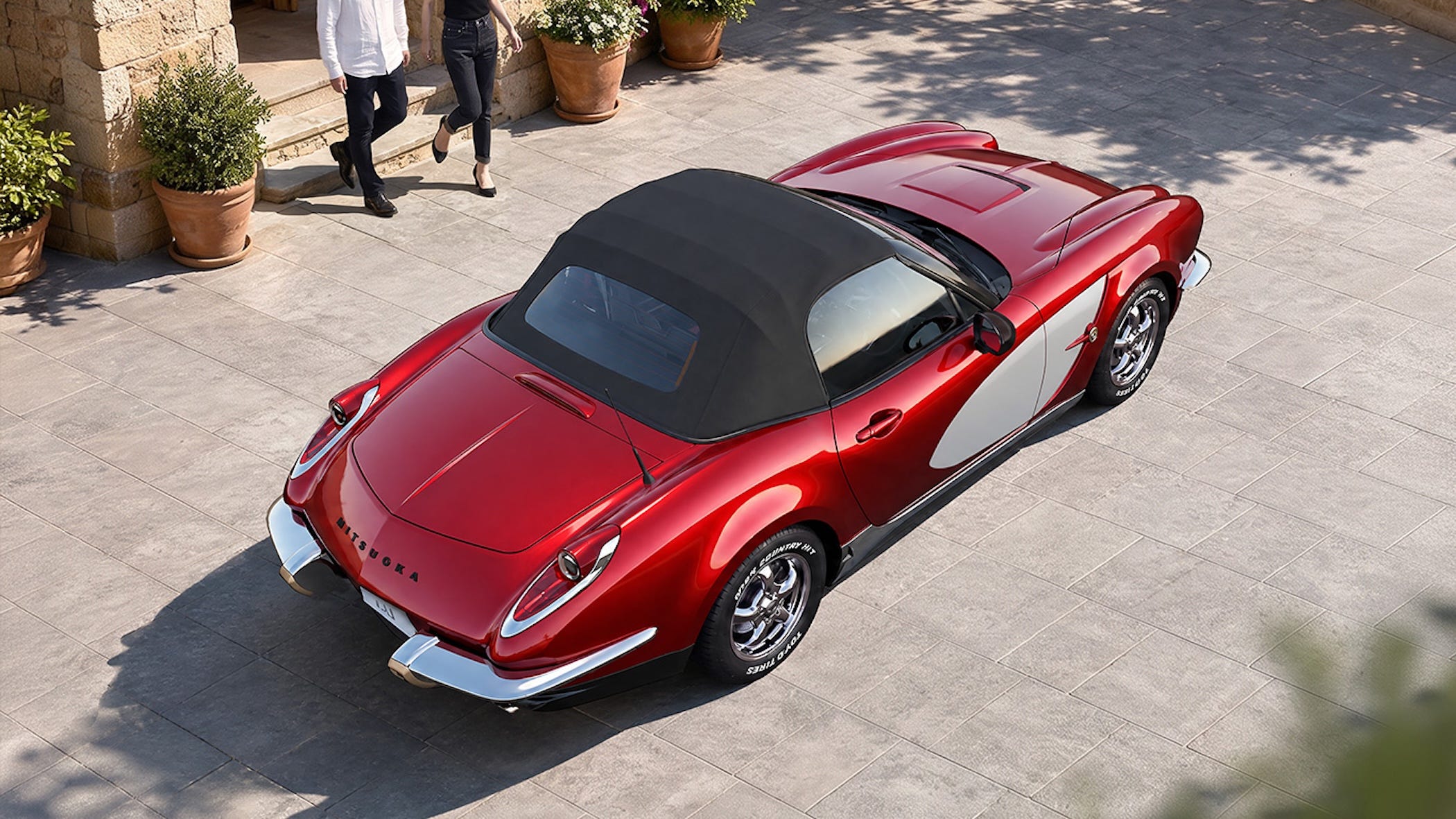


Mitsuoka Motors has done it again. The small Japanese coachbuilder just teased the LA1, what appears to be a current-generation Mazda Miata wearing a body shaped like a 1953 Chevrolet Corvette. The full reveal is set for November 26, but the early images tell you everything you need to know about Mitsuoka’s obsession with shrinking American muscle into Japanese sports cars.
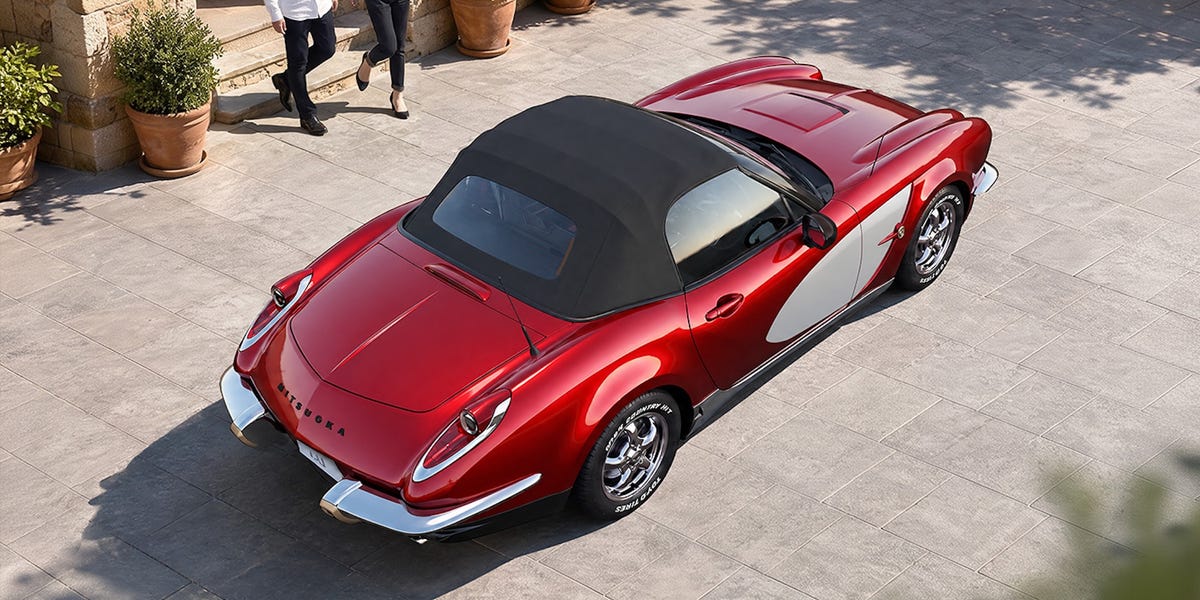
The LA1 is not a faithful replica. It borrows the C1 Corvette’s rounded haunches and long-hood proportions but takes liberties where it counts. Quad headlights replace the original’s dual setup.
Chrome bumpers frame a busier front end. The overall effect is a car that looks like a C1 left in the dryer too long, which is exactly the kind of oddball charm Mitsuoka has been selling for decades.
If the donor car is indeed the current ND Miata, and every visual cue suggests it is, the LA1 sits on one of the best chassis money can buy under $40,000. The Miata’s hydraulic steering, willing Skyactiv engine, and sub-2,400-pound curb weight would give this little faux-Vette something the original C1 never really had: genuinely sharp handling. The 1953 Corvette was a looker with a wheezy inline-six and a two-speed Powerglide.
Chevy didn’t sort it out until the V-8 arrived in 1955. The Miata, by contrast, came sorted from the factory in 1989 and has never lost the plot.
Mitsuoka’s portfolio reads like a fever dream of American nostalgia filtered through Japanese engineering. The Rock Star, still in production, grafts C2 Corvette Stingray lines onto the same Miata platform. The Buddy takes a Toyota RAV4 and gives it the face of a 1970s Chevrolet K5 Blazer for roughly $45,000.
In 2023, the brand showed the M55 concept, a Honda Civic hatchback reskinned to look like a 1970s Dodge Charger. That one apparently stayed a concept. The LA1, based on what Mitsuoka has released so far, is heading to production.
Pricing has not been announced, but Mitsuoka’s track record suggests it will not be cheap relative to the base car. The Rock Star commands a premium over a standard Miata, and waitlists stretch into years. Mitsuoka builds these cars by hand in Toyama, Japan, and production volume is tiny.
The company is not trying to compete with Mazda on price. It is selling something Mazda does not offer: a cosmetic fantasy bolted to a mechanically sound platform.
Whether any of this makes sense from a value proposition is almost beside the point. Nobody cross-shops a Mitsuoka against a Miata the way you would compare a Camry to an Accord. These cars exist for buyers who want to drive something that stops traffic and starts conversations, preferably at the same time.
The bigger question hovering over the LA1 is how long the Miata itself will survive as a donor. Mazda has confirmed a next-generation MX-5 is coming, likely as a 2027 model, and the platform underneath it may change in ways that make Mitsuoka’s rebodying work more complicated or more expensive. Every coachbuilder’s business model depends on a stable, affordable donor car.
If the next Miata goes hybrid or grows in size, Mitsuoka’s math changes. For now, Mitsuoka keeps finding new ways to prove that the Miata is the most versatile canvas in the car business. November 26 should fill in the blanks on power, weight, and price.

Share this Story