


Mercedes-Benz did not hold a press conference to announce its exit from European EV charging. It buried the news in its third-quarter financial report.
The automaker has sold its entire European fast-charging network to French operator Electra. The assets were valued at €99 million ($111 million), according to Electrive, which first reported the sale.
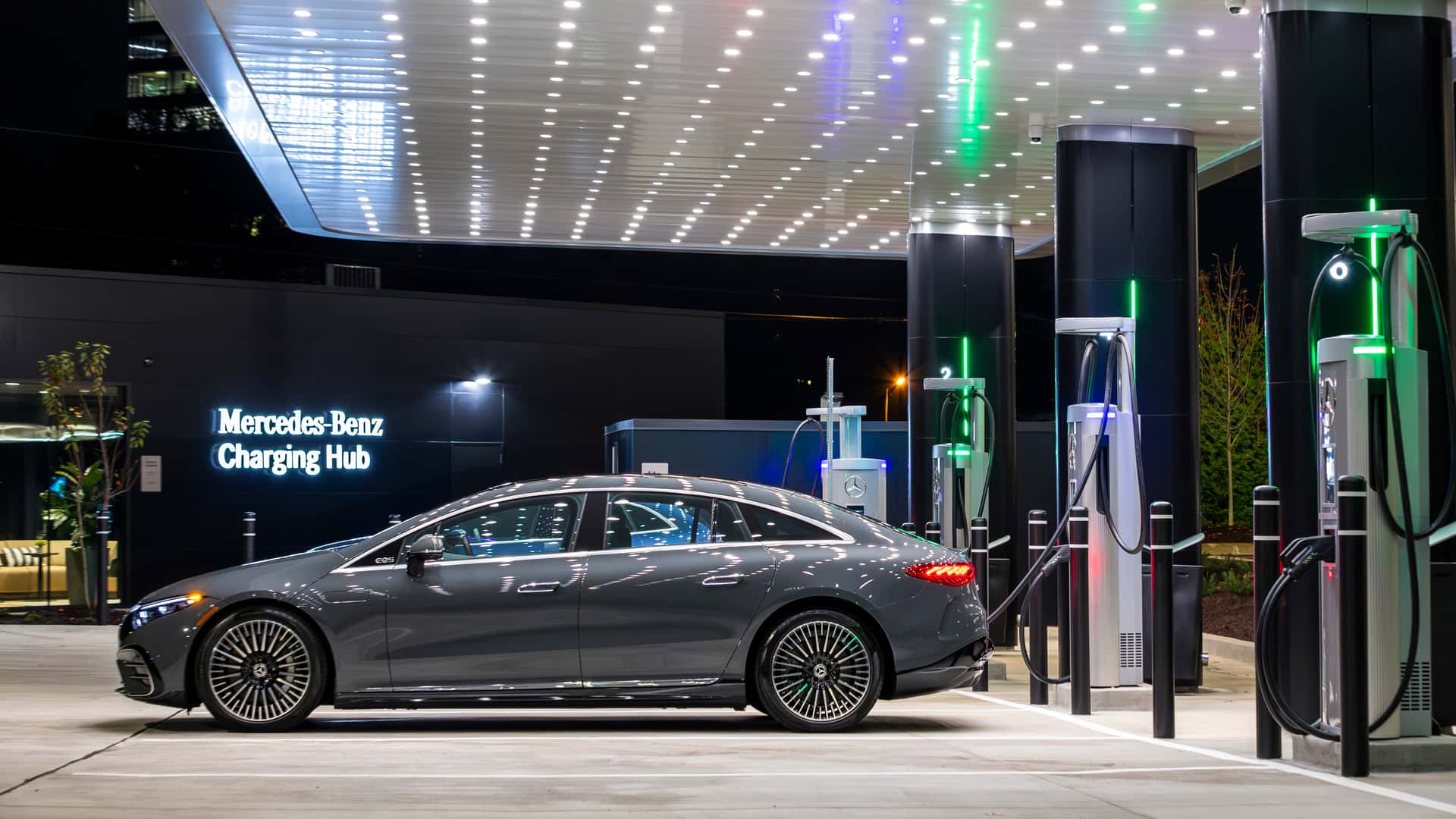
The numbers show how small this operation stayed. The Mercedes-Benz Charging Network in Europe had 374 fast-charging ports at 47 locations. Every one of them now belongs to Electra.
That footprint looks thin next to the ambition Mercedes attached to it. The network launched just three years ago with a goal of more than 10,000 fast chargers worldwide by the end of the decade.
Mercedes did not cut corners on hardware. It used Alpitronic equipment, with most sites running 400-kilowatt dispensers. Earlier this year, the first stalls capable of 1,000 kilowatts went into charging parks in Europe and North America.
So the brand built premium stations and put its name on them. Then it handed them off before reaching even a fraction of its target in the region.
The handover is already underway. This past weekend, the former Mercedes stalls were folded into Electra’s network. Card terminals will be swapped out soon, and the three-pointed star will give way to Electra’s branding.
Mercedes is calling the deal a partnership, not a retreat. Electra now holds “Premium Partner” status, second only to Ionity, the joint venture Mercedes already co-owns.
Mercedes EV drivers get discounted rates at more than 5,000 Electra chargers across 800 locations in several European countries. That is a far bigger pool than the 374 ports Mercedes ran on its own.
Electra is blunter about what happened. Paul Tonini, the company’s general manager for Germany, told Electrive that the market is consolidating around larger providers.
His point was simple arithmetic. Small operators struggle to keep their finances in check, and bigger networks earn more. A 47-site network, however well equipped, sits on the wrong side of that equation.
Mercedes now relies entirely on third-party operators for charging in Europe. It is no longer spending its own money on a branded premium experience there. It is renting access to someone else’s.
North America is a different story, at least for now. The European sale does not touch the company’s High-Power Charging business in the United States.
According to the Department of Energy’s Alternative Fuels Data Center, the U.S. network has 748 ports at 80 locations. Another 62 ports at eight stations operate in Canada.
That makes the North American operation roughly twice the size of the European network Mercedes just sold. It also means those stations now carry the full weight of the 10,000-charger promise.
Mercedes has not said what the European exit means for that global target or its North American plans.
For European owners, the immediate change is cosmetic. The same Alpitronic stalls will sit in the same parking lots next week. Only the name on the canopy, and the company collecting the money, will be different.
Mercedes says it plans to expand partnerships with other third-party providers. Its drivers will get discounted rates across more than one network. None of them will be its own.


Share this Story