
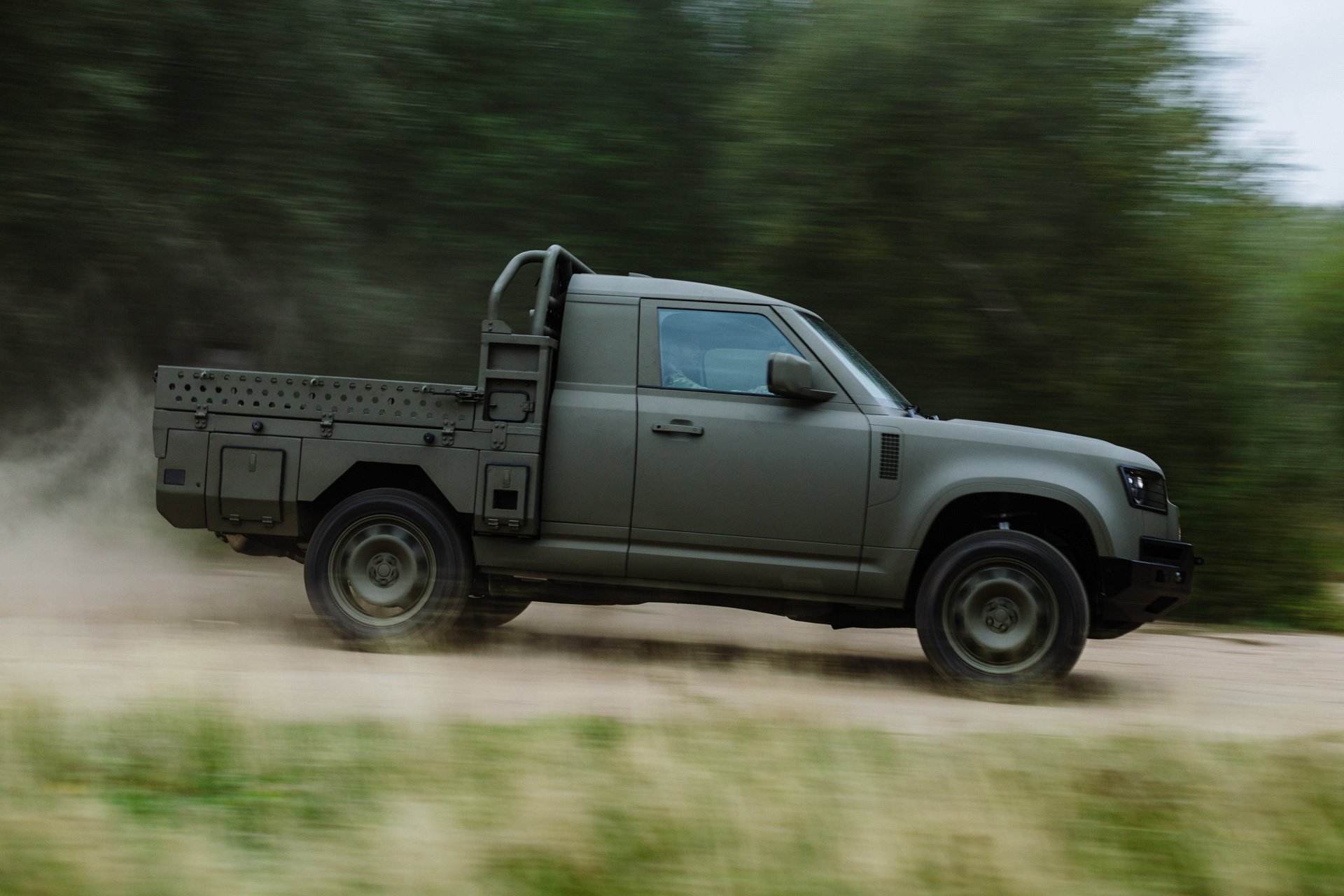


The body-on-frame Defender that armies loved died years ago. Now Land Rover wants back in the fight, this time with a unibody luxury SUV re-engineered for war.
JLR rolled out its new Defender Wolf Series II at DVD2026, the UK’s major defense industry exhibition, marking the first officially mil-spec Defenders since the original boxy trucks disappeared from military fleets. Three variants were on display: a Tactical Mobility Vehicle, a Mono-Tactical Mobility Vehicle, and a Utility Vehicle. One looks like a stripped-down dune buggy with cage doors. Another is a single-cab pickup with a flat utility bed. Some appeared to carry turret mounts.
The tension here is obvious. The old Defender was a tool. Farmers beat them, militaries abused them, and they kept running because they were simple, body-on-frame trucks with nothing precious about them.
The new Defender is a $55,000-plus luxury SUV with a monocoque chassis, air suspension, and a touchscreen the size of a laptop. Turning that back into something a soldier would trust with their life is not a trivial exercise.
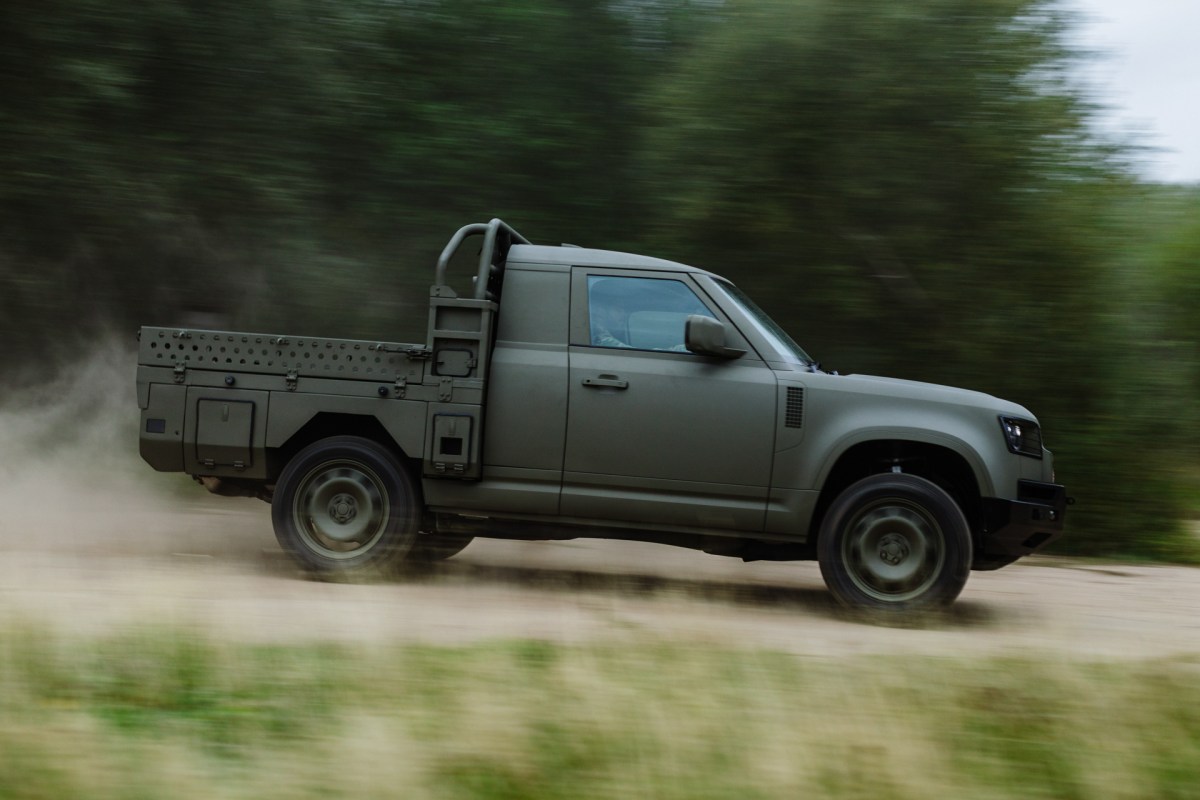
JLR is leaning into the monocoque construction rather than apologizing for it. The company claims the D7x platform “creates a stiffer body structure to tackle the harshest of environments and increased payload capacity over prior ladder-on-frame technology.” That is a bold claim, and one that militaries will test far more aggressively than any journalist ever could.
Specific powertrain and payload numbers have not been released. JLR says there is flexibility depending on how the vehicles are configured for individual buyers.
The company has created an entirely new division to handle this business. The Defender Defence Division exists specifically to sell military vehicles to NATO defense organizations. JLR’s pitch emphasizes sovereign capability and end-to-end engineering control, meaning no third-party converts a civilian Defender into a military one. The whole thing is done in-house.
That distinction matters. Historically, companies like Jankel have taken civilian trucks and armored or militarized them after the fact. JLR is cutting out the middleman and positioning itself as the sole source, backed by its global supply chain. Whether NATO procurement offices care about that branding exercise or just want trucks that work remains to be seen.
The original Defender Wolf served the British military for decades because it was cheap, fixable, and nearly indestructible. A monocoque platform with integrated electronics and complex suspension systems is none of those things. Modern military vehicles do carry far more technology than their predecessors, and the argument for a more sophisticated platform is not without merit. But sophistication has never been what made a Defender useful to armies.
Pricing has not been disclosed, which is standard for military contracts. JLR calls these “the first of many variants,” suggesting a broader family of vehicles is coming. The pickup variant, with its flat utility tray bed, practically begs for a civilian version, though JLR has not hinted at one.
The real test will not happen at a trade show in Warwickshire. It will happen when a 22-year-old private puts one of these through conditions no engineer would sanction, in terrain no test track replicates, with maintenance intervals that exist only in theory. That is where every military vehicle earns or loses its reputation, and where the gap between the old Defender and the new one will either close or crack wide open.

Share this Story