
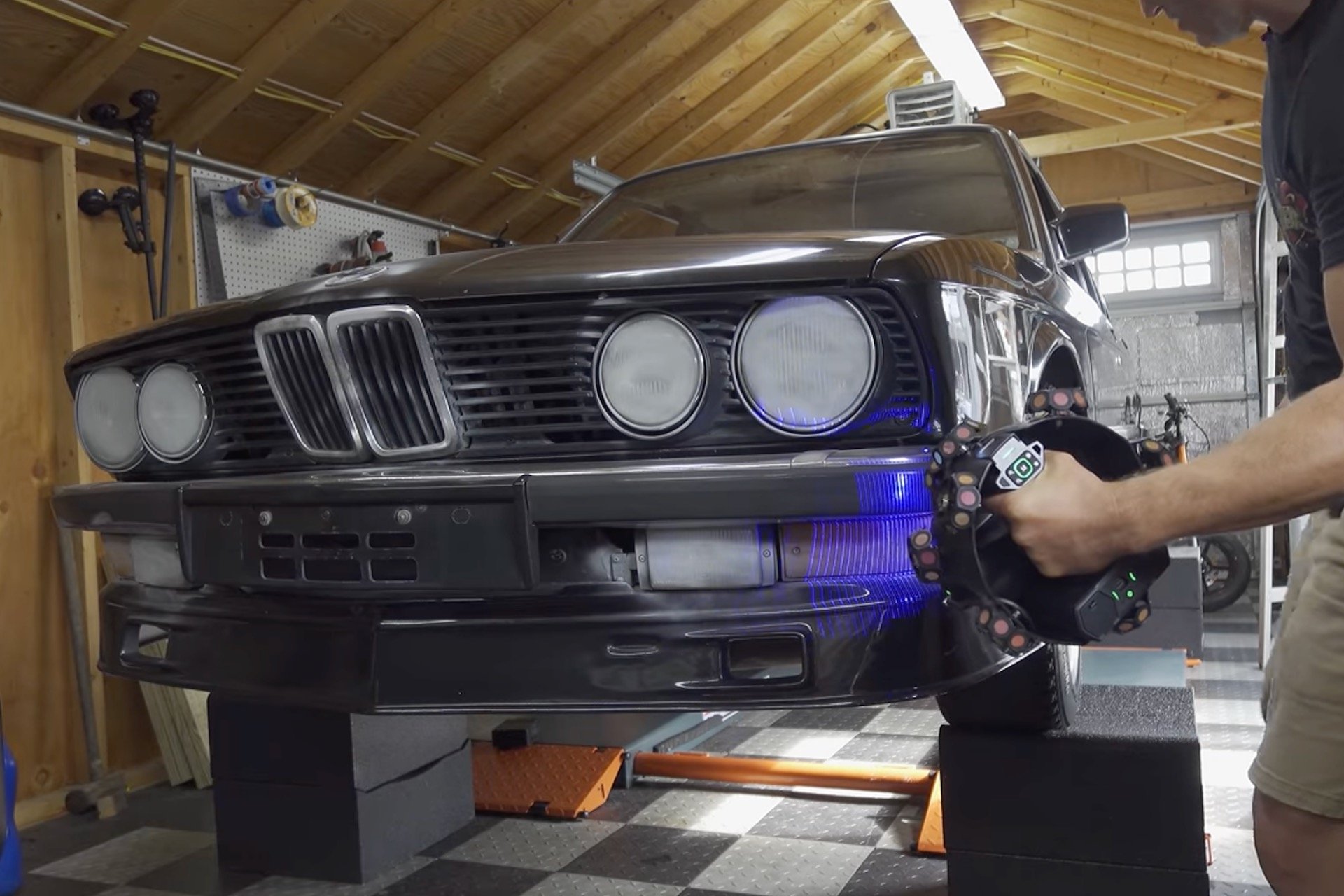


John Volk scanned an entire BMW E28 518i from bumper to bumper. The car makes fewer than 100 horsepower. He needed an exhaust.
That ratio of effort to output is either madness or the future of garage fabrication, and the line between those two things has never been thinner. Volk, who runs the YouTube channel Couch Builds, used an Einscan Trak 3D scanner to digitally capture every surface of a European-market E28 powered by a 1.8-liter M10 inline-four so anemic it was never sold in the United States. The old exhaust had rusted out, he needed a new stainless steel system, so he scanned the whole car.
Only the underside mattered for the exhaust fabrication, and Volk admits as much. But the project doubled as a test bed for the Trak 3D scanner and a demonstration of scanning techniques for his audience. The result is a remarkably detailed digital twin of one of the least exciting BMWs ever made.
The Trak 3D uses a stationary tracking bar that communicates via WiFi with a handheld unit Volk waves over surfaces in a spray-paint motion. The thing looks like a prop from a low-budget sci-fi film, bristling with sensors that capture images at user-adjustable resolution levels. For tighter, more complex geometry, you crank up the detail. For flat panels, you dial it back and move faster.
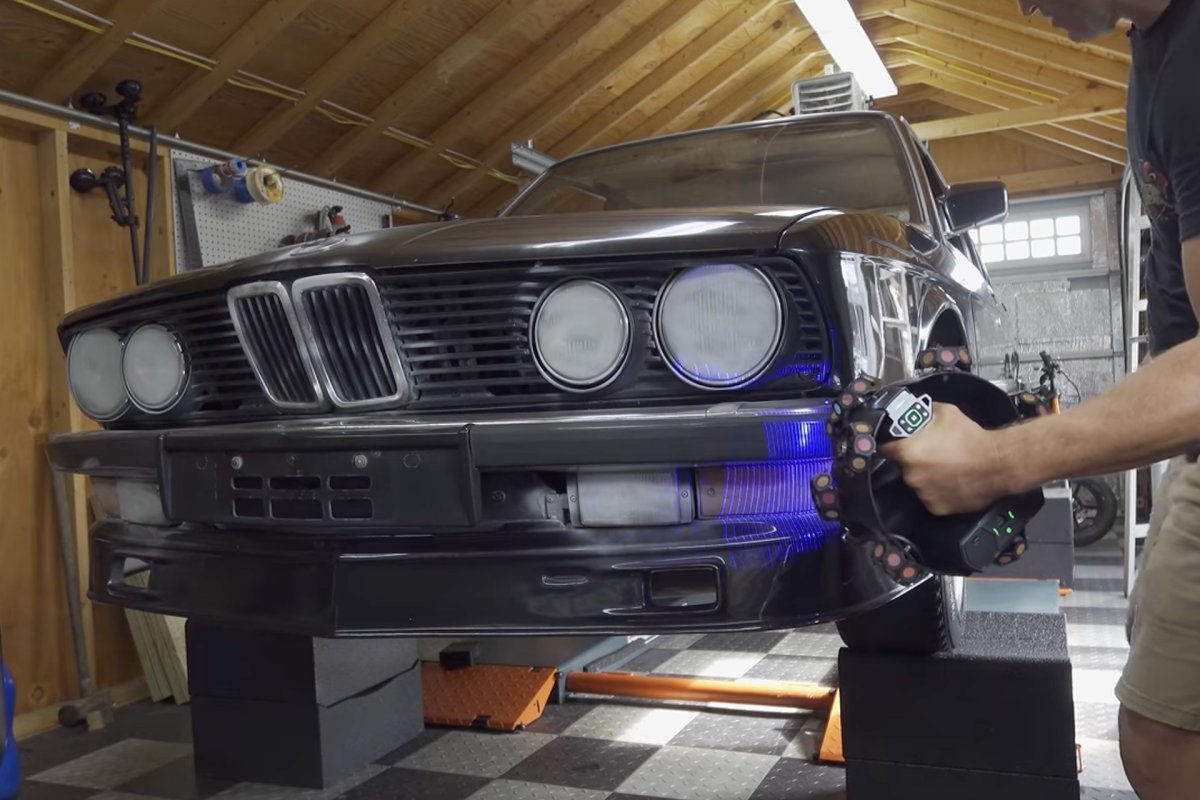
Volk also ran comparison passes with a simpler Einscan Rigil, a compact handheld device closer in size to a barcode reader. The Trak 3D requires less precision from the operator but more physical space, which became a problem in his small garage. The E28 pushed the scanner’s range limits, forcing him to composite multiple captures in software to stitch together a complete model.
Here is where the real story sits. Ten years ago, building a custom exhaust for an obscure European-spec sedan meant crawling underneath with a tape measure, maybe making cardboard templates, and hoping your bends came out right. Now you wave a sensor wand over the car, pull the geometry into software, and design the system on screen before cutting a single piece of stainless.
Volk is no amateur. He built a reputation in the BMW community fabricating turbo exhaust manifolds and once stuffed a 13B rotary engine into a BMW i8. He compares 3D scanners to welders in the video’s introduction, noting that competence with the tool doesn’t eliminate the learning curve on each new job.
The E28 518i is about the least glamorous canvas imaginable for this kind of work. That is precisely the point. The technology is no longer reserved for six-figure restorations or motorsport programs.
It scales down to a sub-100-horsepower commuter sedan with a rotted exhaust, sitting in a cramped garage, operated by one person with a WiFi-connected scanner and a laptop. Whether more hobbyists actually adopt these tools or just watch videos about them remains an open question. The hardware is available, the software is capable, and the only thing missing is the willingness to spend scanner money on a car that barely cracks highway speed.


Share this Story