
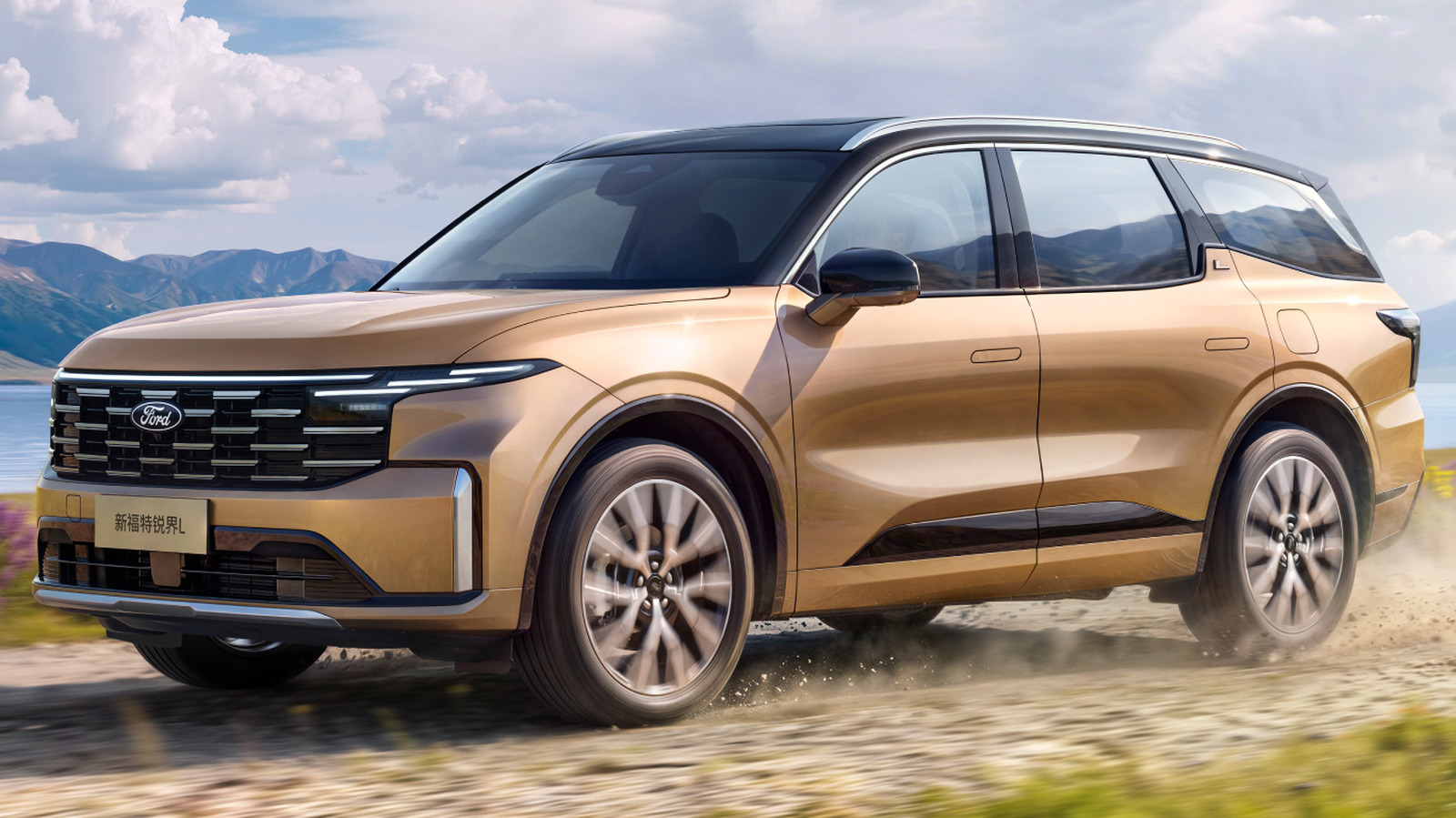


The Ford Edge died in North America after the 2024 model year. In China, it just got a facelift and a 27-inch screen.
The Edge L, built by the Changan Ford joint venture, has received a mid-cycle refresh for 2027 that sharpens its looks and upgrades its cabin tech. It is a three-row, seven-seat SUV that stretches 197 inches long, rides on a 116-inch wheelbase, and starts at roughly $34,500. The U.S.-spec Explorer, Ford’s closest domestic equivalent, starts at $40,475 and is only 1.5 inches longer.
The visual changes are restrained. A wider squared-off grille integrates more cleanly with revised LED headlights. The bumper gets simpler surfacing with vertical slits replacing whatever was there before.
New alloy wheels come in 19, 20, and 21-inch sizes. Out back, the taillights shrink and go darker, and the tailgate and bumper get minor reworking. Nothing dramatic, but enough to keep showroom traffic moving in a Chinese market where domestic brands are breathing hard down Ford’s neck.
The real story is inside. The Edge L keeps its 27-inch 4K touchscreen and 12.3-inch digital instrument cluster, but the infotainment system now runs on a Qualcomm Snapdragon 8155 chip. That chip powers the Chinese-specific Ford SYNC Max software, which Ford says includes AI integration.
Even the base Fashion trim comes loaded with a panoramic sunroof, tri-zone climate control, synthetic leather seats, active noise cancellation, and Co-Pilot360 Level 2 driver assistance. The top Supreme trim piles on a head-up display, B&O audio, a 540-degree surround-view camera, and heated and ventilated second-row captain chairs with power leg rests.
Try getting heated and ventilated captain chairs with power leg rests in a $45,000 American Ford.
The powertrain carries over untouched. A turbo 2.0-liter EcoBoost four-cylinder makes 249 horsepower and pairs with an eight-speed automatic. The hybrid version of that same 2.0-liter bumps combined output to 275 horsepower through an eCVT, and Ford claims a range of 738 miles on a single tank.
Both configurations offer front-wheel drive or all-wheel drive, though the platform itself is a FWD architecture. That is the key structural difference from the Explorer, which rides on a rear-wheel-drive longitudinal layout.
The Edge L also ships to Mexico, which makes the absence from U.S. dealer lots feel less like a strategic decision and more like a missed opportunity. Ford killed the American Edge because it needed plant capacity and the nameplate had gotten stale. Fair enough.
But the Chinese version grew into something the Explorer is not: a tech-forward, value-packed family hauler that undercuts its sibling by thousands while matching or beating it on features and interior space.
Ford has spent years talking about simplifying its North American lineup. Fewer sedans, fewer overlapping crossovers, more trucks and purpose-built vehicles. The Edge L suggests the company still knows how to build a competitive mid-size SUV when the market demands it.
China demands it. Chinese EV startups with six-figure screen inches and massage seats demand it.
Whether Ford ever brings something like the Edge L back stateside is an open question. The Changan partnership controls manufacturing, the SYNC Max software is tuned for a different ecosystem, and tariff math would rewrite the price tag entirely. But every time Ford refreshes this vehicle, the gap between what Chinese buyers get and what American buyers are offered gets a little harder to ignore.
Share this Story