


Ford’s newest president doesn’t come from the car business. Dave Carroll arrives from ENGIE North America, where he ran one of the largest renewables and storage platforms in the United States.
His new job is running Ford Energy, and Ford insists this is no side project.
Ford announced the unit in December 2025 with a simple pitch. It would assemble battery energy storage systems for utilities, data centers, and commercial and industrial customers across the U.S.
These are the big steel boxes that sit beside solar farms and substations, soaking up power and releasing it when the grid needs it. You won’t find them in a dealer brochure.
Ford first gave the job to Lisa Drake, a company insider tasked with building the business from scratch. Drake retires at year-end, and the keys now go to a man who spent his career selling electrons, not pickups.
That handoff tells you how Ford sees the customer. The buyer is a utility procurement desk, not someone kicking tires at a dealership.
The first customer has already signed. EDF power solutions North America agreed to a five-year framework deal for up to 4 GWh of storage per year.
EDF wants that capacity to integrate renewables and harden the grid across North America. Ford has an anchor customer before its storage line has built a single unit.
That line is still under construction. Ford is preparing its Kentucky gigafactory and lining up suppliers to begin production in late 2027.
The money is committed. Ford has put roughly $2 billion into Ford Energy Systems in Kentucky, with about another $2 billion going into the overhaul of Louisville Assembly Plant.
The two projects share more than a state line. Ford is pulling the same thread through both.
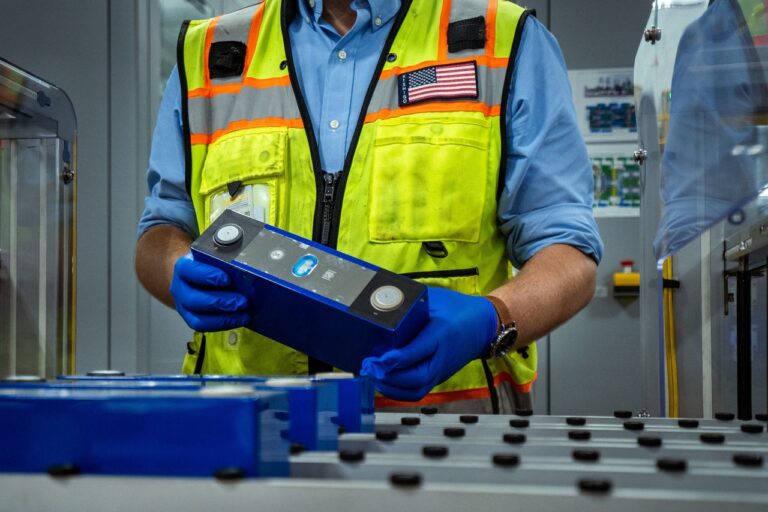
In Marshall, Michigan, the first lithium iron phosphate prismatic cells are coming off the line at BlueOval Battery Park Michigan. They’re headed to Louisville to power prototypes of the Ford Fathom electric truck.
“Ford is in the battery business now,” the company declared. Notice where it put the credit.
Ford didn’t hang the milestone on the truck. It called the cell shipment a key milestone for Ford Energy, the storage unit.
The chemistry matters here. LFP is the workhorse of stationary storage, and the same prismatic cells built in Marshall can feed either a pickup or a utility container.
Ford is building one battery competency and selling it two ways. One path runs through Louisville to a showroom, the other through Kentucky to a substation.
People outside Detroit have noticed. The Ford Energy team earned TIME100 Climate recognition while still moving, in Ford’s words, “from launch to scale.”
Ford has also been shifting its own operations toward geothermal, solar, and wind power. That makes it a buyer of clean energy as well as a would-be supplier of the hardware that stores it.
The new business doesn’t have a finished factory yet. Carroll has yet to see a single storage system leave Kentucky.
What he does have is a signed customer wanting up to 4 GWh a year, cells already rolling out of Michigan, and roughly $4 billion of Kentucky concrete going in around him.
Late 2027 is now on the calendar. Ford made the promise to EDF, and Carroll is the one who has to keep it.

Share this Story