
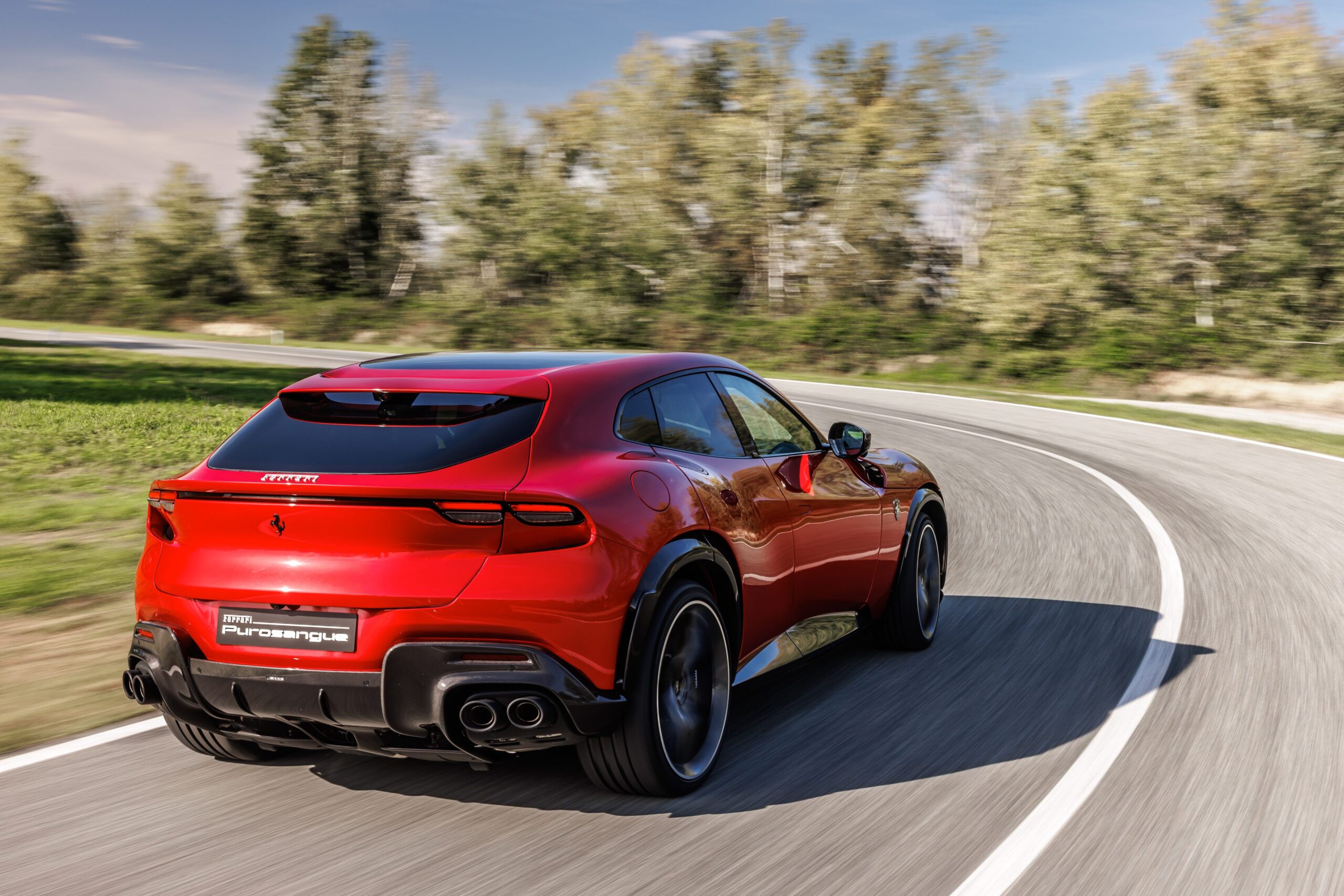


Ferrari didn’t touch the springs. Didn’t swap the shocks. Didn’t even change the tires. The 2027 Purosangue Handling Speciale, the sharpened version of Ferrari’s four-door, high-riding, definitely-not-an-SUV, achieves its performance gains through nothing more than revised software for the adaptive dampers and a pair of carbon-fiber prancing-horse badges on the fenders.
That’s it. New code and dark-gray wheels with diamond-cut accents. The rumored upcharge is around $50,000.
The trick lies in the Purosangue’s TrueActive Spool Valve suspension, built by Multimatic, the same shop that assembles Ford GTs. Each corner gets a 48-volt electric motor driving a ball screw inline with the damper, adjusting damping force and ride height individually, 20 times per second. Ferrari’s engineers rewrote the control algorithms to reduce body movement by a claimed 10 percent.
Car and Driver’s Jared Gall drove the HS at Alfa Romeo’s Balocco Proving Ground, a facility dating to 1962, where a 3.3-mile course packs 36 turns and enough elevation change to launch a $500,000 vehicle airborne. Twice per lap. The suspension handled the landings with little more than a distant clunk.
A sustained 100-plus-mph sweeper had the car twitching at the adhesion limit for nearly eight seconds, with Armco barriers tight on both sides.
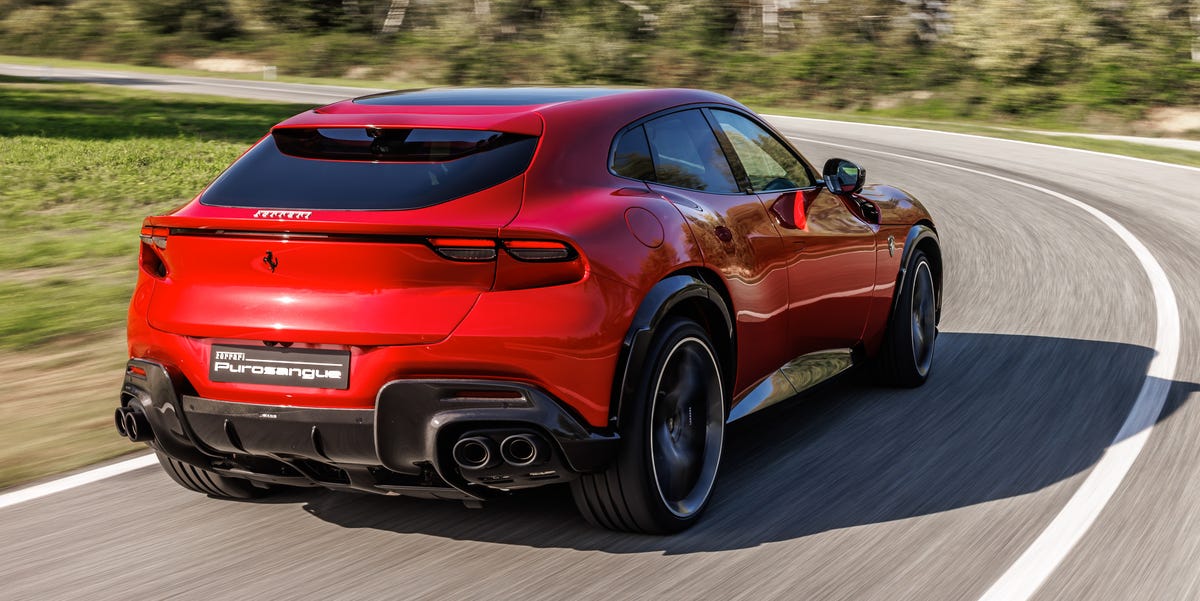
The HS is not a gentle partner at those speeds. More than half of the Purosangue’s estimated 4850 pounds sits ready to overwhelm the rear tires and rotate the car. Ferrari’s own guidance: steady right foot, quick hands.
The dual-clutch transmission shifts with more aggression, and more exhaust note bleeds into the cabin. The steering wheel, despite all the electronic wizardry keeping the body flat, still feels connected and alive.
The 6.5-liter naturally aspirated V-12 makes 715 horsepower at 7750 rpm and sits entirely behind the front axle. The eight-speed dual-clutch transaxle lives at the rear. Weight distribution is 49/51 front to rear.
Ferrari calls it a “high-riding sports car,” and compared to the twin-turbo bruisers from Lamborghini, Porsche, and Aston Martin, the label isn’t entirely ridiculous.
Everything else about the Purosangue remains untouched for HS duty. The forward-opening hood, the rear-hinged back doors that close themselves, rear seats with heating, ventilation, and massage. Seventeen cubic feet of cargo space and an estimated 13 mpg combined, because nobody buying this car is optimizing for fuel costs.
Ferrari still refuses to officially confirm the Handling Speciale’s price premium. The base Purosangue is estimated at $500,000. The HS likely pushes past $550,000 before you start ticking option boxes, and Ferrari buyers always tick option boxes, often to the tune of six figures.
The real question the HS raises is whether recalibrating existing hardware constitutes a legitimate performance variant or a very expensive over-the-air update dressed in marketing. Ferrari’s answer is Balocco, where the car caught air and held triple-digit sweepers with composure that the standard Purosangue apparently cannot match. The company is betting that the difference is real enough to justify the ask.
It is a bet Ferrari will almost certainly win. The Purosangue already has a years-long waiting list. Scarcity does the selling. The HS just gives buyers a reason to feel they got something the next owner didn’t.
Share this Story