
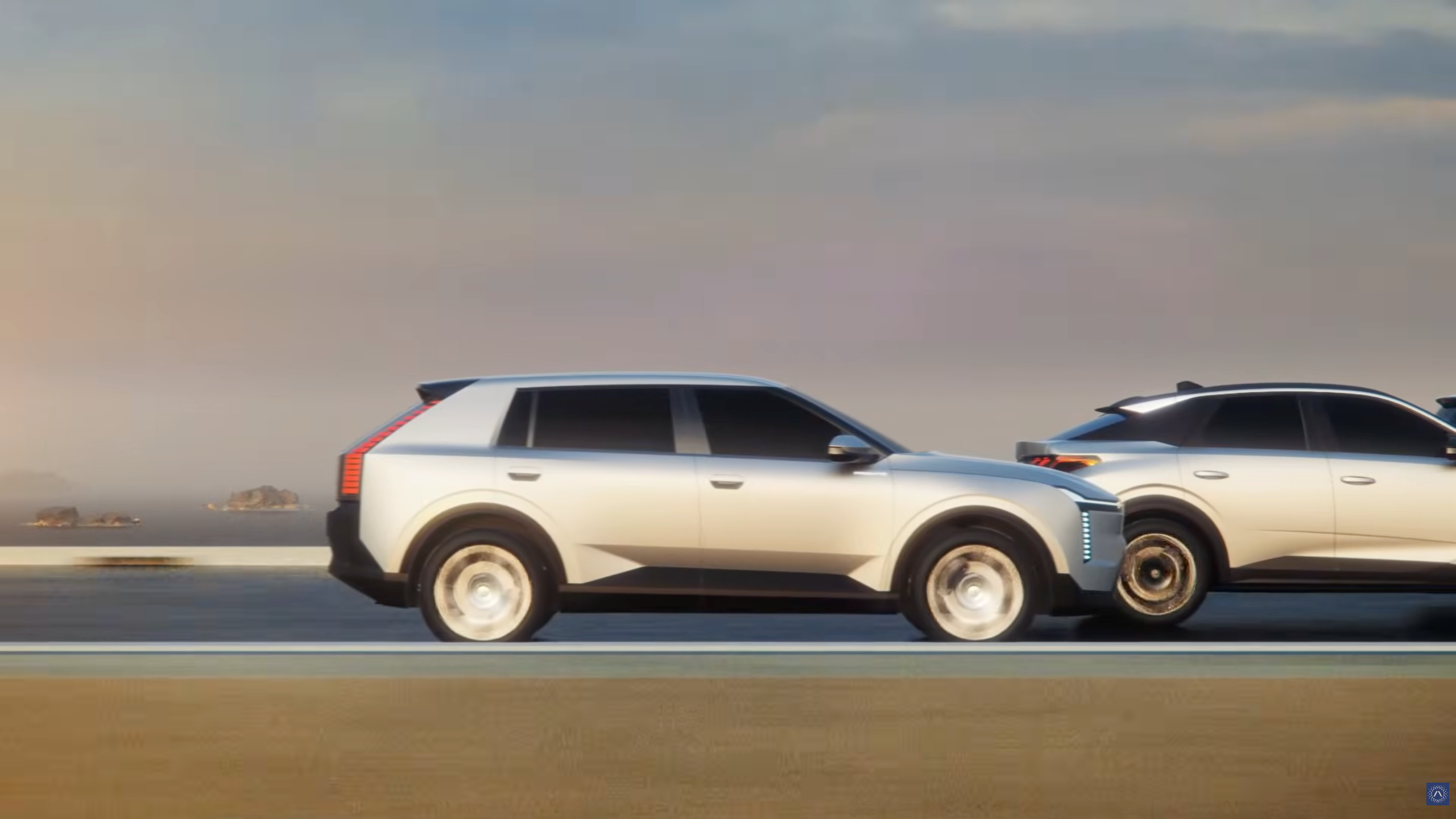


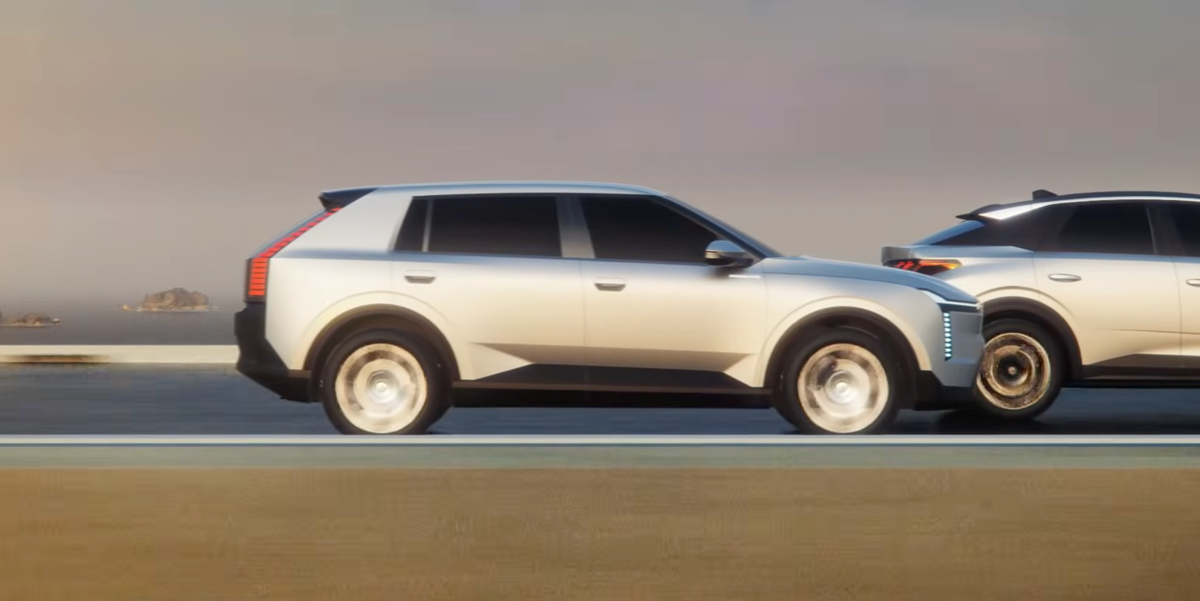
A Stellantis YouTube video about powertrains accidentally became the most important Chrysler reveal in years. Buried in the footage, on the far right of a product lineup, sat the Chrysler Airflow — a compact SUV that represents the clearest signal yet of whether this 100-year-old brand lives or dies.
The Airflow is a boxy, modern compact crossover riding on Stellantis’s new STLA One platform, expected to start under $40,000. Its profile carries a whiff of Hyundai Ioniq 5, with a roofline sitting lower than a Toyota RAV4. An LED strip runs across the front, framing an illuminated Chrysler badge, while vertical LED elements anchor the rear.
It looks nothing like the smooth Airflow concept Chrysler trotted out in 2022, which now feels like it belonged to a different company — because it did.
The powertrain story is where things get interesting. The STLA One architecture supports 800-volt EVs, hybrids, and straight internal combustion. But the video clearly shows what appears to be a transversely mounted turbocharged gas engine under the Airflow’s hood.
That’s likely the 1.6-liter four-cylinder already doing duty in the Jeep Cherokee and across Stellantis’s European lineup, making 177 horsepower without electrification.
Hybrid and EV variants could follow, but the lead foot is gasoline. Two years ago, Chrysler was supposedly going all-electric. Now the brand is hedging hard, reading the room on EV demand and launching with the engine it can actually sell.
The 324-hp Hurricane 4 turbo from the 2026 Grand Cherokee could show up on higher trims, which would at least give the Airflow a pulse-quickening option.
But the Airflow isn’t Chrysler’s only play. Two smaller crossovers — the Arrow and Arrow Cross — are coming, rebadged from the Fiat Grizzly Fastback and Grizzly, respectively. Fiat just published official images of the Grizzly twins, and sources who saw the Chrysler versions at Stellantis Investor Day in May say they’re nearly identical, save for tweaked lighting graphics and that illuminated Chrysler logo.
Both measure under 177 inches, slightly smaller than a Chevy Trax, and Chrysler is promising a starting price below $30,000.
Three new SUVs. That’s the entire rescue plan for a brand currently selling exactly one vehicle — the Pacifica minivan. Chrysler went from America’s oldest automaker to a brand so hollowed out it barely registers on dealer lots.
The strategy is transparent: use Stellantis’s global parts bin to flood Chrysler showrooms with affordable crossovers as fast as possible. The STLA One platform gives them flexibility. The Fiat-sourced small SUVs keep development costs low. And gasoline-first powertrains avoid the demand uncertainty that has spooked every automaker selling EVs at volume.
Whether this works depends entirely on execution and timing. The STLA One platform launches in 2027, which means the Airflow likely arrives as a 2028 model. The Arrow twins have no confirmed on-sale date yet.
Chrysler has to survive the gap between now and then with nothing but a minivan and whatever goodwill remains from the brand’s better days.
The competition won’t wait. The compact SUV segment is the most brutally contested space in the American market, stacked with the RAV4, CR-V, Tucson, and a dozen others that have years of momentum. Chrysler is showing up late, with unproven products, on a platform nobody has driven yet, at prices that sound good but haven’t been tested against real-world trim walks.
Stellantis CEO Carlos Tavares laid out a five-year plan heavy on Jeep and Ram. Chrysler got three crossovers and a prayer. The Airflow better be more than a background extra in a YouTube video, because this brand won’t get another chance.



Share this Story