
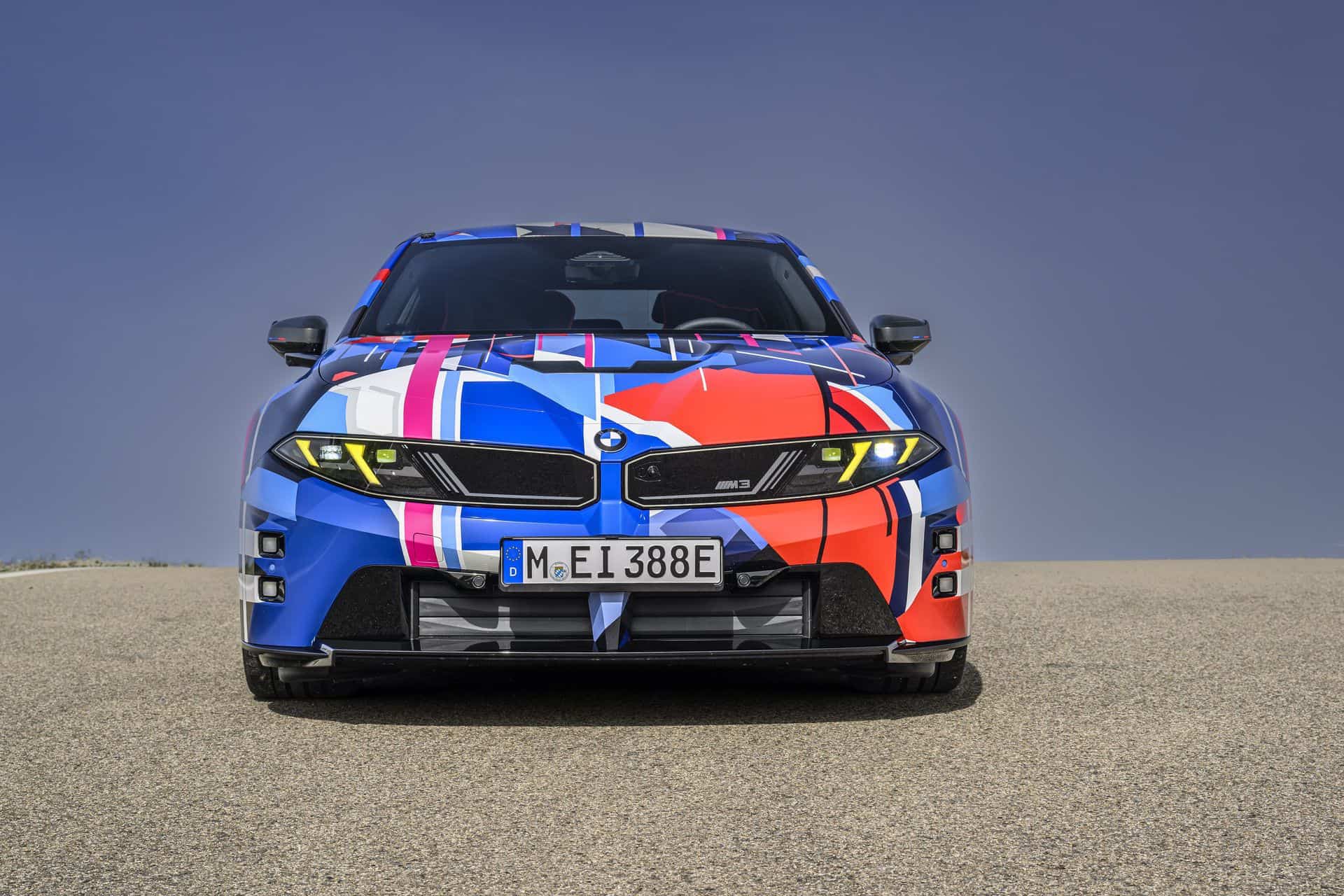


BMW M will tell you the electric M3 makes about 838 hp and 1,200 Nm from four motors. It will tell you the battery is cooled on both sides of every cell row. It will not tell you what the car weighs.
That silence hung over two hour-long engineering workshops at Miramas, the 1924 racetrack in southern France that BMW has owned since 1986. The company spent the time on structure, software and cooling. Power got the least airtime.
The car, internally called ZA0, does not replace the gasoline M3. BMW has confirmed a combustion G84 will be sold alongside it. That tells you how far Munich is willing to bet on electrons alone.
Project lead Philipp Brunn, who ran the complete-vehicle concept on the current G80, joined Neue Klasse development around 2020. His reasoning was blunt. “You can’t just wait for the things to evolve and then raise the hand and say, ‘Okay, I want to do an M3,'” he said.
Starting early meant constant haggling with the team building the regular i3. When M found a weak spot, someone had to decide who paid for the fix. “More expensive doesn’t help the i3,” Brunn said.
The answer shows up on the assembly line. Robots attach four weld-on pickup points only to M3 bodies. The cheaper car never carries brackets it doesn’t need.
The four motors live in two drive units, mounted side by side and turned 180 degrees from each other. The rear axle gets about 1,000 Nm, nearly double the front’s 540 Nm. BMW’s own slides list drifting as a design goal.
Rivals mostly stop at three motors. BMW went to four, and the payoff is subtler than the spec sheet suggests. The motors modulate ABS faster than hydraulics can, which Brunn says is why stability control stays out of the way even when fully on.
There is no mechanical differential, so a failed motor kills its entire axle. The car limps home on the other one. It has “enough power to have a quick ride home,” Brunn said.
The roughly 100 kWh Gen6 pack shares its housing, dimensions and mounting points with the i3. The cells inside do not. M uses thinner, larger electrodes and more electrolyte, then cools every row instead of every second one.
That housing is bolted to both axle carriers through 8 mm milled aluminum plates, turning the battery into a shear panel. Welded steel struts run from the front shock towers into the A-pillars. “You have no weak spots,” Brunn said.
All that bracing exists to keep a heavy body from flexing. BMW’s presentation concedes “the higher vehicle weight of a high-performance BEV.” Brunn put it shorter: “Everyone hates weight.”
The track story is where BMW sounds most confident. A Track preset preconditions the pack, then lets drivers pick a two, eight or 15 minute stint and holds output flat for the duration. “There’s no degradation,” said battery specialist Andreas Bentenrieder.
Read the fine print, though. A Long Run wants at least 80 percent charge. At Miramas, ten laps of the Circuit de Provence drained cars from 100 to about 60 percent, and they were recharged between sessions.
Regeneration peaks at 540 kW including brake pedal input and recovers roughly one lap in three. Bentenrieder’s rule for Miramas is simple. Three laps earn you a fourth.
BMW claims 420 kW peak charging and about 300 miles of EPA range. It has not published a 10 to 80 percent charge time, preconditioning times, or a curb weight.
It also hasn’t ruled out a rear-drive version. For now, that’s one more number BMW is keeping to itself.

Share this Story