
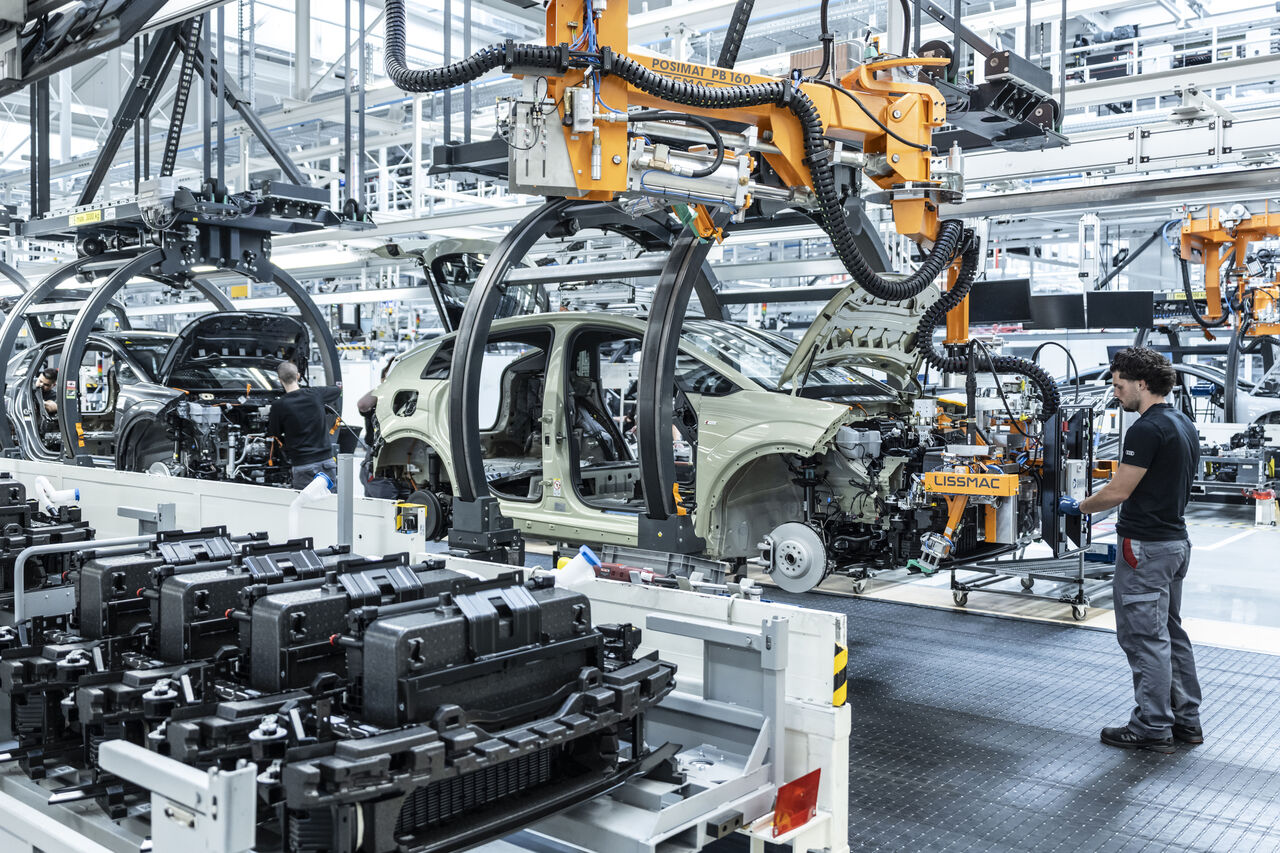


The first Audi A2 e-tron rolled off the line in Ingolstadt this week, and the real story isn’t the car itself. It’s how Audi built it.
Development to production readiness took 21 months less than any previous Audi vehicle project. That’s not a minor trim. That’s nearly two full years shaved off the cycle, a pace that would have been unthinkable from Ingolstadt just five years ago.
CEO Gernot Döllner called it “the most efficient Audi we have ever built.” He’s not talking about kilowatt-hours per kilometer. He’s talking about the factory floor.
Audi slashed the number of production-relevant part numbers, though it won’t say by exactly how much. Fewer parts means fewer logistics supermarkets, less warehouse space, and a simpler material flow inside the plant. The company also deployed its string-of-pearls production principle at Ingolstadt for the first time, a method already proven at Neckarsulm.
Customer order sequences are locked six days before assembly begins, and suppliers build and pack parts in that exact order. Storage and sequencing areas simply vanish from the equation.
The A2 e-tron body shares a production line with the Audi A3. More than 1,200 production components, including roughly 250 robots and various welding guns, were recycled from previous model programs. That’s not just thrifty. It’s a deliberate rejection of the greenfield megafactory approach that companies like Tesla and certain Chinese EV makers have championed.
Fully automated wheel installation arrived at Ingolstadt with this car. So did bin picking in the body shop, where camera-guided robots pull small sheet-metal components from disordered containers and feed them directly into production. Tasks that once required human hands and human backs now run without intervention.
An industrial cloud platform called Edge Cloud 4 Production handles test systems and operator guidance centrally, eliminating more than 450 industrial PCs from the assembly hall. Chatbots assist workers with maintenance troubleshooting, supply chain documentation, and process questions. Audi says it is rolling these tools across multiple production sites.
Bavarian Minister-President Markus Söder showed up for the launch, which tells you something about the political stakes. The works council chair, Jörg Schlagbauer, reminded everyone that the workforce has been lobbying since 2019 for an entry-level electric model to be assigned to Ingolstadt. That fight was about jobs, about keeping industrial production rooted in Germany at a time when labor costs and energy prices make that argument harder every quarter.
Döllner framed the car as purpose-built for Europe, a pointed distinction when Audi’s parent Volkswagen Group is simultaneously tailoring products for China and North America. “Different regions need different answers,” he said. The A2 e-tron is Ingolstadt’s answer for its home continent, and the efficiency gains in manufacturing are clearly designed to make the math work at German wages and German electricity rates.
Production board member Gerd Walker went further, claiming the A2 e-tron “demonstrates that it is possible to build cars profitably in Germany.” That’s a loaded statement at a moment when European automakers are bleeding margin on EVs and eyeing cheaper locations in Eastern Europe, North Africa, and beyond.
Whether the A2 e-tron actually delivers on that profitability promise depends on volumes and market reception, neither of which Audi has disclosed in detail. What Audi has disclosed is a manufacturing philosophy built on reuse, simplification, and automation at a scale the company has never attempted before.
The production ramp is underway. The real test starts when customers decide whether Audi’s most efficient car is also the one they want to buy.

Share this Story