
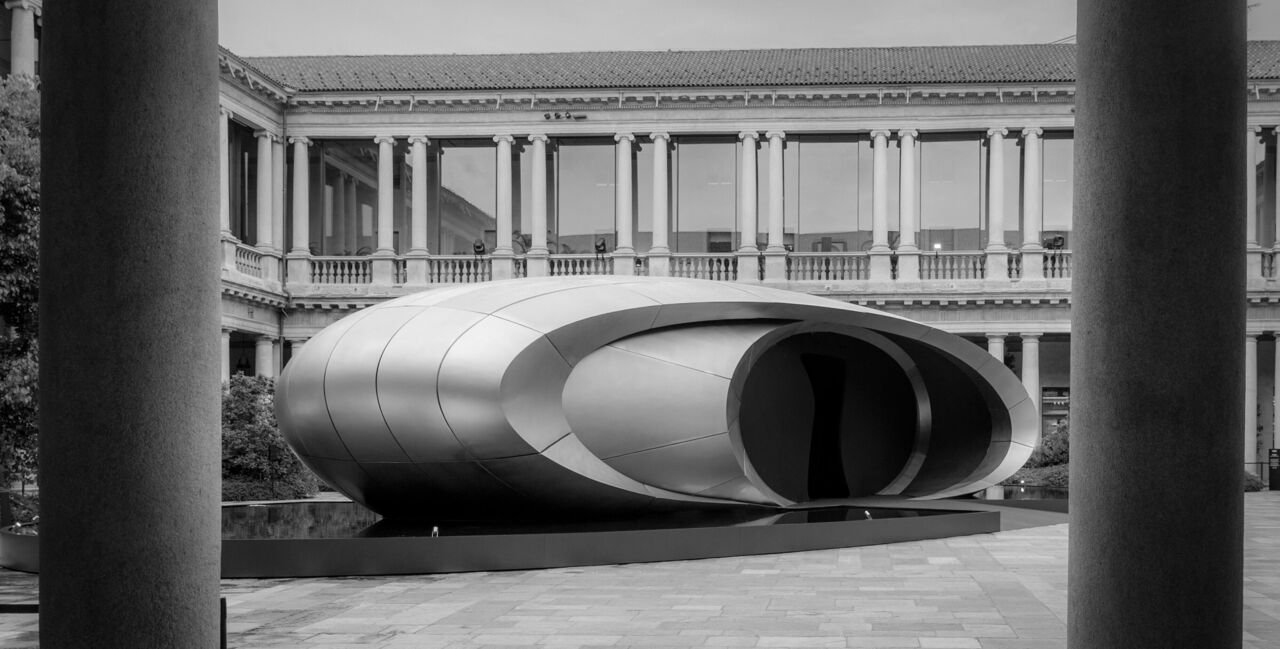


Audi rolled into Milan Design Week with a titanium-skinned pavilion designed by Zaha Hadid Architects and a message about slowing down. Then it parked a Formula 1 show car inside.
The installation, called “Origin,” occupies the courtyard of the former Archiepiscopal Seminary — now the Portrait Hotel on Corso Venezia — and is pitched as an antidote to sensory overload. Shifting reflections, matte metallic surfaces, quiet presence. The press materials read like a spa brochure.
“Design must help people filter the noise, find clarity, and reconnect with what truly matters,” said Massimo Frascella, Audi’s Chief Creative Officer.
Sitting inside that tranquil space: the Audi R26 show car, the brand’s rolling declaration of its Formula 1 entry, and the new RS 5 Avant, a plug-in hybrid performance wagon that still burns 10 liters per hundred kilometers when its battery dies.
This is Audi’s thirteenth consecutive year at Milan Design Week, and the formula has become a recognizable pattern. Use the design community as a cultural shield. Talk about sustainability, urban living, material innovation. Then unveil the hardware.
The RS 5 Avant and RS 5 Sedan are the first high-performance plug-in hybrids from Audi Sport. On paper, the numbers are respectable: weighted combined CO2 emissions between 86 and 100 grams per kilometer, electric consumption around 18 kWh per hundred clicks.
But the CO2 class with a discharged battery is G — the worst rating on the European scale. That detail, buried in the footnotes of the press release, tells you everything about where the engineering priorities actually sit.
The R26 show car is harder to dismiss. Audi’s Formula 1 program is real, expensive, and genuinely ambitious. The car made its national Italian public premiere in Milan, a deliberate choice for a brand that knows Italy treats motorsport like religion.
Placing it inside a contemplative architectural installation rather than on a rotating stage at an auto show is a calculated flex. Audi wants to be seen as a technology company that happens to race, not a racing team looking for sponsors.
Frascella’s design philosophy — clarity, technicality, intelligence, emotion — is doing heavy rhetorical lifting here. The pavilion embodies the first three. The F1 car supplies the fourth.
Together they construct a narrative that Audi is evolving beyond the automobile, becoming something more like a cultural institution with an engineering department.
Whether the design community buys it is almost beside the point. Milan Design Week has long functioned as a credibility laundromat for automakers. BMW, Lexus, Hyundai — they all show up, commission architects, host aperitivos, and leave with a dusting of cultural legitimacy that no amount of Super Bowl advertising can replicate.
Audi has simply been doing it longer and more consistently than most.
The tension at the heart of this year’s presentation is the gap between the message and the metal. A pavilion about stripping away the superfluous sits alongside a 600-plus-horsepower hybrid wagon and a car built to circle tracks at 220 miles per hour. Audi wants you to meditate on clarity while staring at the pinnacle of mechanical excess.
That contradiction isn’t a flaw in the strategy. It is the strategy. Luxury brands have always sold restraint and indulgence in the same breath. Audi just found a particularly elegant courtyard in which to do it.
The installation runs through April 26. The RS 5 Avant is already configurable on the Italian site. And the R26 will hit the grid whenever Formula 1’s regulations and Audi’s Sauber takeover allow. Quiet presence, indeed.


Share this Story