
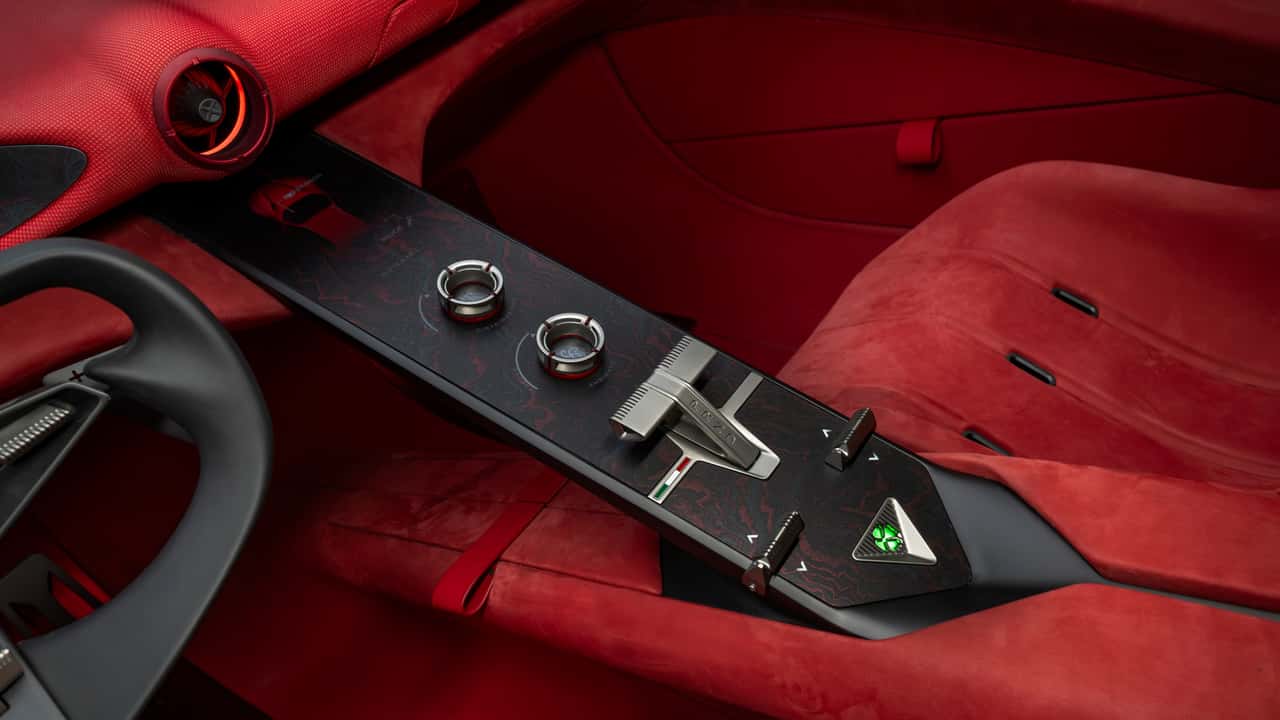


Every modern car interior looks the same. Two screens, two cupholders, a flat console. Alfa Romeo’s head of product, Daniele Chiari, said exactly that at the Paris Motor Show, and he’s not wrong.
The Italian brand just rolled out the Cuorerosso concept as its answer, a deliberate rejection of the sea of identical digital cockpits drowning the industry.
“What we want to do is to detox our interior,” Chiari told Autoblog. The word choice is deliberate. Detox implies addiction, and the auto industry’s addiction to ever-larger touchscreens has produced interiors that could belong to any brand from any country.
Alfa Romeo, a company that once gave us some of the most beautiful dashboards ever designed, apparently has no interest in competing on screen diagonal.
The Cuorerosso’s instrument cluster, called the Cannocchiale Vivente, nods directly to the twin-dial gauges from classic Alfas. Two separate displays sit apart during normal driving. When the driver wants a consolidated view, the gauges physically slide together into a single cluster.
It’s theatrical. It’s mechanical. It’s the opposite of a software update.
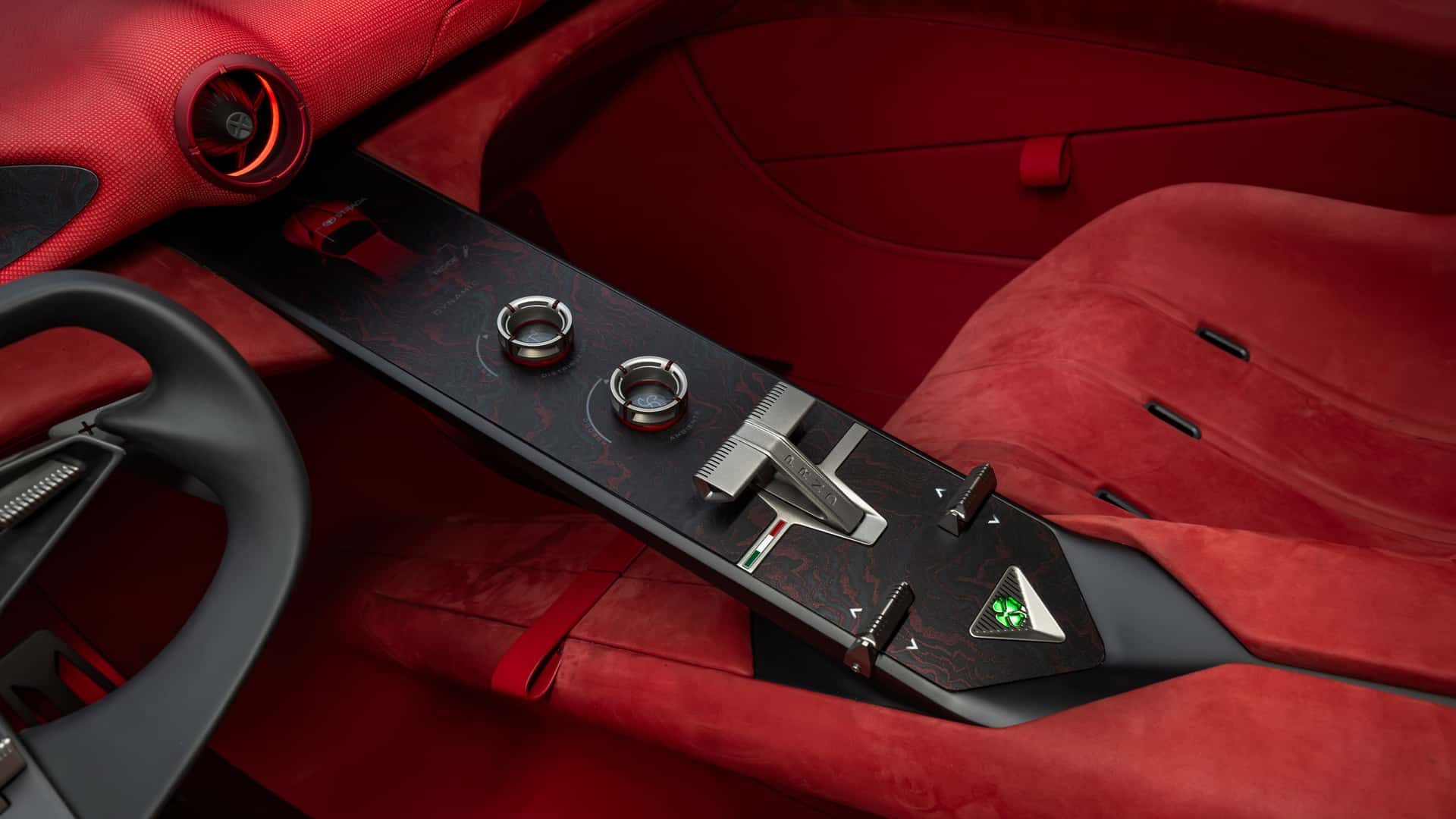
The center console gets something Alfa calls the Magma Display. Instead of bolting a tablet above the dash like nearly every competitor on the planet, the touchscreen is embedded flush into the console surface. Kill the ignition and it vanishes into the material around it.
Fire it up and controls materialize. Surrounding it are a rotary dial, a drive-mode selector, and physical toggle switches. Actual switches you can feel and operate without looking.
The Cuorerosso itself is a concept. It won’t be built. But Chiari confirmed that real production cars will inherit its technology and design philosophy.
The upcoming Giulietta hatchback appears to be first in line, expected to carry both exterior styling cues and interior elements from the concept.
That’s where this gets interesting, and where the tension lives. Alfa Romeo is a brand that talks a spectacular game about heritage and passion but operates within the Stellantis empire, which shares platforms, electronics, and cost structures across more than a dozen brands. Delivering a truly distinctive interior while riding on shared architecture is not a small promise.
It requires either serious investment or serious creativity, probably both.
The timing is worth watching. Automakers across the board are quietly retreating from the all-touchscreen doctrine. Hyundai brought back buttons. Volkswagen admitted its capacitive touch controls were a mistake.
Porsche never fully abandoned physical switches. Alfa Romeo is drafting behind a broader industry correction, but wrapping it in Italian romance and calling it a philosophy rather than a course correction.
Physical controls are not nostalgia. They are ergonomically superior for primary driving functions. Every human factors study conducted in the last decade confirms what drivers already know: you can find a knob without looking, but you cannot find a virtual slider on a glass panel at 80 miles per hour.
The fact that this even needs to be stated in 2025 tells you how far the pendulum swung.
Alfa Romeo has always been better at concepts than follow-through. The 33 Stradale proved the brand can still make jaws drop. But the volume cars, the ones that actually fill showrooms, have struggled to separate themselves from their Stellantis siblings in meaningful ways.
The Giulietta will be the test. If it arrives with a genuinely different interior that delivers on the Cuorerosso’s promise, Alfa Romeo might actually carve out the niche it keeps talking about. If it shows up with a lightly reskinned Stellantis cockpit and a press release about heritage, the detox will have lasted about as long as a New Year’s resolution.
Chiari’s team has drawn a line. Now they have to build across it.

Share this Story