
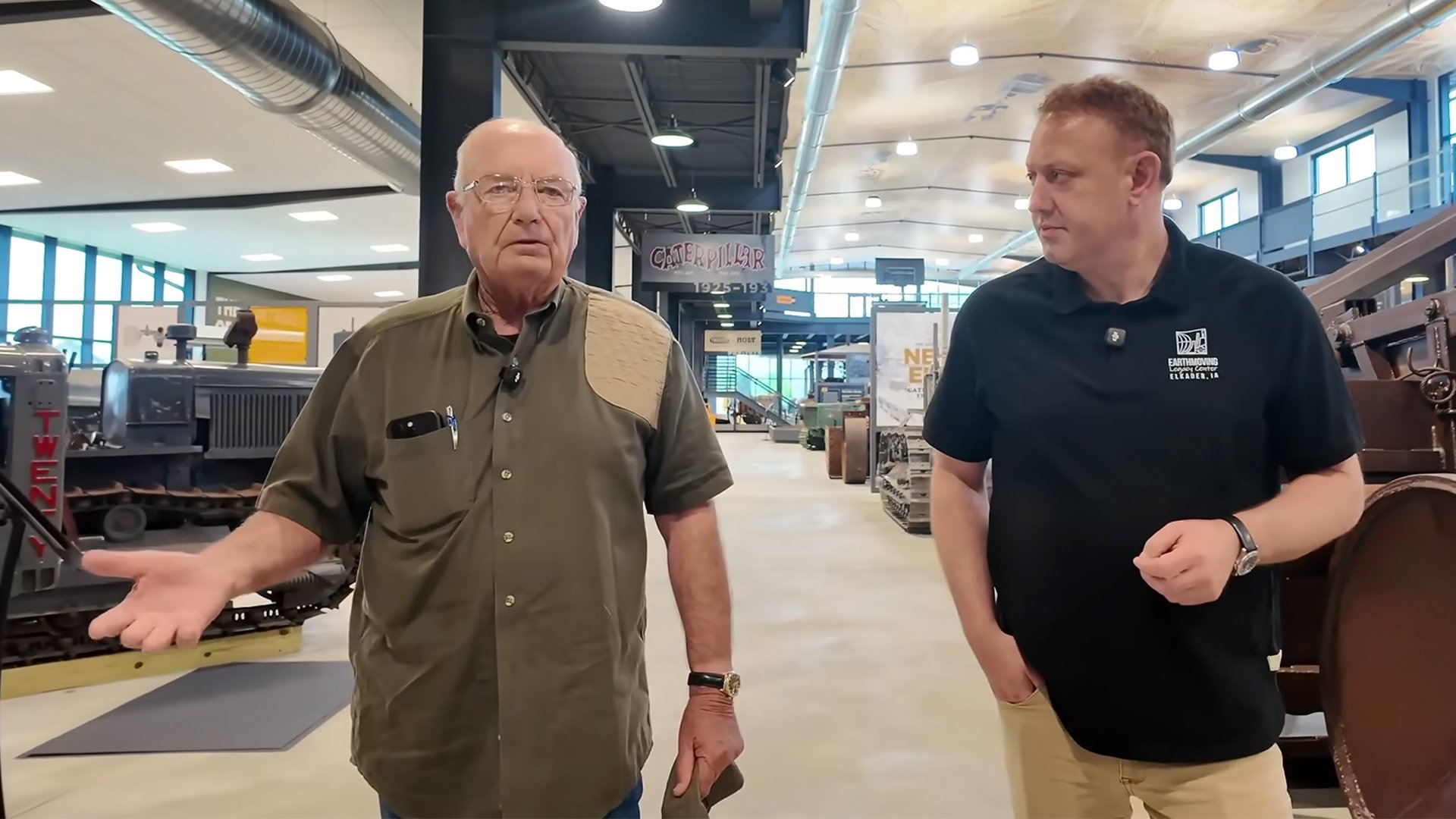


Jim Coles started at Caterpillar in 1966, spent four decades selling Peterbilt trucks across 18 dealerships, and has a message for anyone still defending V-configured diesel engines: you already lost.
In a recent 25-minute interview filmed at the Earthmoving Legacy Center in Elkader, Iowa, Coles laid out the case with the calm certainty of a man who watched the whole thing play out in real time. The inline-six won. Not because of brand loyalty or barroom arguments, but because of engineering fundamentals that never changed.
Caterpillar built its reputation on the 3406, a 14.6-liter inline-six that stayed in production from 1973 to 2007. Internally they called it VITEL, for “vehicle industrial truck engine line.” It powered semi trucks, earthmovers, marine vessels, and stationary generators. Three decades of continuous production tells you something no spec sheet can.
The reasons, as Coles explained them, are almost boringly practical. An inline-six is naturally balanced, running smoother without counterweights or balance shafts. Cooling is simpler because you’re dealing with one cylinder bank instead of two crammed into a V. And when engineers needed to bolt on turbochargers or emissions equipment, the inline layout gave them room to work.
“Caterpillar and everyone else did go into V-type engines,” Coles acknowledged, citing the 90-degree RM180 and the 3408. “But V’s versus sixes were always more of a compromised design.”
Then he delivered the kill shot.
“If you’ll notice today, sixes are all the way up to covering 1,100 hp,” he said. “All the other V’s that were in the market, whether it be the 903 Cummins, the 555 Cummins, the 3208 Caterpillar, the 8V71 and 8V92 Detroits, all those V engines are gone. Nobody’s in the V business today, and rightfully so.”
He is not wrong. Look at what powers the heavy-duty trucking and equipment world right now. Cummins builds inline-sixes. PACCAR builds inline-sixes. Detroit Diesel, once synonymous with its two-stroke V8s and V6s, moved to the DD15 and DD16, both inline-sixes. The V8 diesel, for all its brute-force appeal, has been functionally extinct in the commercial space for years.
The pickup truck crowd still clings to the V8 debate, of course. Duramax and Power Stroke fans will argue their configurations until the heat death of the internet. But in the world where engines have to run 500,000 miles hauling 80,000-pound loads, the market already decided. The V8 diesel was a dead end.
What Coles describes is not opinion dressed up as nostalgia. It is industrial natural selection. The engines that were cheaper to maintain, easier to package, smoother in operation, and capable of scaling to higher horsepower survived. Everything else got discontinued.
Modern materials and manufacturing have pushed inline-sixes into power ranges that would have demanded 12 or 16 cylinders a generation ago. That trajectory shows no sign of flattening. As emissions regulations tighten further, the packaging advantages of a single-bank layout become even more pronounced.
Coles is 80-something years old. He has watched engine families be born, dominate, and die. When a man with that resume tells you the argument is settled, it is probably worth putting down your phone and listening.
Share this Story