
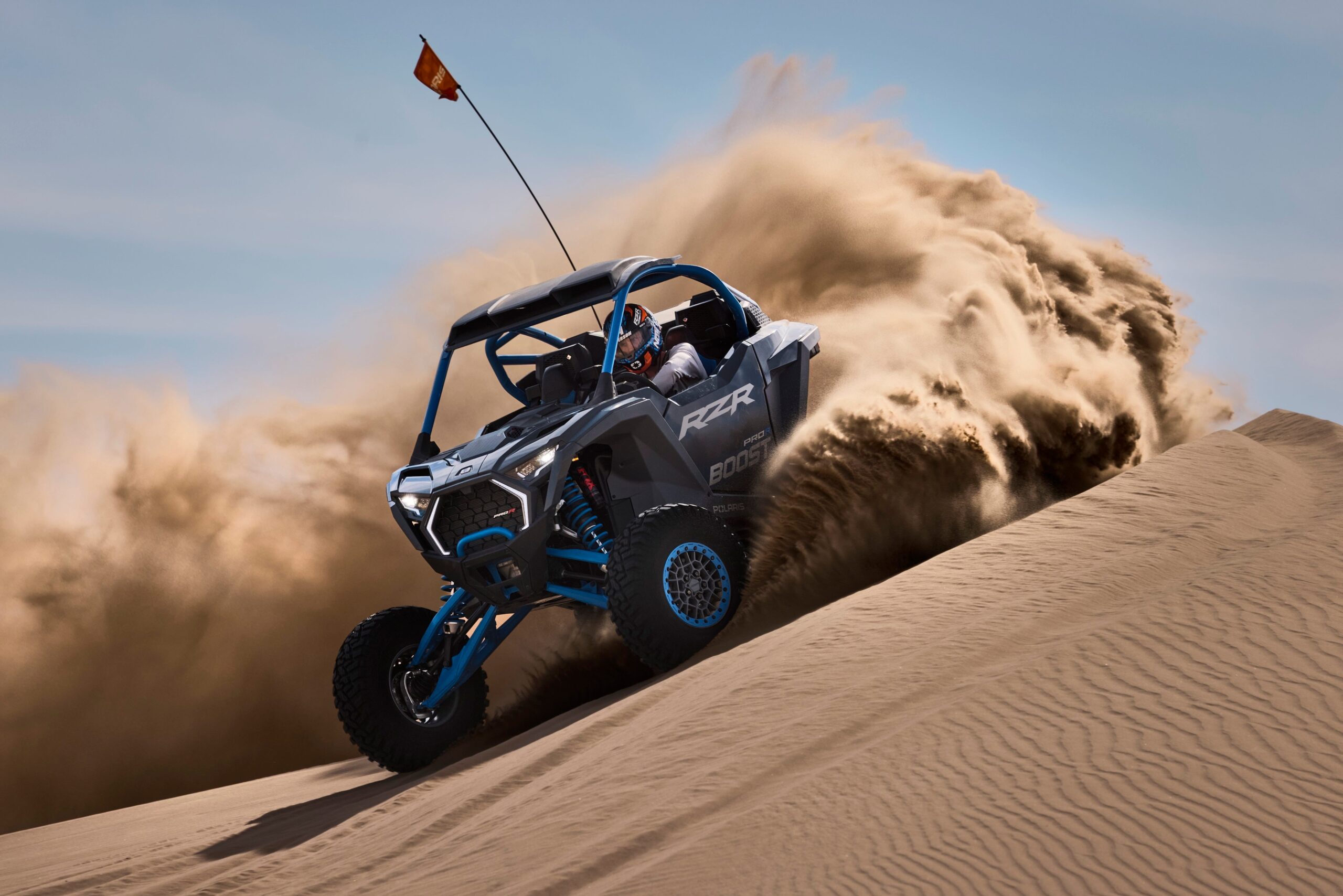


Fifty thousand dollars for a side-by-side. That’s where we are now. Polaris just unveiled the 2027 RZR Pro R Boost, a turbocharged off-road machine that makes 275 horsepower and 223 pound-feet of torque from a force-fed 2.0-liter inline-four. It is, by a comfortable margin, the most powerful production side-by-side ever built.
The base two-seater starts at $49,999. The four-seat Ultra trim tops $56,999. Those are numbers that would have bought you a nicely equipped pickup truck not long ago. Now they buy you a roll cage and a CVT.
A 66-millimeter Garrett turbocharger and liquid-to-air intercooler do the heavy lifting over the naturally aspirated Pro R’s 225-hp version of the same engine. Polaris says the motor won’t derate until ambient temperatures exceed 115 degrees or altitude climbs past 10,000 feet. That’s a bold claim for a turbocharged engine living in desert dust and mountain air, but it sets the expectation clearly.
The real story here is torque. Horsepower wins bar arguments, but torque determines what a machine actually feels like in the dirt. The Pro R Boost delivers 223 pound-feet at 6000 rpm and crosses 200 pound-feet as low as 3300 rpm.
Compare that to the Kawasaki Teryx H2, which peaks at just 146 pound-feet way up at 8800 rpm. The Can-Am Maverick R manages 170 pound-feet at 6000. Neither is close, and the Polaris should pull harder, earlier, and more consistently across its rev range.
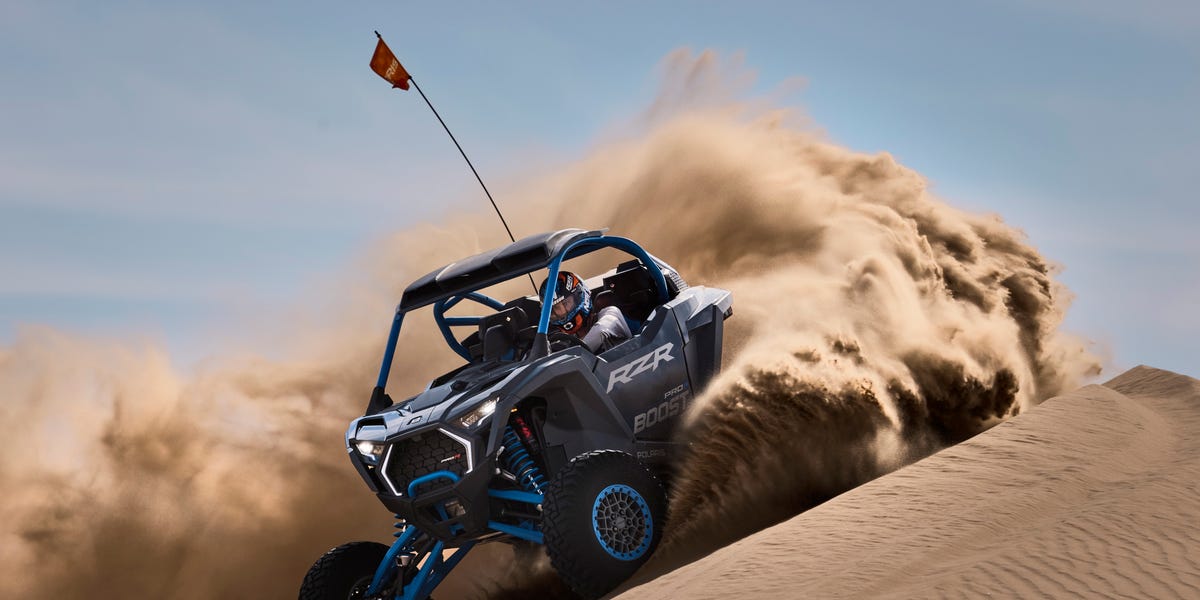
Can-Am’s Maverick R makes 240 horsepower. Kawasaki’s supercharged Teryx H2 produces 250. Polaris leapfrogged both with a single model, and the gap in torque is even wider than the gap in peak power. This is how arms races work: somebody always brings a bigger gun.
The engineering underneath had to change to survive the extra output. Polaris reworked both CVT clutches, added a larger driven clutch with more cooling fins and a stronger belt, beefed up the half-shafts, and redesigned the front differential internals. Previously, Polaris had to electronically limit torque delivery to the front axle because the diff couldn’t handle it. That restriction is gone.
Cooling got a complete rethink too. A new radiator sits behind the occupants, fed by a roof-mounted scoop. Running a boosted four-cylinder at full chat in 100-degree desert conditions with no airflow at crawling speeds is a thermal management nightmare. How well Polaris solved it will only become clear once these machines start piling up hours in Glamis and Baja.
The Pro R Boost weighs roughly 200 pounds more than the standard Pro R. Polaris insists the 50-hp gain more than offsets the weight penalty in terms of power-to-weight ratio. On paper, the math checks out.
Two trim levels are offered. The Ultimate comes with adaptive dampers. The Ultra adds active anti-roll bar links, a carbon-fiber hood and seat bezel, an upgraded steering wheel, and 32-inch BFGoodrich tires.
Dealers will have them in November 2026. The timing puts Polaris out front for the 2027 model year, daring Can-Am and Kawasaki to respond. Both will. That’s the nature of this particular arms race: nobody stays on top for long.
The question nobody at Polaris is asking out loud is whether the side-by-side market can sustain vehicles priced north of $50,000. The customers buying these machines tend to answer that question with a credit application and a trailer hitch.
Share this Story