
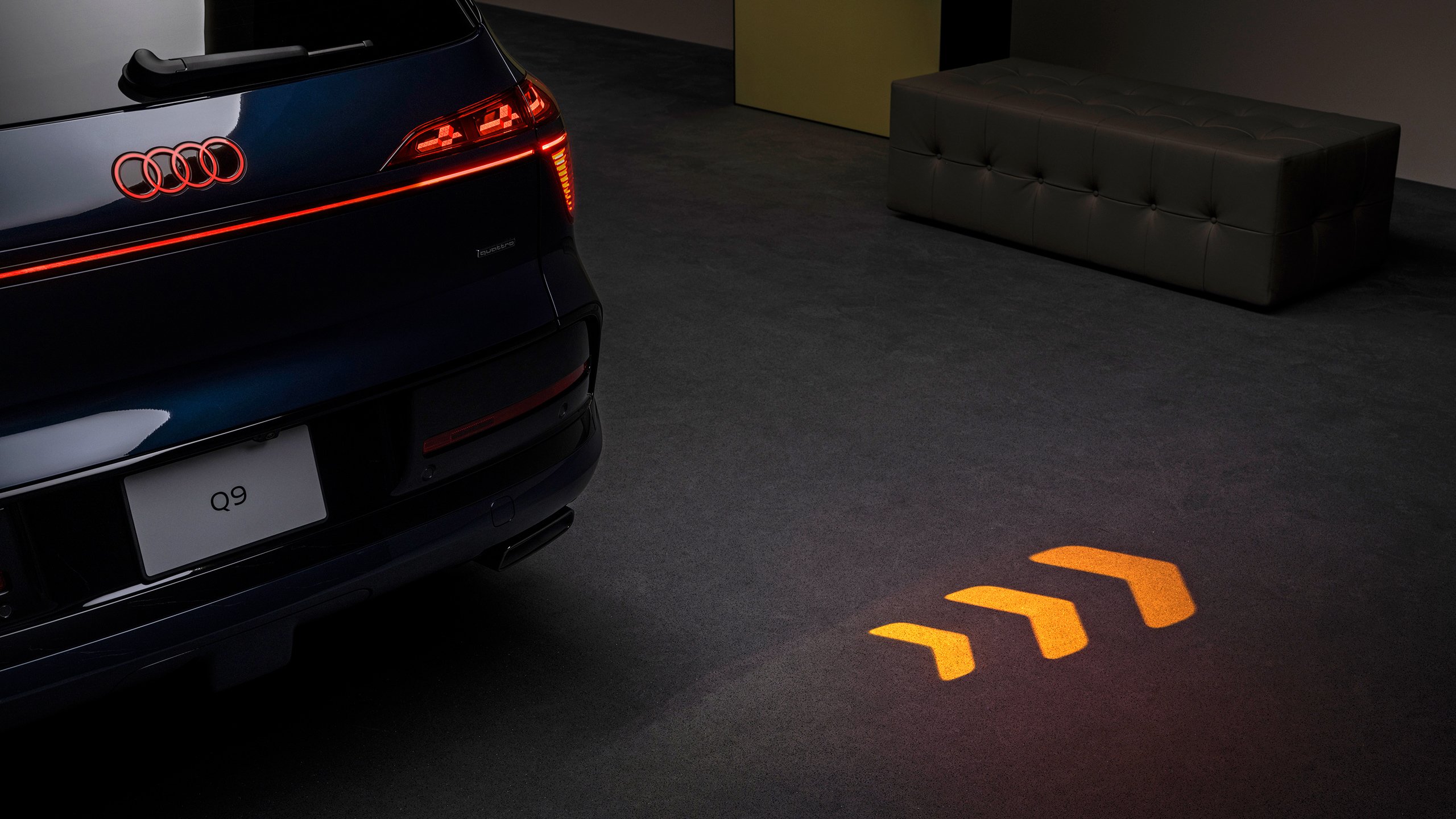


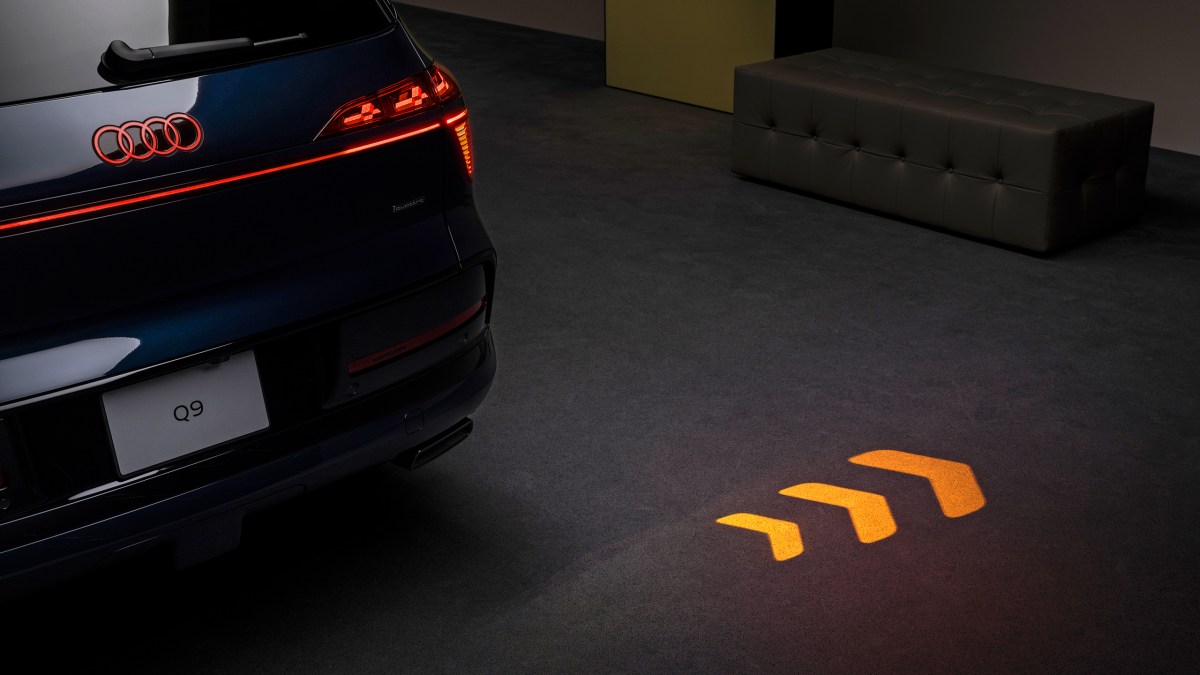
The 2027 Audi Q9 will shine animated turn signal arrows directly onto the road surface, using its Digital Matrix LED headlights to broadcast your intentions to drivers, cyclists, and pedestrians who might not have a clear line of sight to the vehicle’s conventional indicators.
It sounds like a gimmick. It might not be.
Picture the scenario Audi is banking on: you’re sitting three cars back at a red light, a box truck blocking your view of the SUV at the front of the queue. That Q9 signals left, and you’d never know it from the traditional blinkers alone. But diagonal arrows sweeping across the asphalt in front of and behind the vehicle? Those you can read from a shallow angle, even through gaps between other vehicles.
The arrows animate in a repeating pattern, projecting from each corner of the car at an angle designed for readability from the side, not just head-on. Audi says the system could also benefit pedestrians and cyclists, who tend to look at the ground ahead of them rather than scanning for blinking amber lights mounted at bumper or fender height.
Door-sill projectors that splash a logo on the pavement when you unlock the car have been a luxury-brand party trick for years. This is the first time a manufacturer is using road projection for an actual traffic communication purpose on a U.S.-market vehicle.
The feature rides on the same Digital Matrix LED platform that gives the Q9 adaptive high beams capable of steering light around oncoming traffic. That adaptive capability has been standard in Europe for years, but American regulators only recently finalized rules allowing the technology here. Audi is building its U.S. implementation around NHTSA’s specific requirements, which differ from the European framework in ways that forced engineers to essentially start over on calibration and software.
The Q9 won’t be the only Audi to get the treatment. The refreshed Q7 will share the same matrix lighting hardware, and if the system proves itself, a broader rollout across the lineup seems likely.
Timing matters here. American roads are awash in blindingly bright headlights, the predictable result of an LED arms race that regulators were painfully slow to referee. Adaptive beams that manage intensity based on surrounding traffic are a genuine safety advance. Projected turn signals are a smaller move, but they push the same underlying logic: use the technology already embedded in the headlight assembly to communicate more information, more clearly, to more people.
The real question is what comes next. Once you have a high-resolution projector built into every corner of the car, the potential messages multiply. Lane-change warnings for adjacent drivers. Hazard alerts for approaching traffic at a breakdown. Even parking guidance graphics for the driver. The hardware is already there. The software just needs a reason.
Audi hasn’t announced pricing for the Q9’s matrix lighting package in the U.S. or confirmed whether the turn signal projection will be standard or optional. The SUV itself is expected to arrive as a 2027 model, placing it squarely in the window when adaptive headlight adoption should be accelerating across the industry.
Whether rival brands follow Audi’s lead on road projection, or dismiss it as a novelty, depends entirely on whether real-world drivers actually notice those arrows on the pavement.
Share this Story